
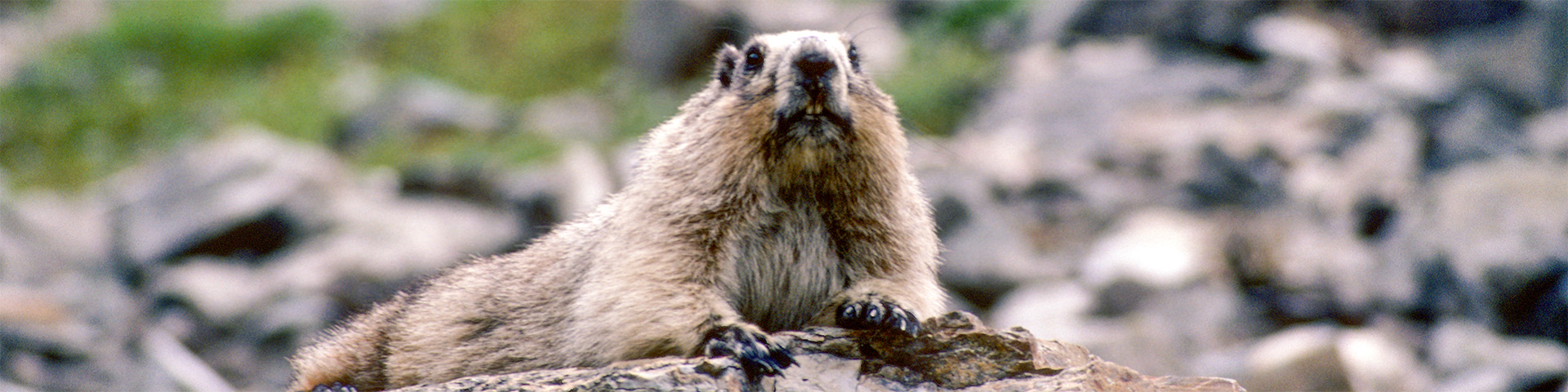
Hoary marmot
Small mammals
Waterton Lakes National Park
They may get less attention than larger park wildlife, but small mammals like rodents play important roles in soil health, flood mitigation, and plant diversity. They are critical species to healthy ecosystems. There are 35 known species of small mammals in Waterton, all contributing to the park’s unique ecological diversity.
Ground squirrels
These ground-dwelling rodents are common throughout the park. They are active only during daylight and you’ll see them popping in and out of multi-chambered burrows. These squirrels can stuff their expandable cheek pouches with seeds, insects and vegetation. All squirrel species found in Waterton are true hibernators and may only be spotted a few months of the year.
It seems that everything eats ground squirrels — from badgers to hawks to coyotes. While this is an exaggeration, their importance cannot be underestimated.
Columbian ground squirrel (Spermophilus columbianus)
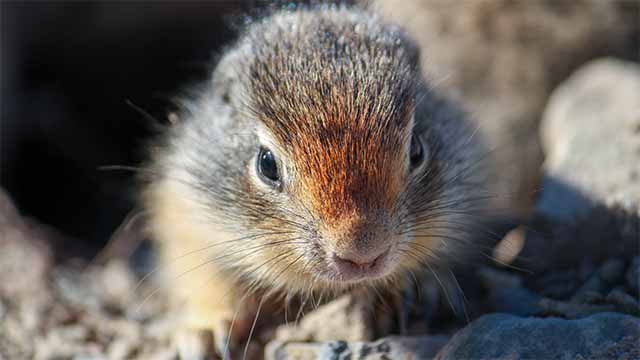
Often incorrectly called a “gopher,” the Columbian ground squirrel is commonly spotted in prairie habitats and in the Waterton townsite.
Columbian ground squirrels hibernate for up to seven months and are a key food source for grizzly bears, coyotes, and golden eagles. This species typically eats grasses, leafy vegetation, bulbs, fruits, and seeds. Given the opportunity, they will also eat insects or carrion, and unfortunately, human food if the opportunity presents itself.
Feeding wildlife has serious consequences for both humans and animals. It is never okay to feed wildlife of any size.
Thirteen-lined ground squirrel (Ictidomys tridecemlineatus)
The thirteen-lined ground squirrel is often mistaken for a chipmunk. Both species’ markings give you the best indication of which are which. These ground squirrels have more stripes — 13, as you might expect — and their darker stripes are dotted with lighter coloured fur. Chipmunks have five wide stripes, alternating between light and dark brown.
Thirteen-lined ground squirrels prefer to make their home in grasslands, particularly near shrubby areas or aspen trees. You can identify their burrows as they lack the tell-tale dirt mounds of other ground squirrel species.
Golden-mantled ground squirrel (Spermophilus lateralis)
Also often mistaken for chipmunks, golden-mantled ground squirrels have a tawny-reddish colour across their shoulders, no stripes on their faces, and a white stripe bordered by black down each side of their backs. You’ll spot these rodents darting in and out of their burrows throughout the park.
They are omnivores, feeding on almost anything they can get a hold of, from seeds to fungi, herbs and shrubs, insects, and even eggs or carrion. Golden-mantled ground squirrels can eat enough to triple their body weight in preparation for their long winter underground.
Hoary marmot (Marmota caligata)
Hoary marmots are found in mainly in the upper subalpine and alpine ecoregions. As the largest of the ground squirrels a hoary marmot can weigh up to 15 kilograms! They spend three months of the year chowing down on wildflowers, grasses and seeds, and spend the remaining nine months in hibernation, in large groups underground.
You may see hoary marmots sunning themselves on rocks, carrying out 'sentry' duties. The marmot produces a loud whistle when alarmed, to warn others nearby, before hurrying to hide in a rocky burrow.
Yellow-bellied marmot (Marmota flaviventer)
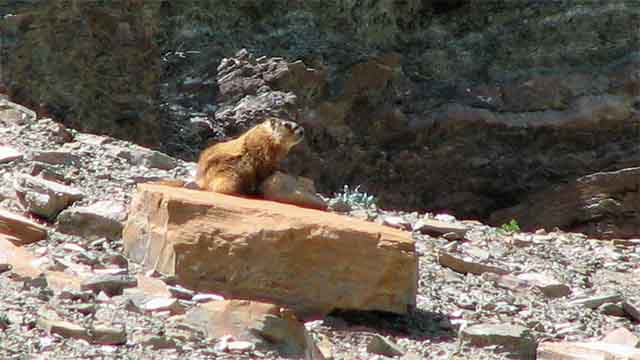
These tawny-coloured marmots are colony dwelling vegetarians whose burrows are usually located in coulees and on hillsides with rocky outcroppings, in central British Columbia and southern Alberta.
Yellow-bellied marmots in Canada live at the edge of their normal habitat range, so sightings are infrequent. Waterton Lakes is the only national park in Canada to see a yellow-bellied marmot, if you’re lucky enough to see one!
Chipmunks
Many people are surprised to learn about different species of chipmunks. They are the busybodies of the forest, recognized by their black racing stripes on their fur and long tails.
Red-tailed chipmunks (Neotamias ruficaudus) live at higher elevations. Yellow-pine chipmunks (Neotamias amoenus) generally live at lower elevations here in Waterton. Well named, the Least chipmunk (Tamias minimus) is the smallest of the species in Waterton, living in rocky places near the tree line.
Tree squirrels
Red squirrel (Tamiasciurus hudsonicus)
The red squirrel lives in coniferous forests within in the montane and lower subalpine ecoregions. They build nests in trees but cache their food underground. If you discover small piles of pinecone pieces (called middens), this species is likely nearby.
Their loud, territorial 'churring' is an often-heard sound in the forest. Red squirrels are an important food source for foxes, bobcats, weasels, hawks and owls.
Northern flying squirrel (Glaucomys sabrinus)
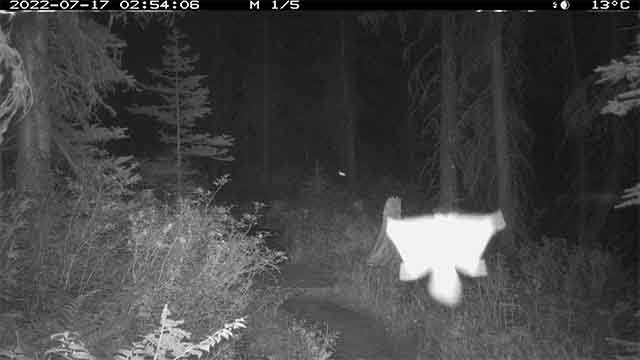
This is a medium-sized, distinctive squirrel species have a broad, flat tail, large eyes, and folds of skin that extend from the wrist to the ankle on both sides.
Flying squirrels might more appropriately be called “gliding squirrels” because they aren’t capable of true powered flight like birds and bats. These nocturnal squirrels are rarely seen, but trail cameras have captured their presence in the park in recent years.
Hares and rabbits
Snowshoe hare (Lepus americanus)
The snowshoe hare is easily recognized by its long, black-tipped ears and large hind feet. Their 'snowshoe' feet are heavily furred to make travel in deep snow easier. As winter approaches their coat turns from brown to snow white. Snowshoe hares are the main food source for pine marten and lynx populations.
Pika (Ochotona princeps)
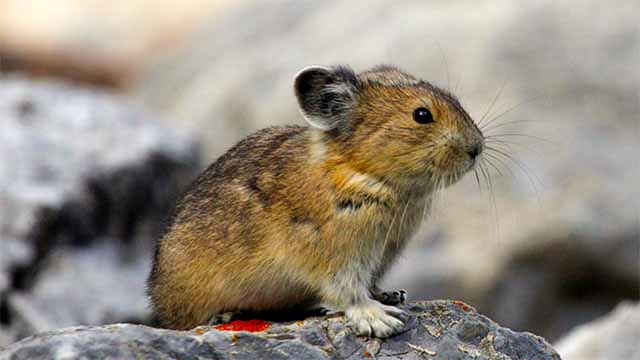
Pikas or 'rock rabbits' live in rockslides and nearby meadows, mainly in the upper subalpine and alpine ecoregions. Small and well camouflaged, pikas are usually located by their piercing, high-pitched "eep" call. They eat wildflowers, lichens and grasses, some of which they collect, dry in the sun and stash for winter snacks.
‘PIE-ka’ or ‘PEEK-ah’? The jury is still out on the pronunciation here in Waterton. Both pronunciations are considered acceptable, and researchers have passionate opinions on their preferred pronunciation.
Species of note
Beaver (Castor canadensis)
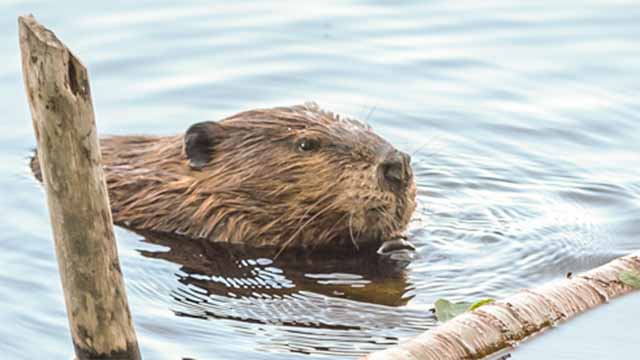
The beaver is the largest resident rodent in the northern hemisphere! Beavers have been known to outweigh badgers and coyotes. You can find beavers hard at work in streams and ponds building lodges and dams out of rocks, grass, branches and mud. These wide-tailed, toothy fellows eat bark. Their favourite flavour? Aspen. Cottonwood trees and willows are also important foods.
Beavers are called the “world’s greatest ecosystem engineers”. Beavers trump even bison when it comes to their influence and impact on ecosystems. The ponds created by their dams provide habitat for aquatic animals, waterfowl, insects, and amphibians. Flying bug eaters like swallows and bats also benefit. A healthy population of beavers indicates good conditions for many plant and wildlife species to thrive.
Historically, Beavers have played a pivotal role in shaping Indigenous cultures and economies, influencing European settlement, and contributing to the foundation of Canada. The beaver is an official symbol of Canada and Parks Canada adopted the beaver as its official symbol in 1973. Today, beavers continue to hold cultural importance for many communities.
Not a squirrel: Northern pocket gopher (Thomomys talpoides)
Sometimes confused with ground squirrels, northern pocket gophers are easily distinguished by their nearly naked tails. The pocket gopher uses its tail as a sensitive navigation tool, allowing it to travel backward quickly through its tunnels. The northern pocket gopher is the only species of gopher found in Waterton.
The northern pocket gopher is nocturnal and lives in grasslands, meadows, and forest openings from low to middle elevations. Spending most of its life underground, this species is rarely seen. The best way to know if this species is nearby, look for the piles of disturbed soil it leaves above ground.
Porcupine (Erethizon dorsatum)
Despite their tough exterior, porcupines like to keep to themselves. These large rodents are strictly vegetarians, but will chew on wood, leather, bones, and cast-off ungulate antlers to hone their continuously growing teeth. They are expert tree-climbers, although a bit on the slow side. Porcupines have been known to stay in trees for days at a time.
A common misconception about porcupines is their ability to “throw or shoot” their quills. You will only be “quilled” if you touch them. When a porcupine clatters their teeth, vocalises or puffs up, showing their quills to you, they’re telling you to keep your distance.
Porcupines do most of their breeding in late summer or early fall, giving birth to a single porcupette (quills and all!) in May or June.
Wildlife safety: Give wildlife of all sizes the space they deserve.
North American river otter (Lontra canadensis)
The recent appearance of river otters is an exciting event for Waterton. Considered to be one of the rarest animals to see in the park, these playful animals had not been spotted for many years.
Otters are active year-round, living in larger streams and lakes. They form tight-knit families, swimming and playing together. Otters particularly enjoy sliding down muddy or grassy banks into the water, where they will find their favourite food, fish.
Honourable mentions
- Bats
- Badgers
- Deer mice
- Packrats
- Shrews
- Skunks
- Voles
- Weasels
- Wolverines
Related links
- Date modified :