
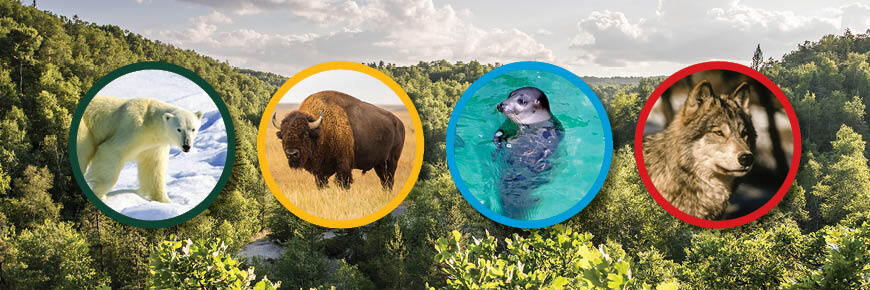
Welcome to Parks Canada’s Animal Adventure!
How to Discover your Inner Wild Animal:
- Pick your favourite wild animal (polar bear, bison, harbour seal, or wolf.)
- Keep an eye out for the green Parks Canada signs as you walk around the zoo.
- Each time you find a sign, become your inner wild animal!
- Don’t be shy: let your inner animal out!
- To learn more about your wild animal, use your phone to scan the QR codes.
- Find us at the oTENTik (across from the butterfly garden) to show off your inner animal with a Parks Canada selfie!
More information about the Parks Canada wild animals:
Polar Bears
Where do you live in the wild?
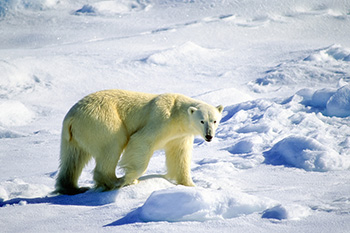
In Manitoba, polar bears can be found in and around Wapusk National Park, near Churchill. They spend time on land when they are having babies and during the summer, but spend winters out on sea ice. Polar bears spend so much of their time on the ice and in the water that we call them a marine (sea) mammal, the same as whales or seals!
What do you eat?
Polar bears’ favourite food is seals because they have lots of fat! They hunt seals on the sea ice in winter, but will also eat just about anything that they stumble across! In the summer they hardly eat anything at all.
What eats you?
Adult polar bears are so big that other animals don’t eat them! However, polar bear cubs will sometimes be eaten by wolves, adult polar bears, or other meat-eaters, so it’s important that they stick close to mom when growing up.
How fast can you go?
Polar bears like to walk a little faster than people (5.6 km/h). But when polar bears decide that they want to run they can go super fast! Polar bears can run up to 40 km/h (almost as fast as a car drives down a city street).They can’t keep up that speed for too long with their big, heavy bodies.
Who do you live with?
Adult polar bears like to live on their own. When growing up, cubs live with their mom for a few years to learn how to hunt and survive, but after that they live on their own!
How far do you like to travel?
Polar bears have a huge home range (an area that they call home and travel within) of several hundred km2! One polar bear’s home range is bigger than all of Winnipeg.
Polar bears travel throughout their range during the year. Manitoban polar bears spend fall, winter, and spring out on sea ice on the Hudson Bay, and spend summer on land when the sea ice has melted.
Bison
Where do you live in the wild?
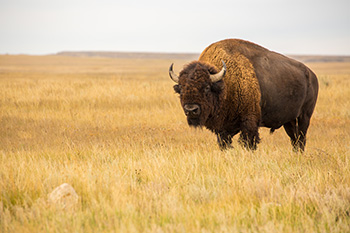
In Manitoba, bison live in Riding Mountain National Park. In the park, bison can be found in a special area of grassland near Lake Audy.
What do you eat?
Bison only eat plants. Bison’s favourite foods are grasses and other plants that grow in grasslands.
What eats you?
Bison are difficult for most animals to kill and eat because they are so big, but there are a few animals that can do it! Cougars and wolves can both hunt young, old, and weak bison and eat them.
How fast can you go?
Bison can run at speeds of up to 55 km/h. This is faster than the fastest human in the world!
Who do you live with?
Bison like to live in herds with lots of other bison. The bison herd in Riding Mountain National Park has about 50 bison all living together!
How far do you like to travel?
In Riding Mountain National Park, the Lake Audy bison enclosure gives the bison 5 km2 to roam and live in. This enclosure has a summer and winter pasture that the bison travel between depending on the season.
In parks where the bison do not live in an enclosure, bison can have a home range (an area that the bison call home and travel within) of 500-1500 km2 depending on how available food is. These bison also have areas that they prefer for summer and winter that they travel between!
Harbour Seals
Where do you live in the wild?
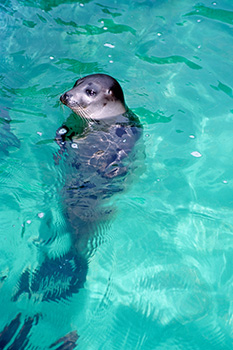
In Manitoba, harbour seals love to live in the north around Wapusk National Park and the town of Churchill. Harbour seals live in the water close to the shore in Hudson Bay and the nearby rivers.
What do you eat?
Harbour seals eat lots of different things that they find in the water! Some of their favourite foods are fish, crabs, shrimp, clams, and mussels.
What eats you?
In northern Manitoba, the two main hunters of harbour seals are polar bears and killer whales. Harbour seals need to stay on the lookout so that they don’t become a tasty snack!
How fast can you go?
Harbour seals can swim as fast as 19 km/h! That’s about twice as fast as most adult people run.
Who do you live with?
Harbour seals like to live on their own. When seal pups (baby seals!) are born, they stay with their mom for a few weeks and then the pups head off alone.
How far do you like to travel?
Harbour seals have a home range (an area that they call home and travel within) of 100-55,000 km2. That means that some don’t move too much and stay in an area smaller than Winnipeg. But some move around an area bigger than 100 Winnipegs!
Since harbour seals don’t have claws on their flippers to dig holes through ice like other Arctic seals, they have to stay in areas with open water. This means that they travel only short distances in the winter, but can travel huge distances during the summer.
Wolves
Where do you live in the wild?
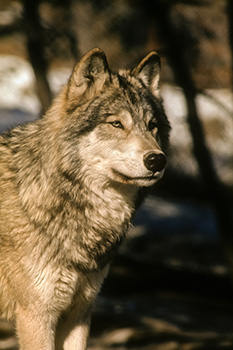
In Manitoba, wolves live in both the south (in Riding Mountain National Park) and in the north (in Wapusk National Park). It’s very hard to see wolves in the wild because they like to hide away from people.
What do you eat?
Wolves are carnivores (meat-eaters). Their favourite foods are elk, moose, deer, and caribou. If they decide they want a treat, sometimes wolves will eat bird eggs and berries!
What eats you?
Wolves are a top predator in Riding Mountain National Park and Wapusk National Park. Once they are adults, they do not get eaten by any other animals.
How fast can you go?
Wolves walk about twice as fast as most people (about 8 km/h), but when they run they can run as fast as 64 km/h. That’s faster than most cars in the city!
Who do you live with?
Wolves like to live in packs (groups of animals) of about 12 wolves. Wolves in a pack will travel, hunt, and live together.
How far do you like to travel?
The size of a wolf pack’s home range (an area that they call home and travel within) depends on how easy it is to find food. In Riding Mountain National Park, where there is lots of food for wolves, a wolf pack’s home range is around 260 km2 (about half the size of Winnipeg). In Wapusk National Park, where food for the wolves is more spread out, a wolf pack’s home range is 75 to 2,500 km2 (up to five times the size of Winnipeg).
Land Acknowledgement:
We would like to begin by acknowledging that we are on Treaty 1 territory and that the land on which we gather is the traditional territory of Anishinaabeg, Cree, Oji-Cree, Dakota, and Dene Peoples, and the homeland of the Métis Nation.
Riding Mountain National Park is located within Treaty 2 Territory and Parks Canada works with First Nations from Treaties 2, 4 and 1. We mention this to honor our relations and the contributions made to establish the park, the province, and Canada.
Wapusk National Park is located on lands traditionally used by Cree, Dene, Inuit, and Metis peoples. Wapusk National Park is located within Treaty No. 5 territory. We mention this to respect the contributions that were made by our Indigenous partners towards building this park, Manitoba and Canada. We dedicate ourselves to moving forward in a spirit of collaboration and reconciliation.
Don’t forget to check out our websites to discover more about animals in Manitoba’s National Parks and for fun activities you can do at home:
You can also record your own nature observations — big and small!
Use the iNaturalist.ca mobile app to capture your observations of plants or animals — anytime, anywhere. It’s nature at your fingertips! Work with experts, other park visitors or on your own. Every observation contributes to our knowledge of biodiversity.
https://www.pc.gc.ca/en/nature/science/impliquez-involved/science
Wapusk National Park:
https://inaturalist.ca/guides/3365
Riding Mountain National Park:
https://www.inaturalist.org/check_lists/62858-Riding-Mountain-National-Park-Check-List
- Date modified :