
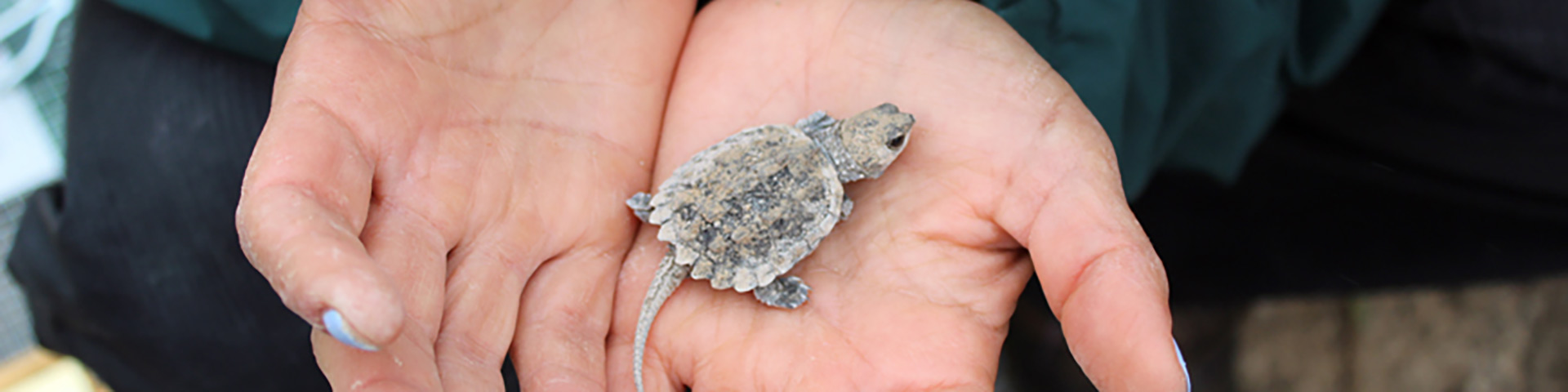
Get involved
Bruce Peninsula National Park
© Willy Waterton
Become a Community Scientist!
If you're interested in protecting turtle populations within Bruce Peninsula National Park, join our team of community scientists – the Turtle Trackers! Get firsthand experience monitoring turtle nests and collecting data, meet new people, and make a difference.
Who can participate?
Anyone in the Municipality of Northern Bruce Peninsula. All you need is a passion for conservation!
- Do you have a turtle nesting on your property that you want to protect?
- Are there turtles that nest on your road every year?
- Did you want to join the past Turtle Trackers program but couldn’t commit to weekly monitoring?
Whether you would like to protect one nest or ten, all training resources and nest protection equipment is now available to everyone who is interested in the Municipality of the Northern Bruce Peninsula!
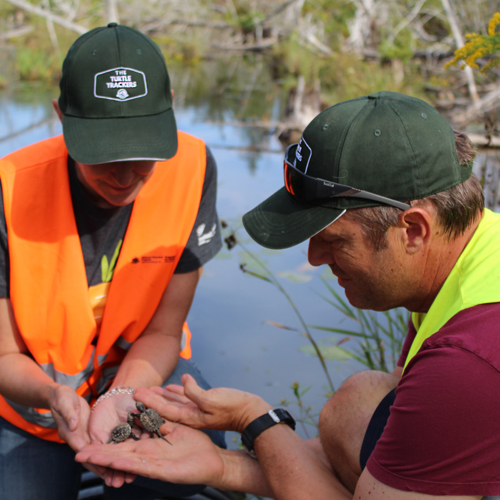
The most exciting moment of the season is the emergence of hatchlings from the protected nests!
Protect Turtles and their Nests
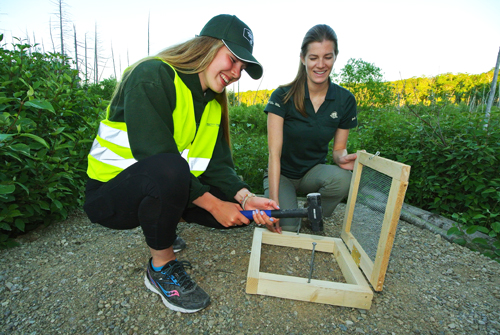
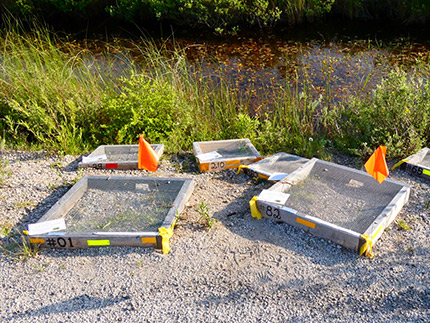
From late May to early July, female turtles leave their safe wetland habitats to search for suitable nesting sites to lay their eggs. As a volunteer, you would look for nesting turtles and recently created nests. When a nesting turtle (or recently created nest) is found, volunteers place a nest protector box over top of the nest. This protects the fragile turtle eggs from being eaten by hyperabundant predators such as raccoons and skunks. Once hatchlings have emerged in late summer and early fall, the nest boxes will be removed.
We have provided resources with everything you need to know about protecting turtle nests around the Bruce Peninsula National Park.
If you want to be involved in protecting turtles in Bruce Peninsula National Park, contact us at r2r@pc.gc.ca.
Going Home - The Turtle Trackers
Transcript
Parks Canada Logo
Narrator: It's a very exciting time at Bruce Peninsula National Park.
A Parks Canada employee measures and weighs a baby turtle.
Tricia: In the fall is hatchling season, the best time of year. [LAUPHS] [MUSIC]Title card - Going Home: A Turtle Trackers Story
A container filled with wriggling baby turtles.
Narrator: These are the first turtles ever incubated for the park's "road to recovery" program.A container has it's lid removed, revealing a makeshift nest filled with a clutch of turtle eggs.
Tricia: Once all the turtles from the clutch or the nest have hatched we weigh them, we measure them, we make sure they're doing okay.A baby turtle hatches from it's egg.
Narrator: These are baby painted and snapping turtles both at-risk species in Ontario.Baby snapping turtles swim in a container filled with water and rocks. An employee places another baby turtle into the container.
They're here because their mom's nested so close to a road the turtles would likely have died had they not been rescued. But finding all these turtle eggs was not an easy task. To get the eggs, park staff relied on the help of some dedicated volunteers: The Turtle TrackersA volunteer in a safety vest steps out of a car with a turtle decal, then walks down the side of the road.
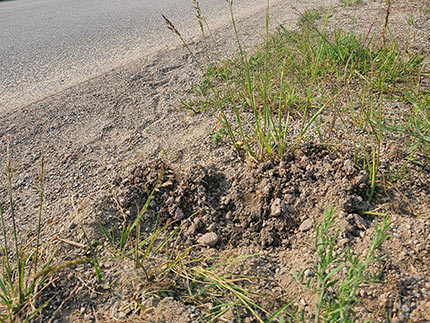
Rod: Turtle nests and their eggs are particularly prone to predation from animals like raccoons and skunks so in the spring we watch for turtles that are laying eggs and we put a protective box over them to keep the predators out.A volunteer closes the lid of a turtle nesting box placed on the side of the road.
Sometimes we can't put a box on them because they're so close to a road. Those eggs are collected and put in an incubatorThe volunteer gets back into the car.
[Door opens, Car chime] [Door closes, truck passes] Narrator: The turtle trackers are part of a comprehensive program the park has undertaken to help at-risk reptiles and amphibians on the Bruce Peninsula recover from the deadly impacts of roads.A turtle walks up to an eco-passage underneath the pavement to cross the road safely.
Tricia: We have installed ecopassages and wildlife exclusion fencing in key areas where road mortality was a problem so that reptiles amphibians could cross the road safely.A volunteer checks a turtle nesting box.
Narrator: While fencing and ecopassages are reducing road mortality they're not practical everywhere and they don't help with nest predation. That's where the Turtle Trackers come in.A snapping turtle sits at the side of the road as cars rush by.
[Car passes] Since only about 1% of hatchlings make it to maturity every baby turtle that volunteers keep safe is key to their recovery.A painted turtle watches as a truck drives by.
Tricia: The more nests we protect that increases our odds to help these animals. because so little of them survive to adulthood. Narrator: In the fall, after months underground the eggs protected by the turtle trackers are ready to hatch.A volunteer opens a nesting box to check for hatched baby turtles.
The volunteers check each nesting box three times a day. Tricia: They check the boxes, looking for hatchlings emerging.A volunteer reaches into a nesting box to remove a baby turtle. The turtle walks across his palm.
Rod: Now have you got four legs there - yes you do!A volunteer walks into a wetland area carrying a container. He releases the baby turtle, which then crawls into the water.
Tricia: And once they do they take them out and help them safely to the wetland that they came from. Narrator: While handling wildlife in the park is usually not allowed the Turtle Trackers have received training for these special circumstances. [Giggle]A larger group of volunteers walks into the wetland with more baby turtles to release.
Rod: These little guys have a chance where in the past they wouldn't have had no chance at all. [ok, it's a little mucky there!] Narrator: When it comes time to release the incubated turtles, everyone's invited.A young volunteer places a baby turtle onto a rock.
[There you go!] Mairin: It felt like holding a little pancake! [Just pick on? Yeah!] Mandy: This is my first time ever touching a baby turtle like this is what I've been working up for so this is absolutely incredible.A baby turtle is placed into the grass.
[You're free!] Rod: People would look at me and say he's probably a crusty old guy.A baby turtle is gently placed onto a rock.
But when there's little turtles like that around I'm just a bit pile of mush. Tricia: We have 290 eggs in the incubator and we've protected over a hundred nests in the area, so that's thousands of young turtles.A baby turtle swims through the water after being released.
We would never have been able to do it without all the community and all the volunteers.A volunteer smiles as she looks down at a baby turtle she's released begins to swim away.
Mandy: It's early mornings and it's a commitment but it's so worth it. It's worth everything.A baby turtle dives underwater.
To learn more about the Turtle Trackers or the On The Road to Recovery project, visit parkscanada.gc.ca/bruce-recovery
Credits:
Parks Canada logo.
© Her Majesty the Queen in Right of Canada, represented by Parks Canada, 2020.
- Date modified :