
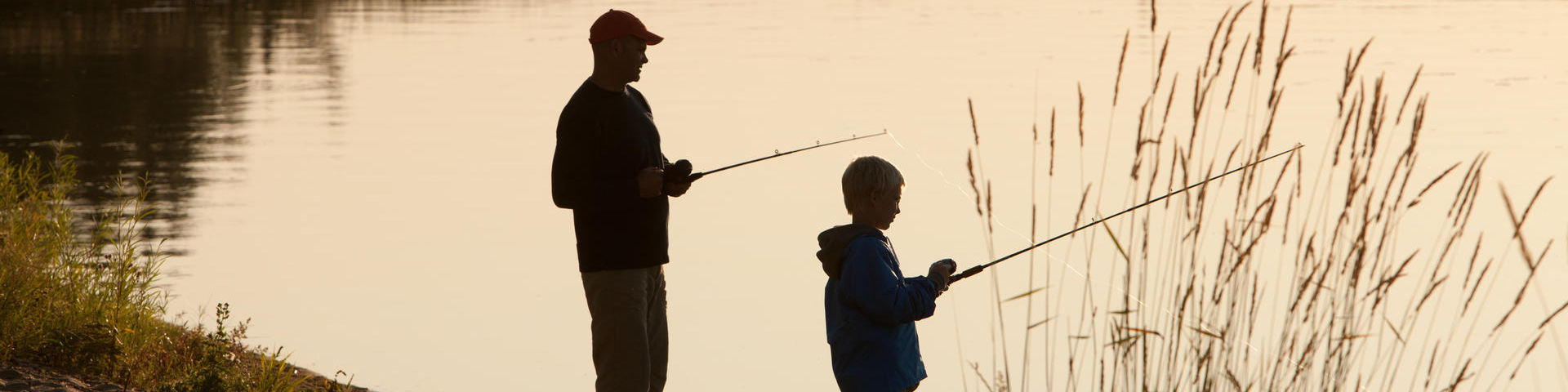
Photo: Kevin Hogarth
Fishing
Riding Mountain National Park
Riding Mountain National Park has more than 1,900 lakes, 650 streams, and countless wetlands. Whether it is backcountry fishing for Northern Pike, landing Walleye on Clear Lake, or fly fishing for Brook Trout in the streams along the escarpment, there’s an experience for you.
Fishing permit
You must have a valid fishing permit for Riding Mountain National Park.
Permits are available for a fee at:
Daily catch and possession limits
- Northern Pike (only 1 more than 76 cm long) – 3
- Walleye – 2
- Yellow Perch – 5
- Lake Whitefish – 5
- Maximum combined total – 5
- Smallmouth Bass – No limit and do not count in the combined total.
Smallmouth Bass are not native to Clear Lake
Kill and keep all Smallmouth Bass – do not release.
Report your catch to Parks Canada at 204-396-4579 or pc.ais-riding.pc@pc.gc.ca.
 Riding Mountain Fishing Regulations (600 KB)
National Parks of Canada Fishing Regulations
Fishing regulations
National Parks of Canada Fishing Regulations Summary
It is unlawful to:
- Fish without a valid national park fishing permit.
- Fish with or possess within 100 metres of park waters:
- Live or dead fish, leeches, and fish parts for use as bait.
- Hooks with barbs. Remove or pinch all barbs.
- Lead tackle (sinkers, jigs, lures, and flies) under 50 grams.
- Lures with more than two gang hooks.
- A line capable of catching more than one fish at one time.
- Fish by any method other than angling.
- Fish with more than one line at a time.
- Leave a fishing line unattended.
- Fish from 2 hours after sunset to one hour before sunrise.
- Sell, trade, or barter any fish caught.
- Harass fish by throwing objects or impeding their movements.
- Continue fishing after reaching the maximum daily catch and possession limit.
- Allow your catch to spoil or waste.
You may use earthworms and nightcrawlers for bait.
Fishing Permits
Provincial fishing licenses are not valid in national parks. You must possess a national park fishing permit to fish in Riding Mountain National Park.
Youth under the age of 16 may fish without a permit if accompanied by a national park fishing permit holder 16 years of age or older. In this case, the permit holder’s daily limit includes the youth’s catch.
Daily Catch and Possession Limits
- Northern Pike (only 1 more than 76 cm long) – 3
- Walleye – 2
- Yellow Perch – 5
- Lake Whitefish – 5
- Maximum combined total – 5
- Smallmouth Bass – NO LIMIT and do not count in the combined total.
You must identify your catch. If you do not know what fish you have caught, release the fish immediately.
Fishing permit holders may take part in the fisheries management control of Smallmouth Bass. Smallmouth Bass are not native to Clear Lake. Kill and keep all Smallmouth Bass. Report your catch to Parks Canada at 204-396-4579 or pc.ais-riding.pc@pc.gc.ca.
Fishing Season
Clear Lake and Lake Audy: May 15 to March 31
All other waters: May 15 to September 30
Open season adjustments:
- If May 15 falls on a Sunday or Monday, the season begins on the Saturday before.
- If closing day falls on a Friday or Saturday, the season ends the following Sunday.
Areas Closed to Fishing
You cannot fish in these areas:
- Swimming areas and marinas.
- South Lake and its outlet stream into Clear Lake.
- Within 23 metres downstream from Lake Audy Dam or the Whirlpool Weir-Fishway.
Respect Our Neighbours
Respect the Keeseekoowenin Ojibway First Nation shoreline. Do not trespass on this private land.
Catch and Release
Help fish survive:
- Land fish quickly. A fish played too long may not survive.
- Keep the fish in the water until you release it.
- Gently hold the fish with bare, wet hands. Keep fingers away from the gills. Do not squeeze or injure the fish.
- Gently remove the hook with needle-nosed pliers. Cut the leader if the hook is deep. Do not pull the hook out. The hook will decompose over time.
- Hold the fish in the water. Gently move it back and forth. This helps revive the fish as water moves past the gills. Face the fish upstream in flowing water. Let the fish go when it begins to struggle.
- If a fish is bleeding, it will not survive. Keep it and count it as part of your catch limit.
- Single hooks are best for catch and release. They release with greater ease.
Protect Our Lakes and Waters
Aquatic invasive species (AIS):
- Threaten water quality.
- Harm fish populations.
- Damage infrastructure.
- Impact water recreation.
Aquatic Invasive Species Prevention:
- Clean, drain, and dry your fishing gear.
Visit our website for current boating and launch information, and updates on how to prevent the spread of AIS.
Winter Fishing
- You may ice fish on Clear Lake or Lake Audy only.
- One line per person.
- Do not leave your line unattended.
- National Parks of Canada Fishing Regulations apply all year.
- Daily catch limits apply.
- Do not drive cars or trucks on the ice surface of any lake in the park.
Clear Lake
- You may place an ice fishing hut on the lake ice until March 15, or earlier if the ice is no longer safe.
- Display owner contact information on the outside of your hut.
- You may use over-snow vehicles for ice fishing only on Clear Lake. Contact us for more information.
Lake Audy
- Remove your fishing hut at the end of each day.
- You may not use over-snow vehicles on Lake Audy.
Contact Us
Riding Mountain National Park Call Centre
- Phone: 204-848-7275
- Email: rmnp.info@pc.gc.ca
Report violations and suspicious activities:
- Parks Canada Dispatch: 1-877-852-3100
Printable format: Riding Mountain Fishing Regulations (600 KB)
Protect park waters
Live or dead fish, leeches, and fish parts are not allowed as bait.
Aquatic invasive species can spread between waters on watercraft and equipment. To reduce this risk, all watercraft and equipment must be cleaned, drained, and completely dried before launching.
All watercraft, towables, wet and dry suits, diving gear, and inflatables that carry more than one person must be inspected by Parks Canada staff and registered for an annual permit.
A one-boat, one-lake approach helps prevent the spread of invasive species. Help protect park waters by having one set of equipment and fishing gear for Clear Lake and a different set for the other lakes in the park.
Where to fish
- Clear Lake (motorized or non-motorized watercraft)
- Other road-accessible waters (non-motorized watercraft only):
- Bobhill Lake
- Deep Lake
- Grayling Lake
- Jackfish Creek
- Lake Audy
- Lake Katherine
- Moon Lake
- Whirlpool Lake
- Whirlpool River
- Backcountry or remote waters:
- East Deep Lake
- Edwards Lake
- Gunn Lake
- Kinosao Lake
- Long Lake
- Muskrat Lake
- Tilson Lake
- Whitewater Lake
- and many more
- Escarpment waters:
- McKinnon Creek
- Scott Creek
Fish consumption advisory (mercury)
Some fish in the park contain higher levels of mercury. Parks Canada and Health Canada recommend limiting how much you eat to reduce health risks, especially for children under 12 or if you are pregnant, may become pregnant, or breastfeeding.
Recommended limits for fish caught in Clear Lake
| Fish species and size | Children under 12 | Pregnant, may become pregnant, breastfeeding |
Other adults |
|---|---|---|---|
| Walleye less than 50 cm long | 3 meals per month | 4 meals per month | 8 meals per month |
| Walleye more than 50 cm long | 1.5 meals per month | 2 meals per month | 4 meals per month |
| Northern Pike less than 65 cm long | 4 meals per month | 6 meals per month | 12 meals per month |
| Northern Pike more than 65 cm long | 2 meals per month | 3 meals per month | 6 meals per month |
Larger fish usually contain more mercury because it concentrates up the food chain.
A meal is considered 227 g for adults and 114 g for children under 12. For reference, 100 g is about the same size as a deck of cards.
Follow the lower limit if you eat both Walleye and Northern Pike in the same month, or if you eat fish from both size categories.
Mercury data does not exist for all fish species in all park waters, and concentrations may change. As a precaution, you may wish to use these limits for all fish caught in Riding Mountain National Park.
Health Canada also provides guidance for store-bought fish: Consumption Advice: Making Informed Choices about Fish.
Related links
- Date modified :