
Rockcliffe Park Historic District National Historic Site
The Rockcliffe Park Historic District was designated as a national historic site in 2023.
Historical importance: well-established and affluent residential neighborhood in Ottawa with a layout strongly influenced by the region’s topography and woodland areas.
Commemorative plaque: will be installed at Village Green Park, corner of Springfield Road and Mariposa Avenue, Rockcliffe Park, Ottawa, OntarioFootnote 1
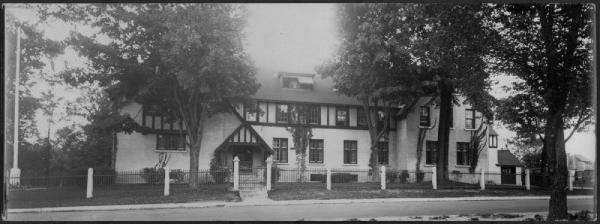
© Library and Archives Canada / PA-051845
Rockcliffe Park Historic District
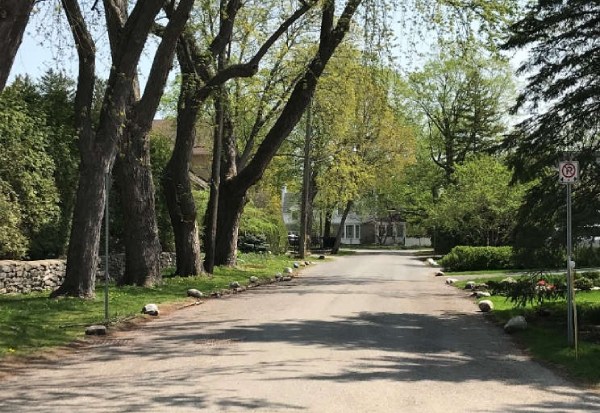
Located on the unceded territory of the Anishinābeg Algonquin, Kishkābikā, Rockcliffe Park, is where Anishinābeg people have lived, gathered, harvested, and traded for millennia. Overlooking the portage route at the confluence of three rivers, it was linked to a complex Indigenous communication and transportation network that spanned North America. Following European settlement, Thomas Keefer designed this residential district in 1864 for the capital of the Province of Canada and then the Dominion of Canada in 1867. Characterized by English and American picturesque suburban planning traditions from the second half of the 19th century, the district now features narrow curving roads without curbs or sidewalks, large lots, gardens, and houses set amid a verdant landscape. The diverse architecture, which promotes the use of natural materials in many revival styles including Tudor, Georgian and Queen Anne, is the work of such architects as Allan Keefer, Werner Noffke, Hart Massey, A. J. Hazelgrove, and A. J. Ames. With its visual integrity and sophistication, Rockcliffe Park hosts much of the capital’s diplomatic corps.
Rockcliffe Park Historic District
The Rockcliffe Park Historic District is located on the unceded territory of the Anishinābeg Algonquin. Located northeast of downtown Ottawa, at the confluence of the Ottawa, Rideau, and Gatineau Rivers, this residential district covers an estimated area of 1.77 km2. It was designed and laid out in 1864 by Thomas Coltrin Keefer, as part of a large estate purchased by Thomas MacKay in the 1830s. It is characterized by narrow curving roads without curbs or sidewalks, large lots and gardens, and houses set within a lush green landscape. Together, these features make it an excellent example of the picturesque English and American suburban planning traditions of the second half of the 19th century. The varied, high-quality architecture was the work of such renowned architects as Allan Keefer, Werner Noffke, A. J. Hazelgrove, Hart Massey, and A. J. Ames. They promoted the use of a variety of styles such as Tudor, Georgian, and Queen Anne. Homes in this district were built with durable, high-quality natural materials, in a setting that respects the original rural ambience of the Village of Rockcliffe Park.
Known to the Anishinābeg as Kishkābikā, Rockcliffe Park is part of an important historical area where Indigenous people have lived, gathered, harvested, and traded for millennia. Artefacts found along the Ottawa River indicate that people from many Indigenous nations passed through this crossroads, which was part of a complex communication and transportation network that spanned North America. More specifically, the Rockcliffe area was known as the hunting ground of Chief Constant Pinesi (d. 1834), Grand Chief of the Anishinābeg Algonquin, and was located on an ancient portage route that provided a shortcut around Rideau Falls between the Rideau and Ottawa rivers.
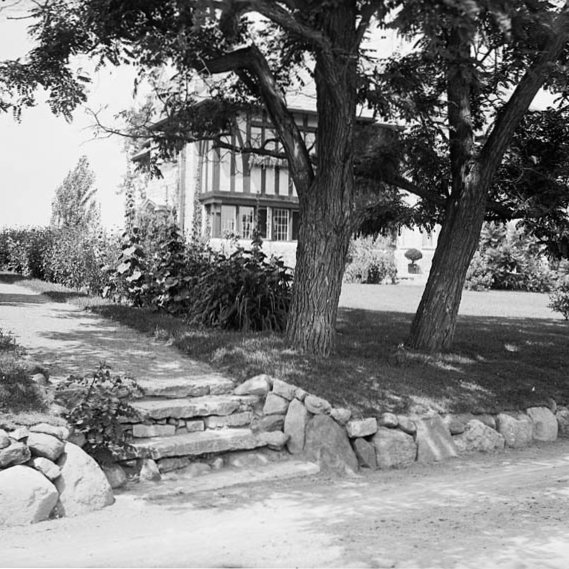
© Library and Archives Canada / William James Topley / PA-011342
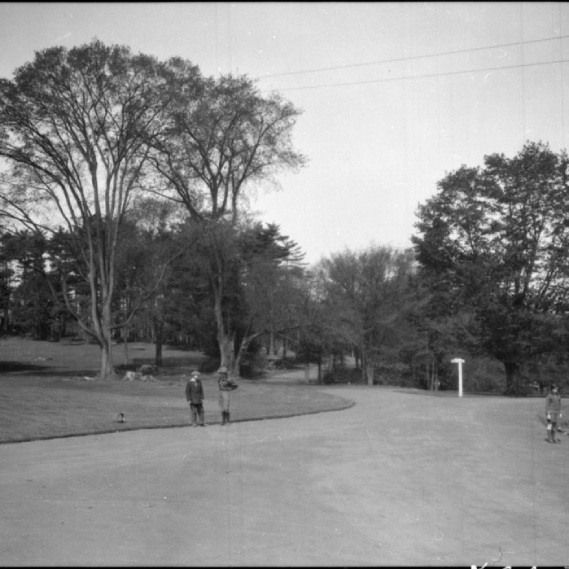
© Canada Department of Interior / Library and Archives Canada / PA-043367
Since 1864, the Village of Rockcliffe Park has been and remains a predominantly single-family residential community. It was planned as a purely residential area to house future civil servants coming to live in Ottawa, which became the capital of the Province of Canada in 1866 and of the Dominion of Canada in 1867 and continues to provide an inviting environment for much of Ottawa’s diplomatic corps. Other land uses, such as high-density housing as well as commercial and industrial development, have always been excluded from this community. The only institutional buildings in the Village are three schools and a combined community centre and library. Of particular note is Hart Massey House. Built in 1959 on Lansdowne Road North, it is an iconic example of mid-20th-century modern residential architecture in Canada. Private residences of national significance such as Stornoway—the residence of the Leader of the Opposition—and a number of embassies can be found in the neighbourhood. McKay Lake, formerly known as Hemlock Lake, and an adjacent small pond (“the Pond”) formed from a quarry, are located in the eastern section of the Village. Rockcliffe Park is known for its parks and green spaces, including the Jubilee Gardens and the Village Green, and the Caldwell-Carver Conservation Area bordering the lake. Amalgamated with the City of Ottawa in 2001, Rockcliffe Park retains a high degree of integrity and many of the key elements associated with its original design.
“It was 1864. Thomas McKay – a builder of the Rideau Canal - owned land by his home that he regarded as fit only for grazing cattle. His son-in-law had a very different vision. Thomas Keefer laid out a plan for a new type of residential community - for houses in a parklike setting, large lots, curving roads that followed the natural topography, no sidewalks, careful siting and proportioning of houses, subdued lighting, and abundant trees. One hundred and sixty years later, we are immensely proud that it has been accorded the rare recognition as a national historic district. Today, we celebrate that vision – and that of generation after generation of residents who have dedicated their time, effort, and love of community to protect and enhance this place of quiet natural beauty in the heart of our nation’s capital.”
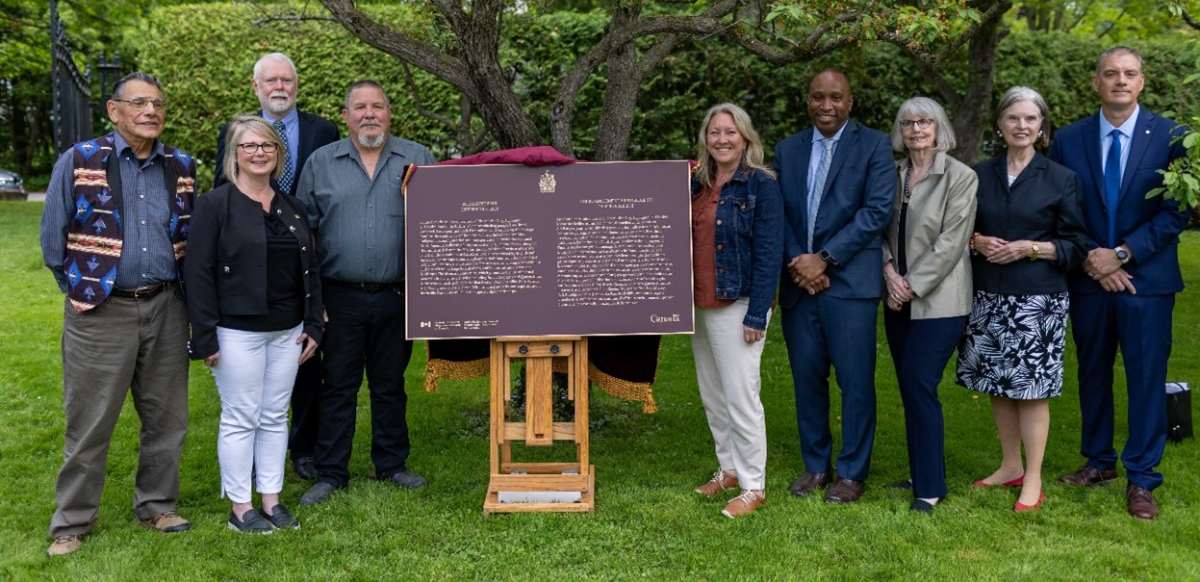
Left to right: Elder Irvin Sarazin, Algonquins of Ontario; Christine Loth-Bown, Vice President, External Relations and Visitor Experience, Parks Canada; Scott Heatherington, President of Rockcliffe Park Residents’ Association; Jim Meness, Executive Director, Algonquins of Ontario; The Honourable Mona Fortier, Member of Parliament for Ottawa – Vanier – Gloucester; Rawlson King, City Councillor for Rockcliffe Park; Martha Edmond, Architectural historian, author of Rockcliffe Park. A History of the Village, and long-time resident; Susan D’Aquino, proponent of the designation; Dr. Tim Cook, Representative of the Canadian Museum of History at the Historic sites and Monuments Board of Canada
© Parks Canada
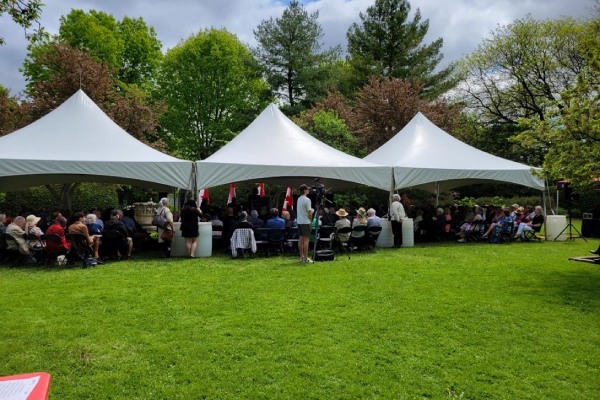
© Parks Canada
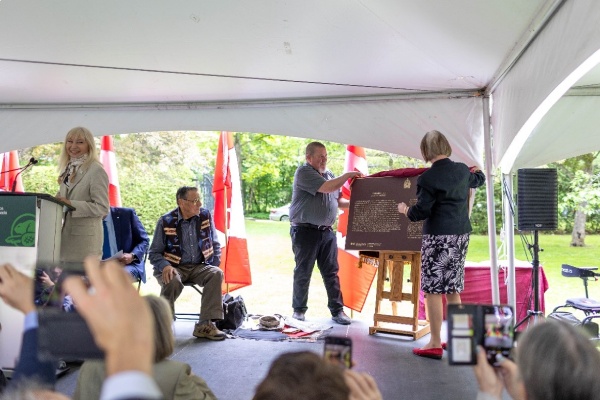
© Parks Canada
This press backgrounder was prepared at the time of the plaque unveiling in 2025.
Description of historic place
Rockcliffe Park Historic District National Historic Site of Canada is a residential neighbourhood located northeast of downtown Ottawa. Incorporated as an independent municipality in 1921, it was amalgamated with the new City of Ottawa in 2001. This area’s design is determined by the region’s topography and woodlands. Its layout includes both small and large lots, winding roads and park like properties. The escarpment, which overlooks the Rideau River, and the MacKay Lake and Pond comprise its natural features. This historic district possesses a high degree of integrity and retains many key elements associated with its original design. Official recognition includes the entire former village of Rockcliffe Park, which corresponds to the boundaries established in the municipal conservation designation.
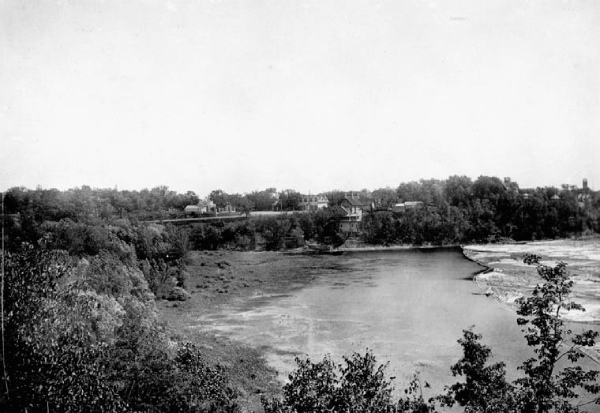
© Library and Archives Canada / PA-034260
© Parks Canada / Christine Boucher
Heritage value
Rockcliffe Park Historic District was designated a National Historic Site of Canada in 2023. It is recognized because:
- designed and laid out in 1864 by Thomas Keefer as part of Thomas Mackay’s large estate purchased in the 1830s, it is characterized by its narrow curving roads without curbs or sidewalks, large lots and gardens, and buildings set within a green landscape, making it an excellent example of the English and American picturesque planning traditions of the late 19th century;
- its quality and architectural diversity, devised by several prominent architects, such as Allan Keefer, Werner Noffke, A.J. Hazelgrove, Hart Massey and A.J. Ames, promote the use of natural materials and site integration that respects the original rural ambience of the Village of Rockcliffe Park;
- planned as a purely residential district to house future civil servants moving to Ottawa, which became the capital of the new Dominion of Canada in 1867, it reflects the city’s role as capital and continues to provide a suitable environment for most of Ottawa’s diplomatic missions, thereby reinforcing Canada’s presence on the international stage.
Rockcliffe Park has played an important and unique role in the capital since its creation in the 1830s by Thomas MacKay, one of the main architects of the Rideau Canal lock system and later a renowned Ottawa industrialist. Most of the existing road network and cadastral plans date back to 1864, when Thomas Coltrin Keefer divided the MacKay estate into lots. The area has undergone four main construction phases: pre 1864, 1864–1907, 1908–1925 and 1926–present. Throughout its history, Rockcliffe Park has been, and remains today, a residential community composed mainly of single family homes. Other land uses, such as high density housing, and commercial and industrial development, have bypassed this area. This district is located at an important crossroads in pre European history, and bears witness to millennia of Indigenous land use and cultural traditions.
Source: Historic Sites and Monuments Board of Canada, Minutes, December 2022.
The National Program of Historical Commemoration relies on the participation of Canadians in the identification of places, events and persons of national historic significance. Any member of the public can nominate a topic for consideration by the Historic Sites and Monuments Board of Canada.
- Date modified :