Hart Massey House National Historic Site
© Parks Canada / Christine Boucher
Hart Massey House was designated as a national historic site in 2018.
Commemorative plaque: 400 Lansdowne Road, Ottawa, OntarioFootnote 1
Hart Massey House
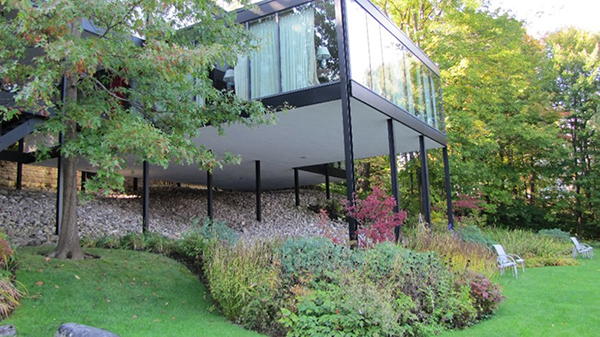
This residence, completed in 1959, sensitively echoes its natural setting, making it a distinctly Canadian interpretation of the International Style. Its minimalist design reflects the modernist ideals of its architect, Hart Massey, who lived here until the 1970s. Elevated on thin steel pillars, the understated structure of modular boxes appears to float above its sloped site along the shore of McKay Lake. Dramatic glass walls open the house to a landscape of mature trees, harmonizing indoor and outdoor space. In 1964, the design won a Massey Medal, then Canada’s highest honour for architecture.
Hart Massey House
Hart Massey House is an iconic example of mid-century modern residential architecture in Canada. The house, completed in 1959, was designed by architect Hart Massey as a home for himself and his family. The architecture’s sensitivity to its natural setting characterizes it as a distinctly Canadian interpretation of the International Style. Built on a rectilinear plan, the minimalist structure is made up of a series of modular boxes enclosed by alternating glass and opaque walls. The building is elevated on thin steel columns so that it appears to float above its sloped site on the shore of McKay Lake, contributing to a design that preserves the integrity of the natural environment. Its architecture is an extension of the landscape, and the house’s dramatic expanses of glass harmonize indoor and outdoor space. This design reflects the personal tastes and modernist ideals of Hart Massey and in 1964, the design won a Massey Medal, then Canada’s highest honour for architecture.
Hart Massey House is situated in the Ottawa residential community of Rockcliffe Park and is one of the few houses built directly on the shoreline of McKay Lake. There are mature trees, shrubs, bushes, flowers, perennial plants, and grassy areas throughout the property, all of which integrate nicely into the sloped site. The house has two storeys: the common areas are on the lower level, while the bedrooms are on the second floor. The exterior façades are smooth and unadorned, and the large glass surfaces expose a structural system based on a steel frame or reinforced concrete. Inside, partition walls on the ground floor are only three-quarters high, contributing to an open plan. The east side of the house, which faces the lake, features floor-to-ceiling windows that provide an unobstructed view of the surrounding landscape. A common colour scheme of beige and black extends throughout the house.
The building has undergone changes over the years, the most important of which was the enlargement of the house to the north in 1993, when a modular box was added on each level. However, the integrity of its aesthetic design, as well as the treatment of materials, have been maintained. Some changes have also been made to the landscaping, in keeping with the architecture of the house. Gardens have been successfully integrated and new varieties of plants and flowers continue to be introduced.
Hart Massey and his family lived in this home until the 1970s. Subsequent owners have carefully restored and renovated the house, while meticulously respecting its original concept.
Backgrounder last update: 2019-04-25

© Parks Canada / Christine Boucher

© Parks Canada / Christine Boucher
Description of historic place
Hart Massey House National Historic Site of Canada is located in Rockcliffe Park, Ottawa. It is a two-storey, detached residential building. Elevated on thin steel columns, the house comprises a series of modular boxes. It has a wood frame with steel joists in the floors and roof. The exterior is covered in wood and glass cladding. A series of pointed dormers punctuate the flat roof. The exterior of the building is painted in black and white, except for the front door, which is red. Hart Massey House is on a steeply sloped site facing McKay Lake. Its vast window walls open onto mature trees. Official recognition refers to the legal boundary of the property.
Heritage value
Hart Massey House was designated a National Historic Site of Canada in 2018. It is recognized because:
- it is an iconic example of mid-century modern residential architecture in Canada, and a particularly Canadian example of the International style because of its sensitivity to its natural surroundings; the minimalist structure consists of a series of modular boxes enclosed by alternating glass and opaque walls, which open the house to its site creating a completely unique architectural ensemble;
- this prestigious house reflects the personal tastes and modernist ideals of its architect, Hart Massey, who designed it for himself and his family in 1959; it earned him the Silver Medal of the Massey Awards for Architecture, the highest honour at the time;
- elevated on thin steel columns so that it appears to float above its sloped site on McKay Lake, the house was designed to preserve the integrity of its natural environment; its architecture is an extension of the landscape, and its dramatic expanses of glass erase the line between indoor and outdoor space.
Hart Massey House is located in Rockcliffe Park, a residential area of Ottawa, Ontario. It is one of the rare houses built directly on the shore of McKay Lake. Erected in 1959, the house was designed to the plans of architect Hart Massey, who lived in it with his family until the 1970s. Based on a rectilinear design, it is a minimalist structure consisting of a series of modular boxes, some glazed, other with opaque walls. There are mature trees, shrubs, bushes, flowers, perennial plants and grassy areas throughout the property, all of which integrate nicely into the sloped site.
The heritage value of Hart Massey House is based on its architectural and environmental features. Designed with a minimalist esthetic typical of the modern movement, it is a unique expression of the International style in its reflection of the landscape. Its architecture is an extension of the landscape and the vast glass walls of the house diminish the barriers between indoor and outdoor spaces. The sensitivity to natural surroundings in its design makes this residence a particularly Canadian example of the International style.
Source: Historic Sites and Monuments Board of Canada, Minutes, December 2017.
The National Program of Historical Commemoration relies on the participation of Canadians in the identification of places, events and persons of national historic significance. Any member of the public can nominate a topic for consideration by the Historic Sites and Monuments Board of Canada.
- Date modified :