
The Former Kamloops Indian Residential School National Historic Site
The Residential School System is a topic that may cause trauma invoked by memories of past abuse. The Government of Canada recognizes the need for safety measures to minimize the risk associated with triggering. A National Residential School Crisis Line has been set up to provide support for former residential school students. You can access information on the website or access emotional and crisis referral services by calling the 24-Hour National Crisis Line: 1-866-925-4419.
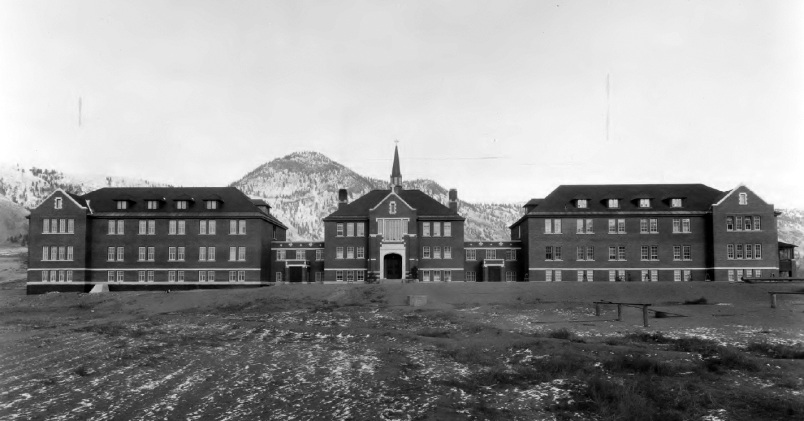
© Archives Deschâtelets-NDC, Fonds Deschâtelets
The Former Kamloops Indian Residential School was designated as a national historic site in 2024.
Commemorative plaque: no plaque installedFootnote 1
The Former Kamloops Indian Residential School, Tk̓emlúps te Secwépemc, British Columbia
The Former Kamloops Indian Residential School is located on the Kamloops Indian Reserve #1 lands of Tk̓emlúps te Secwépemc. This former residential school site was nominated for designation by Tk̓emlúps te Secwépemc members, and a collaborative process was undertaken between Parks Canada and the First Nation to identify the historical importance of this former school.
Located on the north bank of the South Thompson River at the foot of Sqeq7é7em (the Peter and Paul mountains), the former Kamloops Indian Residential School opened in 1890 as the Kamloops Industrial School and closed in 1978. In 1967, students began attending local provincial schools while continuing to live at the school. Two years later, the federal government took over its administration, and the residence operated until 1978.
The school was part of a system of residential schools for Indigenous Peoples instituted by governments working with Christian churches in the 19th and 20th centuries. As part of the government policy of forced assimilation, these institutions separated Indigenous children from their families and communities in order to eradicate their cultures, spiritualities, languages, and traditions. Run by the Roman Catholic congregations of the Oblates of Mary Immaculate and the Sisters of St. Ann, the Kamloops Indian Residential School was the largest institution in a system designed to carry out what the Truth and Reconciliation Commission of Canada described as cultural genocide. Many, including Pope Francis and the Canadian House of Commons, have referred to it as genocide.
Among the students who attended the Kamloops Indian Residential School were children between the ages of four and 18 from over 108 communities and at least 38 Indigenous nations from across British Columbia and beyond, including the Secwépemc, Stó:lō, St’át’imc, Nłeʔkepmxc, and Syilx. Forcibly removed from their homes, these children experienced physical, emotional, spiritual, and sexual abuse, forced labour, malnutrition, inadequate and overcrowded living conditions, poor healthcare, and high rates of infectious diseases and death. Before the late 1950s, the school operated on a half-day system in which children spent half of their time participating in religious practices and performing physical labour that contributed financially to the school, and half of the day or less receiving basic or deficient academic instruction. The traumas experienced by Survivors have had profound, lifelong, and intergenerational consequences that continue today.
The former Kamloops residential school is one of the few remaining residential school sites in Canada with a large group of original buildings and landscapes. It bears witness in physical form to the experiences of generations of children who lived and died there, as well as to the broader history of the residential school system in all its phases. Its notable buildings are the Main Building (1923–29), the Gymnasium (1938), the Workshop (1942), and the Annex (a former residence) (1962). The grounds of the site include a row of maple trees in front of the Main Building and the former orchard, which Survivors’ testimony has indicated contains unmarked burials.
“The commemoration and designation of the former Kamloops Indian Residential School to a site of national historic significance reflects how arrangements made collaboratively will benefit all people, indigenous and non-indigenous. It will serve as a place that will contribute to greater understanding of Secwépemc history and traditional knowledge. The designation symbolizes hope and the vision of our ancestors for a prosperous future for our children, and those not yet born. We collectively know all too well the often-impoverished view of reciprocal obligations and how it has dominated our people. Today, at Tk̓emlúps we take great pride in this path we walk together to commemorate that real collective history. Proud and honored to be in my ancestor’s vision of Clexléxqen or Petit Louis (1828-1915), who advocated for schooling that would benefit the Secwépemc people, together we will educate and share for a prosperous future with pride, the designation is a confirmation of our shared commitment and the hope for change.”
Tk̓emlúps te Secwépemc chose to preserve several of its buildings to commemorate and teach about the impacts of residential schools on children and families and to serve as a place for teaching Secwépemc language and culture as an act of reclamation. In 1982, 17 communities of the Secwépemc Nation signed the Shuswap Declaration, agreeing to work together to preserve, record, enhance, and perpetuate Secwépemc language, history, and culture. The declaration led to the establishment of the Secwepemc Cultural Education Society and the Secwépemc Museum & Heritage Park at the site. Tk̓emlúps te Secwépemc renamed the former residential school site the Chief Louis Centre in honour of the visionary leader, also known as Clexléxqen or Petit Louis (1828-1915), who advocated for schooling that would benefit the Secwépemc people.
This press backgrounder was prepared at the time of the Ministerial announcement in 2025.
The National Program of Historical Commemoration relies on the participation of Canadians in the identification of places, events and persons of national historic significance. Any member of the public can nominate a topic for consideration by the Historic Sites and Monuments Board of Canada.
Related links
- National historic designations
- National historic persons
- National historic sites designations
- National historic events
- Submit a nomination
- Residential schools in Canada
- Former Muscowequan Indian Residential School National Historic Site
- Former Portage La Prairie Indian Residential School in Manitoba
- Former Shingwauk Indian Residential School National Historic Site
- Former Shubenacadie Indian Residential School National Historic Site
- This Week in History
- Date modified :