
Former Muscowequan Indian Residential School National Historic Site
The Residential School System is a topic that may cause trauma invoked by memories of past abuse. The Government of Canada recognizes the need for safety measures to minimize the risk associated with triggering. A National Residential School Crisis Line has been set up to provide support for former residential school students. You can access information on the website or access emotional and crisis referral services by calling the 24-Hour National Crisis Line: 1-866-925-4419.
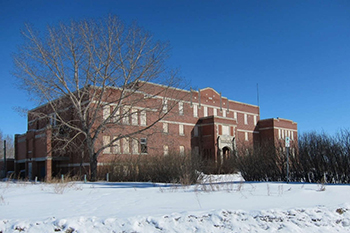
© Parks Canada / Allison Sarkar
The Former Muscowequan Indian Residential School, Lestock, Saskatchewan was designated a national historic site in 2021.
Commemorative plaque: not installedFootnote 1
Nominated by the Muskowekwan First Nation
The Former Muscowequan Indian Residential School is located on the reserve lands of Muskowekwan First Nation in Treaty 4 Territory (southeastern Saskatchewan). This site was nominated for designation by Muskowekwan First Nation. Parks Canada and Muskowekwan First Nation worked collaboratively to identify the historic values of this former residential school, and co-developed the report on the history of the school and the experiences of students for the Historic Sites and Monuments Board of Canada.
Truth awakens our spirit
Muskowekwan First Nation Portfolio Councillor Vanessa Wolfe and Elder Andrew "Nick" Hunter, a Survivor of Muscowequan Indian Residential School share their connection to this site. This video was developed as a collaboration between Muskowekwan First Nation and Parks Canada.
Transcript
[TEXT SLIDE]
This video deals with topics that may cause trauma involved by memories of past abuse. A 24-hour National Residential School Crisis Line has been set up to provide support for former residential school students and their families.
Please call the Crisis Line at 1-866-925-4419 to access emotional and crisis referral services.
[A drone view of the road leading to the former Muscowequan Indian Residential School fades on screen, faint symphonic music plays in the background.]
[TEXT SLIDE]
The former Muscowequan Indian Residential School
National Historic Site
Treaty 4 Territory
Southeastern Saskatchewan
These are the traditional lands of nehiyaw/Cree, Nahkawe/Saulteaux, Dakota, Lakota, Nakota, and the Michif/Métis Nations
(VANESSA WOLFE)
111 years, that place was an operation.
[Transitions to Vanessa Wolfe, Muskowekwan First Nation Portfolio Councillor, speaking to the camera]
It was federally funded by the government, mandated to kill the Indian in me and my ancestors.
[Archival photograph of a Muscowequan Indian Residential School class is shown, with nuns standing in the back row, faint sounds of children can be heard.]
[TEXT SLIDE]
Muscowequan Indian Residential School opened in 1886.
(VANESSA WOLFE)
Today I sit here reclaiming my language, my culture and the connection to the land, but also creating an awareness for all nations. Creating a sacred space of healing.
[Footage of a car driving towards Muscowequan Indian Residential School appears, and then Vanessa Wolfe walking along the road, and walking throughout the building.]
[Transitions to Andrew “Nick” Hunter, Community Elder and Survivor of Muscowequan IRS, speaking to the camera.]
(ANDREW HUNTER)
When I was about 7 or 8 years old, when I first went there. I didn't like to leave home,
[Several archival images of children who attended Muscowequan IRS are shown.]
but I figured I've done wrong and my parents were just putting me in penance by putting me there. I didn't know they were really actually forced to put me in a residential school.
[Background music becomes louder with an aerial shot of the former Muscowequan Indian Residential School and then views of the building from the ground.]
(VANESSA WOLFE)
If you go drive by it, it's just an old abandoned structure.
[Vanessa Wolfe reappears talking to camera.]
It has many, many truths from students that have been through those doors.
[Archival photograph of Muscowequan Indian Residential School.]
To me, it represents the history. The history of those students that went through there.
[Vanessa Wolfe standing inside the Muscowequan Indian Residential School, and walking through a darkly lit hallway.]
My ancestors who went through there.
[Two archival photos of Muscowequan Indian Residential School appear.]
Thankfully, they survived their experiences. Otherwise, I wouldn't be sitting here today.
[Andrew Hunter speaks to camera.]
(ANDREW HUNTER)
My family all went to school at these residential places. My mother, grandfather, and probably his parents.
[Aerial footage of the former Muscowequan Indian Residential School.]
[Several archival photographs of life at Muscowequan Indian Residential School.]
A lot of times the priests and nuns would give us a licking or strap, strapped the hell out of us for speaking our own language, and a lot of things that were done at home, which was cultural ways to us. You know, that broke a treaty way of life.
[Interior scenes of Muscowequan Indian Residential School appear.]
[Cuts back to Andrew speaking to the camera.]
Well, there's a lot of people that are affected by it, and a lot of them turned to alcohol and drugs, you know. It's been hurting the community for numbers of years.
[Scenes inside Muscowequan Indian Residential School including a hallway, a staircase, and a red emergency door with shattered glass and a bright yellow caution sign.]
You know even I still, you know I still cry sometimes when I think of things like this. You know, how children were treated, you know, I wouldn't want to see that happen again.
[Red dress hangs on a tree outside the front doors of Muscowequan Indian Residential School]
[TEXT SLIDE]
After the school closed its doors in 1997,
Elders, Survivors and community members voted to keep the building standing.
(VANESSA WOLFE)
There was a huge gathering and over 300 community members voted to keep that school standing.
[Video footage and photographs of residential school reconciliation activities.] The reason, from my understanding, is to remind the world, Canada, other nations, of our history and what we have been through as nations. The site, to me, represents generations of resilience.
[Hopeful background music continues with soft marimba]
[Archival photograph of Muscowequan Indian Residential School students playing hockey.]
It tells a story.
[Archival photograph of children in a playground.]
(ANDREW HUNTER)
I would like to see this place restored and put into a museum so our children would understand down the road the lives we went through.
[Music fades away.]
[Vanessa Wolfe walks through a classroom, video then cuts to her speaking to camera.]
[Hopeful symphonic background music plays.]
(VANESSA WOLFE)
The truth. That is the ultimate goal, is to have the truth known.
[Contemporary photograph of children’s shoes lined next to each other on a staircase, while a man in an orange hoodie looks on, and a photograph of a reconciliation ceremony.]
And it's not my truth.
[Vanessa Wolfe reappears talking to camera.]
It's many, many truths out there that are still unknown.
[Vanesa walks through a hallway.]
Let it be known to the world.
[Cuts back to Vanessa speaking.]
Not only Canadians. To the world.
[Vanessa Wolfe walks down a dark hallway towards a more well-lit hallway inside the building.]
[TEXT BELOW]
The Former Muscowequan Indian Residential School was designated as a National Historic Site in 2021.
[CUTS TO BLACK]
[Background music fades away with sounds of gates closing]
END TITLES
[Logo of Muskowekwan First Nation appears below text.]
This video is brought to you through a collaboration between Muskowekwan First Nation and Parks Canada.
With deep appreciation this film features Muskowekwan First Nation Portfolio Councillor Vanessa Wolfe and Elder Andrew “Nick” Hunter, a survivor of Muscowequan Indian Residential School.
Parks Canada is supporting the efforts of Survivors and communities to commemorate residential schools.
Learn more: parks.canada.ca/residential
Photo Credits
The archival photos used in this video come from the archives of the Missionary Oblate Sisters and are used with permission.
END CREDITS
PARKS CANADA LOGO
GOVERNMENT OF CANADA WORDMARK
The site and property
The large, three-storey former school building was built in 1930-31 to replace residential school buildings dating to the late-19th century, and remained open until 1997. It was once part of a large school property that included a working farm, outbuildings, playgrounds, and skating rinks. An unmarked graveyard was later discovered on the grounds. It is the only standing residential school in Saskatchewan, and one of the few remaining residential school buildings in Canada.
The Residential School System
Muscowequan Indian Residential School functioned within the system of residential schools in Canada that was imposed on Indigenous Peoples by the federal government and certain churches and religious organizations, who worked together in a deliberate effort to assimilate Indigenous children and convert them to Christianity by separating them from their families, cultures, languages, and traditions. Until 1969, Muscowequan Indian Residential School was operated by the Missionary Oblates of Mary Immaculate, a Roman Catholic missionary congregation, and staffed by the Sisters of Charity of Montreal (Grey Nuns) and the Missionary Oblate Sisters of the Sacred Heart and of Mary Immaculate. In the 1980s, it came under the administrative control of a local First Nations organization and was among the last residential schools to close in Canada.
The mistreatment of students
For over a century, children from many First Nations and other Indigenous communities in Treaty 4 Territory, across Saskatchewan, and elsewhere in Canada attended this residential school. While there, they faced severe discipline, punishment and abuse, harsh labour, inadequate nutrition, poor living conditions, separation from siblings and cousins attending the school, the attempted suppression of their language and cultures, and isolation from their families and home communities. Many children ran away, some to be later returned by force. Some children died while attending the school. In the face of threats by government officials of fines or imprisonment, Indigenous families engaged in acts of resistance such as refusing to send their children to school, withdrawing them without permission, and writing letters to government officials protesting the poor treatment of their children. The far-reaching effects of the residential school experience continue to have significant impacts on former students, their families, and communities today.
A place of cultural reclamation
The school building has been saved from demolition by Muscowequan IRS survivors and community members who see it as an important witness to the history of residential schools, and wish to repurpose the site into a place of commemoration, healing, cultural learning, and as a site of memory for all Canadians.
Backgrounder last update: 2021-03-17.
The National Program of Historical Commemoration relies on the participation of Canadians in the identification of places, events and persons of national historic significance. Any member of the public can nominate a topic for consideration by the Historic Sites and Monuments Board of Canada.
Related links
- Residential schools in Canada
- Former Portage La Prairie Indian Residential School in Manitoba
- Former Shingwauk Indian Residential School National Historic Site
- Former Shubenacadie Indian Residential School National Historic Site
- National historic designations
- National historic persons
- National historic sites designations
- National historic events
- Submit a nomination
- Date modified :