
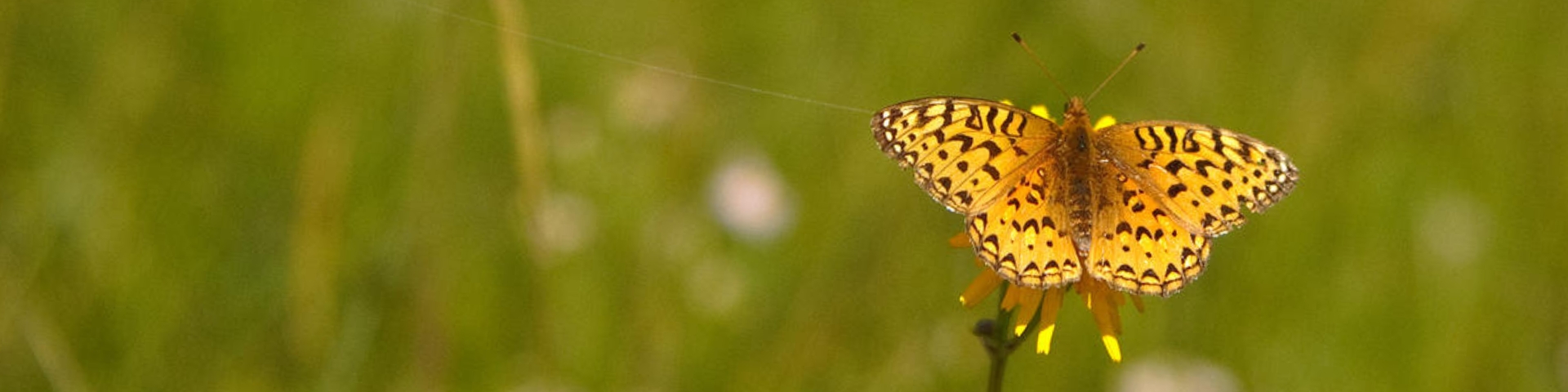
Insect biodiversity
Forillon National Park
Small creatures, big indicators
The presence and diversity of insects are excellent indicators of ecosystem health. Yet insect populations are declining in many parts of the world. But what about Eastern Canada?
From 2023 to 2025, ten national parks in Quebec and the Maritimes are taking part in a study on insect biodiversity in Eastern Canada. Initiated by Forillon National Park, this initiative brings together research teams from the Canadian Forest Service, the Centre for Biodiversity Genomics at the University of Guelph in Ontario, and Parks Canada.
Want to learn more? Watch the video by Parks Canada’s Climate Team.
Investigating Insects | Climate Crew
Transcript
It can feel like the climate is changing faster than we can react.
But there are people doing good work.
There is a Climate Crew.
Insects represent 90% of all animals living on Earth. They're really important in the biodiversity, in the ecosystem diversity interrelations and the food chain.
I'm Daniel Sigouin. I'm a park ecologist in Forillon National Park. Forillon is one of ten national parks on the east coast of Canada who are part of a three year study on insect biodiversity.
Traps are set up in May and stay up until October.
Specimen bottles are changed once a week and sent off to
Guelph University for DNA testing.
From there, the collected insects are sent to the
Canadian Forest Service for visual
identification and cataloging.
And one of the great thing about these Malaise traps is
that they are so efficient at catching biodiversity.
Like right now, just in the trap, I can see some
robber flies, some butterflies,
some weevils.
There's many of them.
Some Hemlock loppers, like there's many,
many species right there.
And I really look forward getting back these samples to
try to catalog them.
So this is a really good trap for this environment.
And all the fly insects will kind of go around willl hit the
surface here and we'll have a natural tendency to go up and
will be eventually collected in the jar.
What's interesting is that we put out the same traps ten
years ago, so we'll be able to compare the
change in biodiversity.
And it gives us a great sense of what we have presently,
but also with climate change, we should be able to detect
some change, like native species coming from the south
and moving north, but also some invasive species that may come
in the area.
Aside from the main study with the Malaise traps, the Climate
Crew decides to do a bit of sweeping.
Net sweeping allows them to capture insects and get a
snapshot of species present in the different ecosystems
throughout the park.
So we have found some flies around there, that will be
found only in this kind of area.
They all have a different role in the ecosystem.
Take one of these insects out.
Well, the ecosystem is going to be different.
Yes.
And this is one of the good reasons we have to monitor and
to increase our knowledge about insects.
And one of the things regarding climate change is that our
environment will be more resilient if we have a diverse
habitat and diverse species that we have in the park.
So yeah, not all ecosystem will change in the same way
regarding climate change.
So we really need to monitor them to make sure that we know
what direction they're going on and how we can
preserve them better.
All this project is a partnership with the
Canadian Forest Service.
We have the habitat, we have the field where we can collect
the data, but afterwards we need their expertise to be able
to complete the work.
So yeah, I had a very interesting field trip last
week in Forillon.
Have you found anything unusual?
We went into a salt marsh and I found this salt
marsh spittlebug, which is very typical of these ecosystems.
Maybe Christian, we can widen our research to sample
the salt marsh?
Yeah, this kind of species might be interesting to monitor
in the future, and this kind of habitat can be impacted
by forest harvesting.
This cascading effect may impact biodiversity because
everything is being linked with biodiversity.
It requires many partners to understand what's happening
with insect biodiversity in the parks.
Guelph University takes all the insects collected and
identifies them through DNA sequencing.
That data is shared with both Parks Canada and the Canadian
Forest Service for further analysis.
Good morning everyone.
We are getting to the end of the collecting season.
So far we have great data, which seems to have a
lot of biodiversity.
That's great.
We're just working through 2023 samples, so we'll be able
to get you the sequence results from those soon.
So we're looking forward to doing the same with
the 2024 samples.
The University of Guelph has a unique facilities and unique
teams to make this work.
It's important to have collaborators because nobody
has all the expertise needed to conduct such projects.
All specimens that are pinned are also labeled in database
and they are integrated into this collection.
The beetles are in the first two units here because we have
been working a lot over the last years.
These are witnesses of the past, and these are very
important in the perspective of climate change.
Even insects that are conserving collections be
useful to understand what's driving climate change.
We have even seen that insect size change with respect
to climate change.
We are watching evolution in real time.
The biodiversity of habitats and the biodiversity of
organisms like the insects are absolutely necessary for the
resilience of nature to climate change.
Everyone can participate in protecting the insects.
Biodiversity is as important in your yard as it is
in national parks.
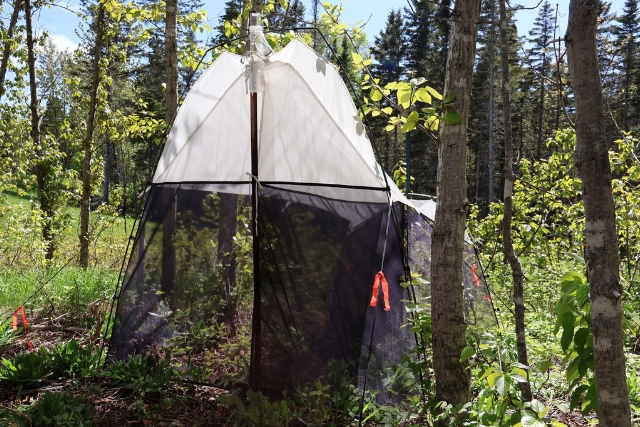
Malaise traps are used to collect insects.
When the bug really bites!
To get a clearer picture of this biodiversity, specimens must be collected in the field. To do this, Parks Canada teams use Malaise traps—fine mesh tent-like structures that capture flying insects, as well as other groups such as ants, beetles, and even spiders.
Sampling begins in May. Every week for 20 weeks, staff collect specimens and send them to researchers for analysis.
In 2013, the BIObus Project, an initiative of the University of Guelph in Ontario, conducted a global inventory of insect biodiversity across Canada. The results of the BIObus project have greatly enriched our knowledge of the insects present in Forillon. Of the 28 national parks studied in Canada, researchers observed the greatest diversity in the country at Forillon National Park.
Measuring change in real time
Collecting insect samples over three consecutive years will allow us to observe variations from one year to another. For example, we will be able to detect the arrival of new species, the decline of other species, or the presence of invasive species.
It is important to regularly measure changes in biodiversity and the state of our ecosystems so that we can adapt our conservation actions in the parks and share our learnings with stakeholders elsewhere in Canada.

Clouded sulphur butterfly.

Cherry-faced meadowhawk.
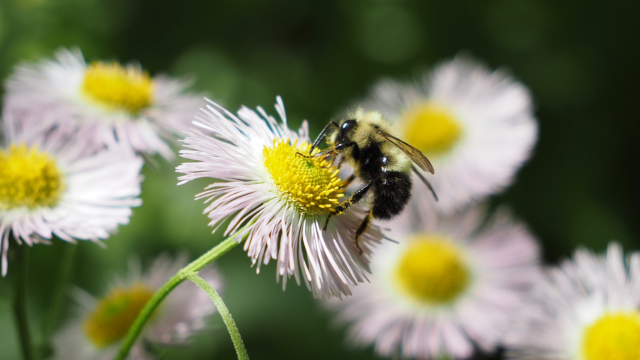
Yellow-banded bumblebee.
- Date modified :