

Silver-haired bat in flight
Photo: Sherri and Brock Fenton
Monitor and protect bats and their habitat
Forillon National Park
Often victims of misconceptions, bats play a key role in maintaining the balance of our ecosystems.
In addition to helping control biting insect populations, they help protect our forests and crops from harmful insects. They are highly effective natural insecticides!
At Forillon, seven species of bats have been identified. Of these, four are resident species, meaning they hibernate at our latitudes, and three are migratory, meaning they spend the winter further south.
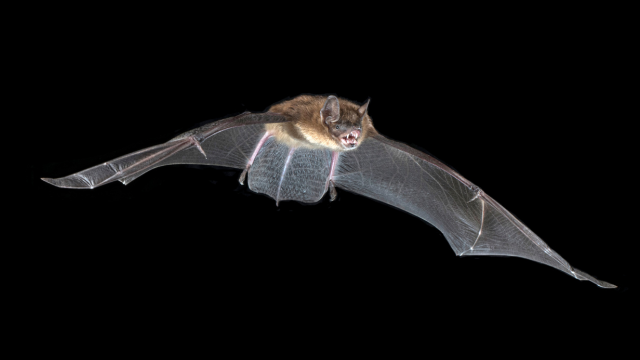
The big brown bat is a resident species. Photo: Sherri and Brock Fenton
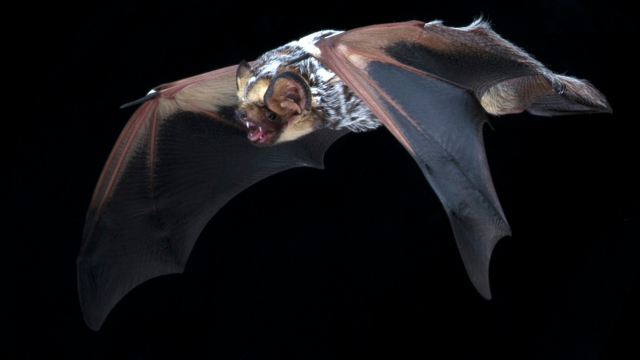
The hoary bat is a migratory species. Photo: Sherri and Brock Fenton
Resident species
- Little brown bat
- Northern long-eared myotis
- Tri-coloured bat
- Big brown bat
Migratory species
- Red bat
- Hoary bat
- Silver-haired bat
Species at risk
Unfortunately, all of these bat species, except for the big brown bat, are listed as species at risk by COSEWIC.
The Committee on the Status of Endangered Wildlife in Canada (COSEWIC) is an independent advisory committee to the Ministry of Environment and Climate Change that assesses the status of wildlife species at risk of extinction. Its members, experts in wildlife biology from various backgrounds, are responsible for identifying species at risk of disappearing from Canada.
Among the causes of bat population decline in North America are habitat loss and a decrease in insect populations, their main food source. Their low reproduction rate also affects their recovery, as they generally give birth to only one to three offspring per year. In addition, their social nature makes them vulnerable to certain diseases, as they tend to gather to hibernate or raise their young.
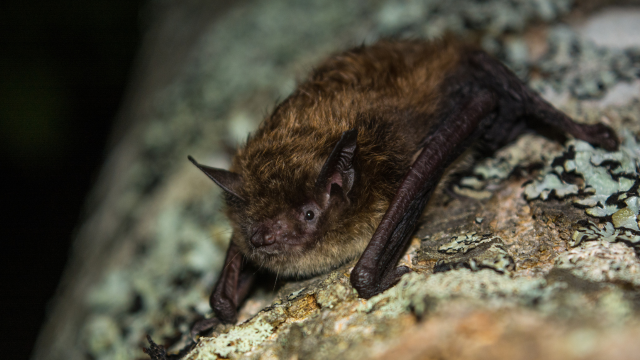
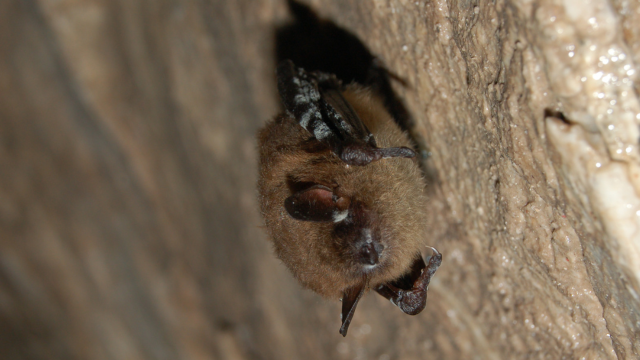
Little brown bat
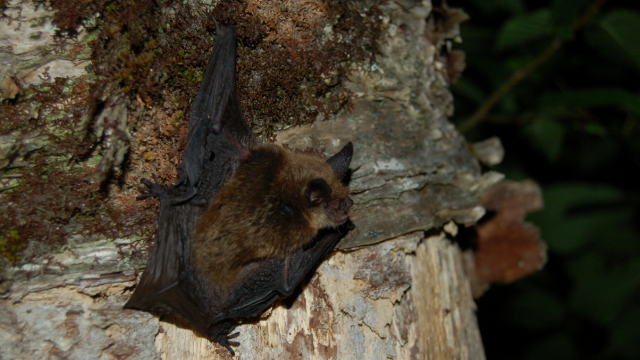
Northern long-eared myotis
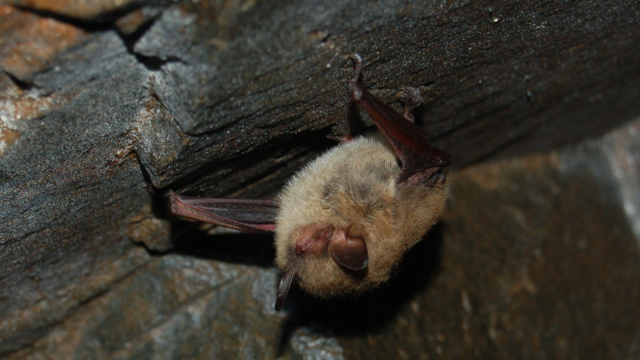
Tri-coloured bat
White-nose syndrome
Since 2010, bat populations have drastically declined due to a serious fungal infection: white-nose syndrome. In caves and caverns where this disease has been detected, mortality rates of 90 to 95% have been recorded in just a few years. This highly contagious disease develops on the skin of bats, causing severe skin irritation. In hibernating bats, it causes premature awakening, which can be fatal.
Bats under surveillance at Forillon National Park
The following video highlights the seven species of bats found in the park, most of which are listed as species at risk in Canada. It also shows the actions taken by our conservation teams to better understand and protect these valuable allies of our ecosystems.
Bats under surveillance at Forillon National Park
Transcript
Forillon National Park has seven species of bats.
Of these, four are residents, meaning they spend the winter here.
We’re talking about the little Brown Bat,
the Northern Bat, the Tri-colored and the Big Brown Bat.
There are also three migratory species, meaning they spend the winter further south.
These are the Red Bat, the Hoary Bat and the Silver-haired Bat.
With the exception of the Big Brown Bat,
all these species are on the list of species at risk and are designated as endangered.
The Little Brown Bat, the Northern Bat and the Tri-colored Bat are all small in size.
They are around 10 cm high and between 20 and 27 cm wide when their wings are spread.
The Little Brown Bat and the Northern Bat can be recognized by their distinctive fur,
which is lighter on the belly and darker on the back,
while the Tri-colored Bat has tricolored fur.
Despite their similar appearance,
they can be distinguished by the shape, size and colour of their ears,
which are quite imposing in relation to the size of their heads.
The Red Bat has brownish orange fur with a white spot under the chin.
The Red Bat has brownish orange fur with a white spot under the chin.
The Hoary Bat is easily distinguished by its yellowish face and throat.
The Silver-haired Bat is distinguished by the silver-tipped hairs on its back.
These are medium- to large-sized bats.
Their height is around 15 cm,
while the width ranges from 30 cm to 42 cm when their wings are spread.
Bats are victims of misconceptions
and play an important role in the ecological balance of our ecosystems.
They are mammals like us,
but they use echolocation to move around and detect their prey in space.
By feeding on flying insects,
bats provide us with invaluable services in controlling the biting insect population
and pests that cause major damage to our crops and forests.
They are valued allies for both gardeners and campers.
The diversity of its ecosystems means that
Forillon National Park offers a multitude of bat-friendly habitats.
As insectivores, bats like to hunt in natural environments where insects are in abundance.
For example, they will seek out wetlands, open areas, ponds, clearings,
woodland edges or below the forest canopy.
When bats are not busy feeding, they rest.
Some bats use trees, whether in hollow tree cavities, under the bark or in the foliage,
while others prefer rock cavities or old buildings such as barns or garages.
In autumn, resident bats take refuge in caves, crevices
or abandoned mines to hibernate until spring.
Unfortunately, the Little Brown Bat, the Northern Bat and the Tri-colored Bat populations
have seen drastic declines of 90-95%
since the introduction of the white-nose syndrome in 2006 in the United States and in 2010 in Quebec.
This disease is caused by a fungus and spreads extremely quickly,
representing the main threat to resident species.
This fungal infection develops on the skin of bats
and increases the number of early awakenings during hibernation.
Bats then have to expend a lot of energy, which causes them to draw on their fat reserves.
With food sources extremely scarce during the cold season,
they eventually die of starvation and exhaustion.
For species that spend their winter further south, migration exposes them to a number of threats.
The Committee on the Status of Endangered Wildlife in Canada (COSEWIC)
has identified wind farms as a major cause of mortality for migratory bats.
These species, the Red Bat, Hoary Bat and Silver-haired Bat,
have been added to the list of species at risk in 2023.
There are also other threats that affect bats,
which include habitat loss and declining insect populations in North America.
By preserving the ecological integrity of Forillon National Park,
we help bats recover by protecting and conserving their habitats.
In order to monitor the status of the various species,
the conservation team carries out inventories every year.
We use a variety of inventory methods, including stationary recording stations,
mobile inventories and twilight observations of our buildings.
In this way, we can observe the rate of activity, the rate of occurrence
and the diversity of species throughout the park.
To boost the survival rate of bats,
Parks Canada is working with its partners and with researchers to find solutions to white-nose syndrome.
There are many things you can do at home to help protect these endangered species.
When maintaining your land, take care to preserve important habitat features for bats,
such as waterholes, edges, forests and dead trees.
You can also build or purchase a bat shelter and install on your own property.
You can also build or purchase a bat shelter and install on your own property.
However, be sure to follow https://batwatch.ca recommendations,
which will give you all the details on where to install it and how to build it.
Avoid using pesticides,
minimize light pollution.
They will repay you by reducing the biting insect population on your property.
If you see many bats, please let us know at https://batwatch.ca.
This site enables researchers to track bat populations across Canada.
Finally, make your friends and family aware of the precarious situation of bats,
and the importance they play in ecosystems,
and share this video!
Our conservation efforts
Our conservation efforts include protecting bat habitats, conducting annual field inventories, creating a joint conservation plan, and raising public awareness and education.
First, by protecting habitats used by bats, we contribute to population recovery. In addition, over the past five years, we conducted an annual field inventory to monitor their progress. Methods vary: fixed recording stations, mobile recordings, dusk observations, and building inspections.
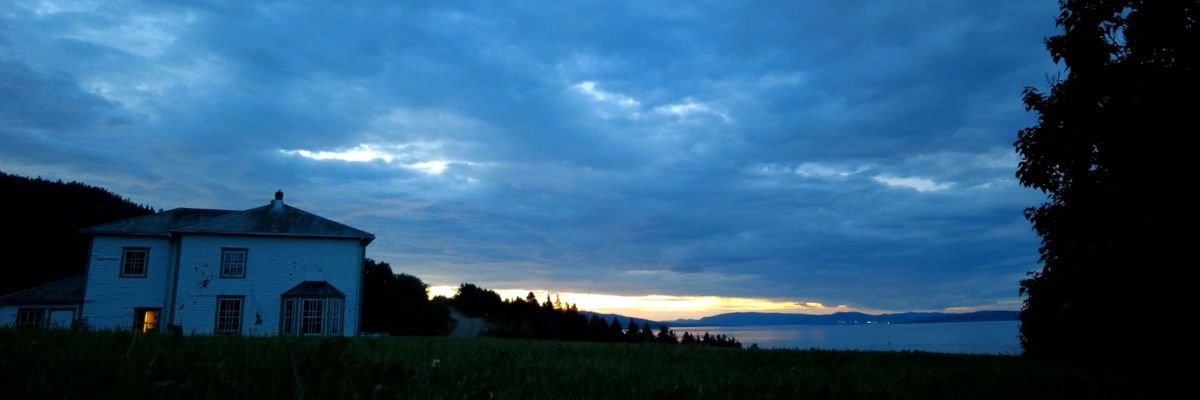
Our annual inventory leads us, among other places, to the heritage buildings in the Grande-Grave area.
In 2023, we developed a joint bat conservation plan with teams from other Parks Canada locations in Quebec, including La Mauricie National Park, the Quebec Field Unit, and the Mingan Archipelago National Park Reserve. This will allow us to have a better overview of population trends in the region.
We regularly conduct awareness and education activities to inform the public about the status of bat populations and the importance of collective action to protect and restore these animals.
What you can do
Would you also like to lend a hand to help bats? Here are a few tips:
- In your yard, set aside a 'wild' space.
- Reduce outdoor lighting.
- Install a bat shelter.
- Avoid visiting bat hibernation sites (caves, old buildings).
- Report the presence of bats to park staff.
- Take part in Bat Week activities.
Bats, an ally worth protecting
In this short video from Parks Canada's Field Notes series, see how annual bat inventories are conducted at Parks Canada sites in Quebec. Because collaboration is key to protecting our winged allies!
An ally worth protecting
Transcription
My name is Antoine Plouffe Leboeuf
I’m an ecosystem scientist at Forillon National Park
and I’m going to talk to you about
our bat conservation work. [Name Tag] Antoine Plouffe Leboeuf, Ecosystem Scientist, Forillon National Park
[Title] Field Notes: Bats, an Ally Worth Protecting
Today, we’re in the field to install
ultrasound recorders, in order to measure [Name Tag] Steve Pronovost, Resource Conservation Officer, Forillon National Park [Name Tag] Michael Ouellet, Resource Conservation Student, Forillon National Park
bat activity in Forillon National Park.
So, bats emit sounds that are inaudible to the human ear
but we can measure them with specialized devices.
To be able to measure the activity rate in our park,
we’ve placed our devices near feeding sites.
Bats feed mostly on insects
and so it's good to place the stations
near streams, marshes and ponds...
... places where there are a lot of insects.
[Text] In Canada, bats play an essential role in maintaining ecological balance by controlling insect populations.
[Text] Parks Canada is part of a dynamic community of bat researchers across Canada.
[Text] We work with private landowners, universities and other conservation organizations to better understand and protect bats.
To protect species like bats,
it takes a group effort. So, at Parks Canada
we started a great collaboration
with La Mauricie National Park, [Location Tag] La Mauricie National Park
Mingan Archipelago National Park Reserve [Location Tag] Mingan Archipelago National Park Reserve
and with us, Forillon National Park, [Location Tag] Forillon National Park
to work on bat conservation and more specifically
on three bats at risk:
the Little Brown Myotis, [Text] Little Brown Bat
the Northern Myotis and the Tri-colored Bat. [Text] Northern Bat [Text] Eastern Pipistrelle
[Text] In Canada, the main threats to bats are habitat loss and a fungal disease called white-nose syndrome. [Label] Fungus (Evidence of white-nose syndrome)
[Text] Our goal is to help restore bat populations by protecting hibernation sites, maternities and shelters. We are also tracking the progression of white-nose syndrome. [Label] Bat shelter
We’ve conducted
twilight inventories by observing our buildings [Location Tag] Forillon National Park
to check for the presence of bats.
We do this just before sunset
because now is the time that bats usually
choose to go out hunting at night.
So we have binoculars, then we observe the potential exits
to possibly find our famous bats. [Name Tag] Josée Blier, Resource Management Officer, La Mauricie National Park [Name Tag] Valérie Turcotte-Blais, Resource Management Technician, La Mauricie National Park [Location Tag] La Mauricie National Park
[Label] Heated nest box
[Text] Like in Forillon, other Parks Canada sites in Quebec regularly look for, listen to and monitor bats.
[Location Tag] Mingan Archipelago National Park Reserve
This evening, we’re doing mobile inventories of bats. [Location Tag] La Mauricie National Park
To do this, we attach a microphone to a pole
that we will have outside the vehicle. Then we will drive on the road [Location Tag] Forillon National Park
across the park.
It will allow us to document all the bats
that are detected by our recorder.
This inventory gives us an idea of the relative
abundance of bats found in the park.
[Music]
So, today we
came to take down the station, the stationary recorder.
It's been ten nights that the
device has been taking recordings of bats and we think we’re
going to have lots of recordings because the temperature was good. [Name Tag] Marie-Soleil Pétrin, Resource Conservation Officer, Mingan Archipelago National Park Reserve [Name Tag] Adam Desjardins, Resource Conservation Officer, Mingan Archipelago National Park Reserve [Location Tag] Mingan Archipelago National Park Reserve
It's been hot, there's been no rain
and the winds were still relatively weak.
So the conditions have been ideal for having
bats on our site.
And so today, we’ll take down the station and then we’ll go
look at our recording data which will be on an SD card.
We will be able to analyze it using
special software afterward.
[Label] A sound clip of a bat using echolocation to find food. The clip has been slowed down to be audible to the human ear.
So by working together
and also by working
with other conservation organizations in North America
we increase our chances of success to protect these species.
[Text] Learn more about bat conservation at Parks Canada: parkscanada.gc.ca/canada-bats
- Date modified :