
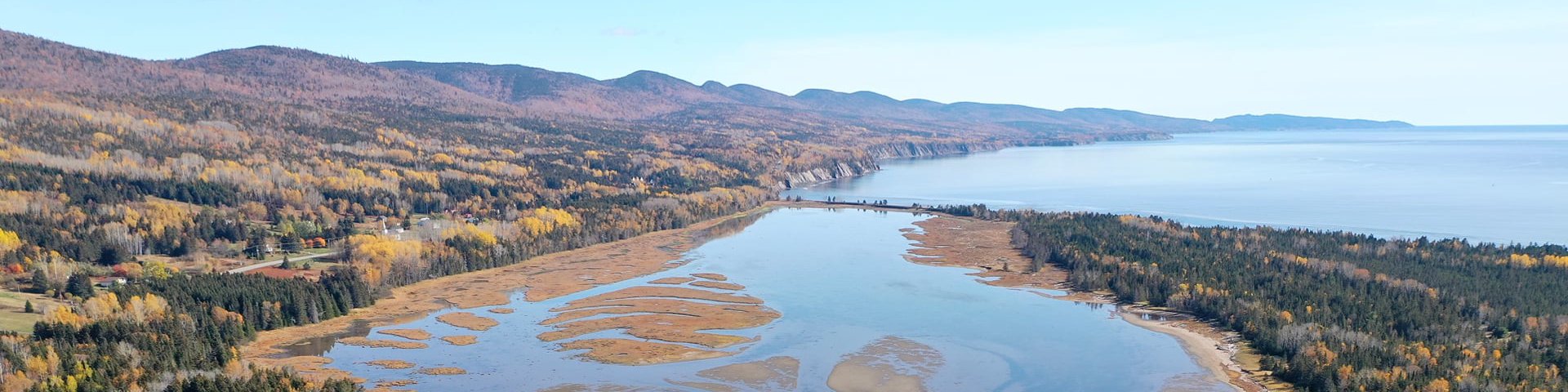
Penouille peninsula
The Mi'gmaq and their ancestors - Forillon’s first inhabitants
Forillon National Park
The Mi'gmaq and their ancestors frequented the territory of Forillon long before the Europeans arrived.
Penouille peninsula

Representation of the first inhabitants of this land.
Indigenous peoples, including the Mi’gmaq and their ancestors, have frequented the Penouille area since immemorial times. Stone tools and weapons, as well as flaking debris, unearthed during archaeological excavations, bear witness to their presence.
Indigenous groups are thought to have begun occupying the terrace dominating the Penouille salt marsh as early as the end of the Late Palaeo-Indian period. Indeed, spearheads discovered on the plateau where the Penouille visitor centre stands are believed to date from this period, between 9,000 and 6,000 years ago. Further down, on the Penouille peninsula, the shape of the projectile points indicates a regular indigenous presence from 2000 to 1500 years ago, and from the year 1000 until 1534.
Archaeological excavations conducted on Penouille have offered up an impressive quantity of flaking debris, testifying to the presence of several lithic workshops. Numerous tools and a few traces of fire pits also provide evidence of craft-making and various domestic activities on this site. Terracotta containers were also used to cook foods such as fish and, most likely, seal.
Anse-au-Griffon Valley
The Mi'gmaq and their ancestors also frequented Anse-au-Griffon Valley. This natural corridor was regularly used for portaging across the Forillon peninsula – i.e., from the Gulf of St. Lawrence to Gaspé Bay. Three of the four inventoried archaeological sites are perched upon natural platforms, offering an unobstructed view out over the valley and vicinity.
Related links
- Heritage cemeteries
- Forillon historical collection
- Context to the creation of Forillon National Park - A duty...
- The French Regime - The first fishing stations
- The English Regime - Families take root
- Archaeological heritage of Penouille
- Grande-Grave - A typical Gaspé fishing village
- L'Anse-au-Griffon Valley - Living from the land and the...
- Cape Gaspé - A lighthouse at Land’s End
- World War II at Forillon's gate
- A heritage building had to be relocated at Forillon
- Date modified :