
Protecting Eastern hemlock in Kejimkujik
Kejimkujik National Park and National Historic Site
A healthy forest ecosystem, including all the species that live within it, starts with the health of the trees. Slow the Spread was a five-year project (2019-2024) that focused on protecting priority Eastern hemlock stands throughout Kejimkujik National Park and National Historic Site by managing the threat of invasive Hemlock woolly adelgid (HWA).
Protecting Kejimkujik’s Hemlock Legacy | Field Notes | Parks Canada
Transcript
[Parks Canada Beaver logo]
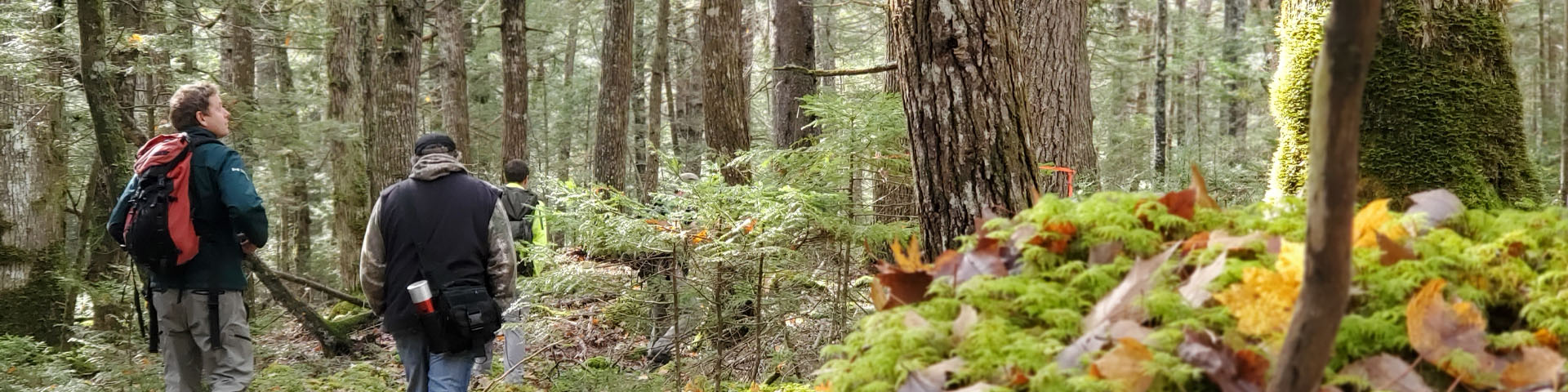
[Erin speaks] Today, we're here in Hemlocks and Hardwoods, an old-growth hemlock forest here in Kejimkujik. And we're going to talk to you a little bit about an invasive forest pest here called hemlock wooly adelgid that's having a really significant impact on the health of all of our hemlock trees.
[Erin speaks] Eastern hemlock stands are really important here in Kejimkujik. Approximately 10% of our forested area here contains hemlock, so they’re a really big feature on our landscape. They create their own unique ecosystem. So they have really dense canopies that create really cool shady environments that support a lot of species that are pretty unique to them.
[Erin speaks] Additionally, about 90% of the old-growth forest in Kejimkujik is composed of hemlock. So they hold a really important ecological value for us here.
[Text: The Mi’kmaq were the first people on this land. They used hemlock forests for shelter, food and medicine.]
[Erin speaks] The latest threat to our remaining old-growth hemlock in Kejimkujik is a new invasive forest pest called hemlock woolly adelgid. It's a non-native, aphid-like insect that feeds exclusively on Eastern hemlock. They are prolific asexual reproducers and each individual female can produce between 50 and 200 eggs each. Not only that, they have two full generations per year.
[Text: HWA is native to Asia and western North America. It first arrived in eastern North America in the 1950s. Labels: adult HWA with woolly covering + mobile "crawler" HWA.
[Erin speaks] So in western North America and throughout Asia, it has predators that will naturally feed on it and keep those populations in check. But we do not have any of those natural native predators in eastern North America. So the HWA population here is really able to exponentially explode, and grow unchecked really.
[Text: It is predicted that HWA could infest and kill most of the Eastern hemlock within Kejimkujik by 2030.]
[Text: That is why Parks Canada has implemented a pest management strategy that uses chemical control and biocontrol.]
[Erin speaks] So as part of our integrated pest management strategy, one of these kind of main pillars is chemical control. So this is our short term kind of stopgap solution to protecting hemlock trees right now.
[Brendan speaks] Good morning. Del and I are out today heading to a northern area of the park, Frozen Ocean Lake. What we're going to do is some basal bark spraying at several of the backcountry campsites. So we've got the truck all packed with the ATV, and we're going to take you along for the adventure. Stay tuned.
[Brendan speaks] We have made it to our first site here on Frozen Ocean. Del is in the background right now calibrating the backpack sprayers. This is important for determining our application rates and having the right amount of product going on to the hemlock trees. The first thing we do is we approach a tree that has been marked for treatment.
[Brendan speaks] We can see that the DBH has been recorded. And so then that is the amount of beats that we will count in our head as we apply the treatment around the tree.
[Text: We also use a chemical application method called stem injection.]
[Text: Parks Canada monitors impacts to other native species and pesticide concentrations to ensure that chemical treatments do not post a risk to the environment.]
[Lucas speaks] So in a system with predators and prey, it's important that if prey populations are to be regulated -as in not going to go and high numbers where they're going to be damaging other species- that there are sufficient predators in the system to actually regulate their populations. We call this top-down regulation.
[Text: Scientists are studying the Lariconuis nigrinus beetle from BC. As a natural specialist predator, it could help control the HWA population.]
[Text: This specialist predator feeds and develops on HWA. Since this beetle helps control HWA in British Columbia, it’s being used to regulate HWA in Nova Scotia.]
[Lucas speaks] So our goal is to figure out if these little guys can live through Nova Scotia's kind of unique environment. And the second thing we're trying to do is to figure out how they're actually affecting HWA in a closed environment. So the idea here is we put a known amount of beetles in with HWA in a closed environment. And then based off that and sampling through the year, we can also make sure that the beetles are actually affecting HWA.
[Text: Biocontrol sites are selected based on criteria like absence of nearby chemical treatments, proximity to water corridors, and adequate HWA levels to ensure ample food.
[Erin speaks] These methods work together as part of an integrated pest management strategy, which essentially means that we use a variety of different strategy types to ensure the long-term protection of Eastern hemlock in the Kespukwitk region.
[Check out other #ParksCanadaConservation projects]
[Parks Canada logo]
[Canada]
Protecting Kejimkujik's hemlock legacy, Kejimkujik National Park and National Historic Site
Project summary
The establishment of HWA in Kejimkujik poses a significant threat to Eastern hemlock, which contribute to approximately 10% of Kejimkujik’s forested area. Imminent mortality of hemlock trees will negatively impact the ecological integrity of Kejimkujik’s forests in the future.
When HWA was first detected in Kejimkujik in 2018, Parks Canada was presented with an opportunity to actively manage and protect Eastern hemlock forests while the overall ecological integrity of Kejimkujik’s forested ecosystems remain good and stable.
Working with the Mi’kmaq of Nova Scotia and regional partners, Parks Canada implemented different techniques to manage the impact of HWA, including:
- protecting individual hemlock trees in priority locations with chemical control,
- improving forest resilience and diversity in Jeremy’s Bay Campground with silvicultural control,
- and supporting the early stages of biological control research as the long-term HWA management strategy.
With the help of many visitors, volunteers and partners, a great deal was accomplished during this five-year project.
Objectives
Slow the Spread focused on two main objectives in relation to the recent invasion of HWA in Kejimkujik;
- protecting high priority Eastern hemlock stands, and
- limiting the long-term impact of hemlock decline on overall forest ecological integrity and resilience.
Collaboration
The first years of the project were primarily focused on increasing the understanding and options to protect hemlock forests.
Through this process, a regional working group was established (HWA Working Group – Maritimes) with participants from federal, provincial, academic, and non-governmental agencies to coordinate and collaborate on priorities related to the impacts and management of HWA. The collaborative nature of this project extended into the relationships with Indigenous partners, resulting in managing hemlock forests of Kejimkujik through Etuaptmumk (two-eyed seeing).
Results
This project successfully delivered all aspects outlined in the Integrated Pest Management (IPM) strategy for protecting hemlock trees, detailed below. While additional years of monitoring will document the overall benefit of the IPM, initial results suggest that treated trees are healthier than untreated trees, and that biological control agents are actively feeding on HWA.
Chemical control
Chemical treatments are an important short-term measure to protect Eastern hemlock while long-term control solutions establish. The first chemical treatments of Eastern hemlock trees in Kejimkujik occurred in Fall 2021, where 428 hemlock trees were treated in the old growth forest around the Hemlocks & Hardwoods trail. With the success of this first phase of the project, there have been increasing numbers of trees treated in subsequent years in high priority stands, identified through the Hemlock Stand Prioritization Framework. Through the Slow the Spread project, over 4,000 individual hemlock trees were protected from HWA in priority stands throughout Kejimkujik.
Silvicultural control
Thinning the overstory of Eastern hemlock by 25% allows for remaining trees to access increased light and nutrients, improving overall vigor. Implementing this strategy in Jeremy’s Bay Campground (JBC) also allows Parks Canada to pre-emptively remove dead or dying trees that pose risk to visitor safety and campground infrastructure. Areas that are thinned are then planted with seedlings of Wabanaki-Acadian forest species to diversify the understory species and create a more resilient future forest.
Since 2021, approximately 1,300 Eastern hemlock trees have been removed from JBC followed by the planting of over 5,000 seedlings. Deer browse protection measures have helped over 90% of planted trees survive throughout the course of this project.
Biological control
Since there are no native predators of HWA in Eastern Canada, biological control (biocontrol) is the only long-term, landscape scale management tool for controlling HWA. Regional partners have developed a regional biocontrol program to support the long-term population control of HWA through the release of four insects: Laricobius nigrinus, L. osaneksis, Leucotaraxis piniperda, Le. argenticollis.
In Fall 2023, over 5,000 Laricobius nigrinus beetles from Western Canada were released in southwestern Nova Scotia by the Canadian Forest Service, approximately 185 of which were released in Kejimkujik. Releases of L. nigrinus will continue annually throughout Nova Scotia, with efforts underway to support future releases of the remaining three biocontrol agents.
No intervention
While Parks Canada staff have been working to protect priority Eastern hemlock stands and manage the impact of HWA, much of the forest will be left to transition naturally. Parks Canada is actively monitoring these sites to assess the impact of HWA on Eastern hemlock ecosystems and natural succession processes.
Public awareness
In addition to the control of HWA in Kejimkujik, this project focused on increasing public awareness and visitor experiences. Initiatives included public awareness and education campaigns, field tours and outreach programs, and interpretive programs focused on connecting visitors to hemlock conservation.
Future work
We are currently observing the early stages of widespread changes to the forests of Kejimkujik resulting from the impacts of HWA, climate change, and recent and imminent arrivals of other invasive forest species (e.g., Beech leaf mining weevil, Emerald ash borer).
Meaningful protection and conservation of Kejimkujik’s forests is expected to be a long-term process that extends beyond the Slow the Spread project.
Lessons learned
Population management
Initial findings show that by managing the HWA population, Parks Canada can limit the long-term impact of hemlock decline on the overall forest ecosystem.
Regional coordination
The regional coordination and collaboration between federal, provincial, academic, and non-government agencies was essential in increasing the momentum on knowledge building, focusing research priorities, developing management strategies, and increasing public awareness of HWA. This helped facilitate public support for the project while ensuring proper considerations and mitigations were incorporated into the management of HWA throughout Kespukwitk.
Monitoring and early detection
Slow the Spread, however, was not without its challenges. HWA was detected in Kejimkujik only after populations were well established, which resulted in delays in developing and approving management strategies. Advanced awareness, early detection, and pre-emptive engagement with regional partners and experts may have provided Parks Canada with additional time and resources to prepare and plan responses ahead of the population’s establishment.
The invasion of HWA in Kejimkujik has reinforced Parks Canada’s understanding of the importance of continual monitoring for invasive species and engaging with regional partners to support advance planning and rapid response to invasive species.
Future projects
Slow the Spread has helped transform how the public views invasive species management in Kejimkujik National Park and National Historic Site.
The successes and lessons learned from this project will be used by Parks Canada and partners to inform park management and future conservation efforts.
The project has demonstrated the potential for limiting the impacts to ecological integrity in a threatened ecosystem with proper management and regional collaboration.
Full report
Request a copy of the Slow the Spread report: kejimkujik@pc.gc.ca
Contact us
More information and media inquiries: kejimkujik@pc.gc.ca
- Date modified :