
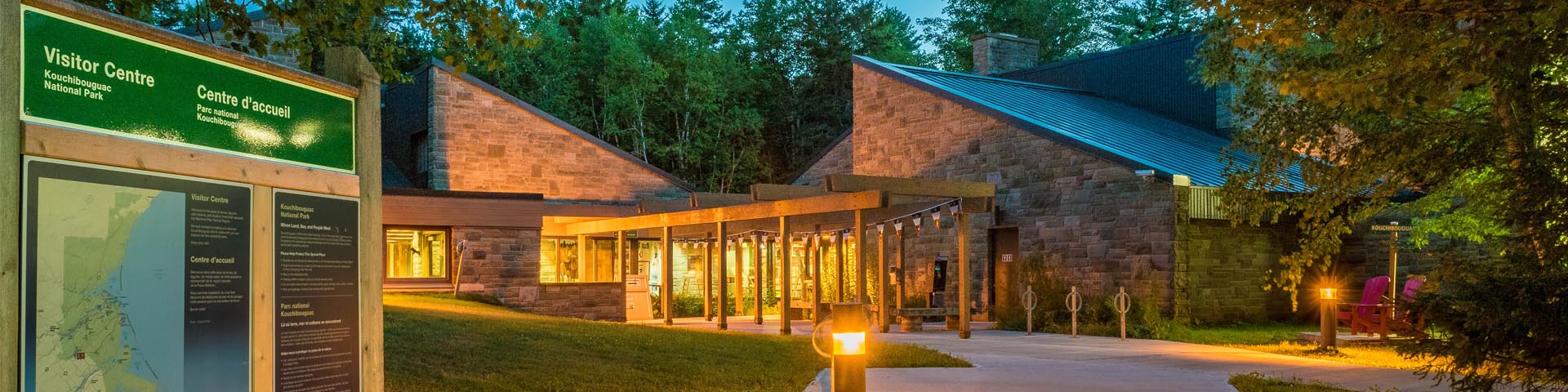
© Doug Currie
Visitor reception centre
Kouchibouguac National Park
On your next visit to Kouchibouguac, take the time to stop at the Visitor Reception Centre and talk to our staff, check out our new exhibits, watch our audio-visual presentation in the Theatre or buy a souvenir at the gift shop.
Reception desk
The reception desk at the Kouchibouguac National Park visitor centre is the perfect starting point for any park visit.
The knowledgeable and friendly staff are available to answer any questions you may have about the park, including its history, activities, and amenities. They can provide you with park maps, brochures, and other resources to help you plan your visit.
Whether you're looking for hiking trails, paddling routes, or information about park wildlife, the reception desk at the visitor centre is the place to start.
Exhibits
The two exhibits on display at the Visitor Reception Centre are Memories of Our Communities and Where Land, Sea and People Meet.
Memories of Our Communities: Learn, contemplate and reflect on the history of the once-thriving communities and the turmoil caused by the expropriation of the former Acadian and English-speaking residents’ lands to create the park.
Memories of Our Communities
This self-commented multimedia exhibit looks at the great cultural diversity of the people who lived in the area that now makes up Kouchibouguac National Park.
Deportation
Beginning in 1755, thousands of Acadians were deported from the Maritime Provinces. In 1764, however, Acadians still in the region received permission to re-establish their settlements. The Acadians who eventually settled in what is now Kouchibouguac National Park came from elsewhere in New Brunswick such as Memramcook and the Gaspésie region of Québec.
Almost simultaneously, United Empire Loyalists from the United States and immigrants from Scotland, Ireland, England, and elsewhere also arrived; they established prosperous farms and many successful businesses.
Expropriation
Starting in 1969 however, the lands of approximately 1,200 Acadian and English-speaking residents, comprising about 228 households, were expropriated to create Kouchibouguac National Park. Some Acadians compared the shock of the expropriation with their ancestors’ deportations centuries earlier.
The Government of Canada eventually stopped the practice of expropriating people’s lands to create national parks.
The memory of the villages that were once located in what is now the park – Cap-Saint-Louis, Claire-Fontaine, Fontaine, Guimond-Village, Kouchibouguac (includes Middle and South Kouchibouguac), Rivière-du-Portage, and Saint-Olivier rests mainly with the former residents, whose traditions, beliefs, and identities were inextricably linked to the land and water.
Legacy
A variety of interpretive techniques are used to highlight the rich history of the former residents. An eye-catching wall-size map and a large stylized “house” diorama form the central elements within the exhibit. They provide the backdrop for several main elements, including the Creation of a National Park.
Period photos, newspapers and film clips are used to set the context for the creation of Kouchibouguac National Park and the conflict that ensued. Surrounding the central diorama are seven large photo-mural-style panels representing each of the former villages. The Bounty of the Land and Waters element combines archival photos, dioramas, artifacts, and oral history recordings to portray the common experiences that the people shared with the environment and the natural resources that they depended on to survive.
In the Legacy component, the 228 former households are figuratively represented by a “wall” of inter-connected bas-relief mailboxes juxtaposed with seven actual mailboxes symbolizing the villages. An interactive “Memories” kiosk provides access to hundreds of photographs that former residents have given to the park over the years. As well, a list of the families whose lands were expropriated is displayed in one of the building’s windows, drawing a visual connection to the exterior and the places they once lived in.
The Memories of Our Community exhibit was produced by Parks Canada in partnership with members of its Former Residents Advisory Committee.
Where Land, Sea and People Meet: Discover the parks awe-inspiring coastal geography and ever changing ecosystems, and its centuries old dynamic human history.
Where Land, Sea and People Meet
This self-guiding, multimedia exhibit delves into the park’s diverse natural environment and interweaves the dynamic history of the people who once lived off the area’s natural bounty and their descendants who still depend on it.
The exhibit’s main objective is to help visitors create their own experiences at Kouchibouguac National Park.
A variety of interpretive techniques are used to bring the park’s natural world “to life,” including interpretive panels, interactive programs, originally produced videos, striking wildlife film clips, artifacts, models, and dioramas.
Archival and re-enactment photos interwoven throughout the exhibit’s theme components highlight the park’s centuries of human history: Mi’kmaq, Acadian, English, Scottish, Irish, and others as well as their present-day descendants.
Gift shop
Discover a piece of Kouchibouguac National Park to take home with you.
Located inside the Visitor Information Centre, the Kouchibouguac National Park gift shop offers a warm and welcoming space featuring products inspired by the region’s landscapes, wildlife, and cultures.
Each purchase supports local creators and Parks Canada programs and conservation efforts.
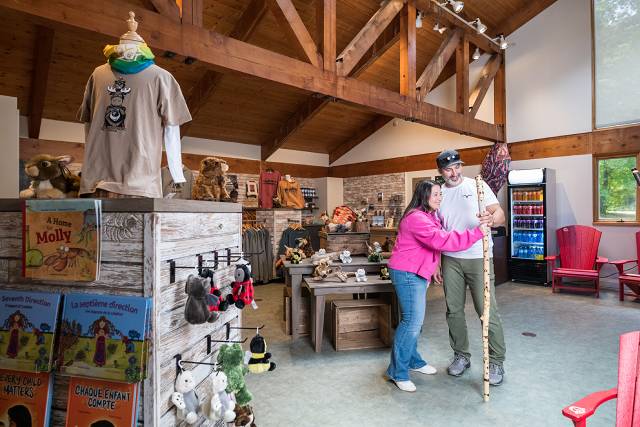
Browse a unique selection of items including:
- Official Parks Canada merchandise
- Locally made crafts, jewelry, and artwork
- Books, postcards, and publications highlighting the park’s natural and cultural heritage
- Outdoor essentials and eco-friendly souvenirs
- Apparel and accessories inspired by Kouchibouguac’s beaches, forests, and rivers
- Authentic Indigenous art and products created by Mi’gmaq artisans
Are you a local or Indigenous artisan or business owner?
We’re always looking to collaborate with new partners whose work reflects the spirit of Kouchibouguac.
To learn more about opportunities to feature your products in our gift shop, please contact:
Email: boutique.kouch@pc.gc.ca
Phone: 506-876-2443
 Accessibility – Know before you go
- The parking lot has 2 designated accessible parking spaces, located approximately 50 m from the Visitor Centre.
- A single-user wheelchair accessible washroom and gendered washrooms are located at the entrance of the Visitor Centre.
- Baby-changing facilities are available in all washrooms.
- The Visitor Centre, exhibit hall and gift shop are wheelchair accessible.
- The exhibits feature interactive audio and tactile elements.
- A wheelchair is available upon request.
- All-terrain wheelchairs are available free of charge.
- The picnic area near the parking lot is a grassy area. One table is wheelchair accessible.
- Date modified :