
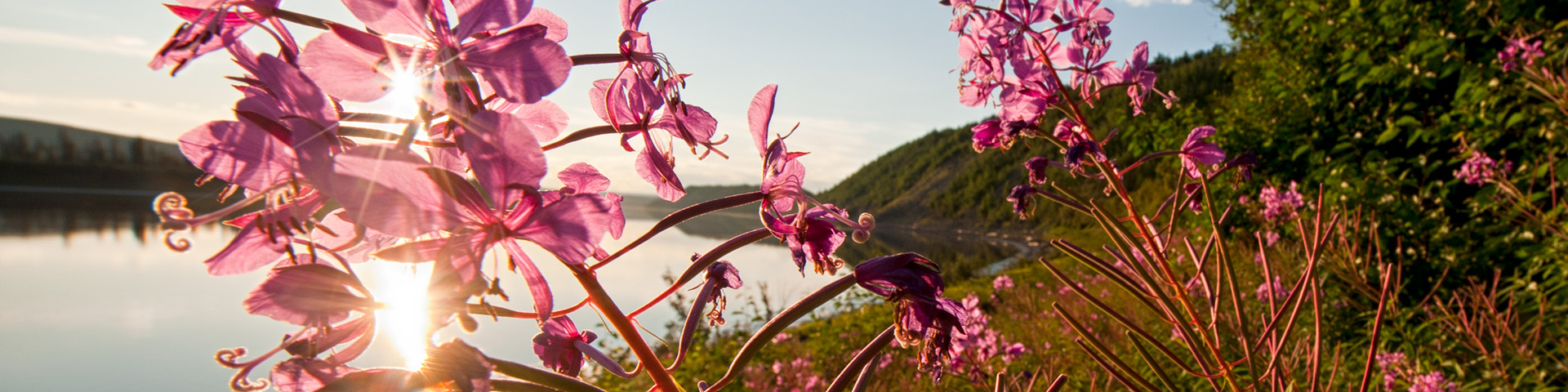
©Peter Mather
Proposed national park in the Teetł’it Gwinjik (Peel River) Watershed, Yukon
Feasibility assessment complete
The feasibility assessment for this proposed national park is complete. The next step is to negotiate an establishment agreement. Learn more about this major step.
Overview
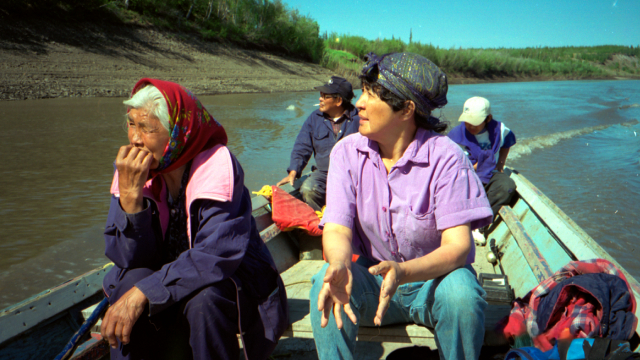
The Teetł’it Gwinjik (Peel River) Watershed is a unique northern area. It is a stunning landscape of forests, free-flowing rivers and wildlife. It is located within the Traditional Territories of the Gwich’in and Na-Cho Nyäk Dun and the Gwich’in Settlement Region. The Teetł’it Gwinjik (Peel River) Watershed is central to their traditions, cultures and ways of life.
Who is involved
The Gwich’in Tribal Council, the First Nation of Na-Cho Nyäk Dun, Parks Canada and the Government of Yukon (“the Parties”) are exploring the possibility of creating a new national park in a portion of this watershed.


This is a collaborative process. All stages of this work will be based on the recognition of Indigenous rights, respect, co-management and partnership.
Possible outcomes
A potential national park in the Teetł’it Gwinjik (Peel River) Watershed would:
- permanently protect the ecosystem
- advance Indigenous-led conservation
- ensure cultural practices can continue on this landscape
- support the creation of land-based economies
- strengthen biodiversity
- contribute to the recovery of species at risk
- protect and showcase this important region for current and future generations
- align with the vision and goals of the Peel Watershed Regional Land Use Plan
About the Teetł’it Gwinjik (Peel River) Watershed
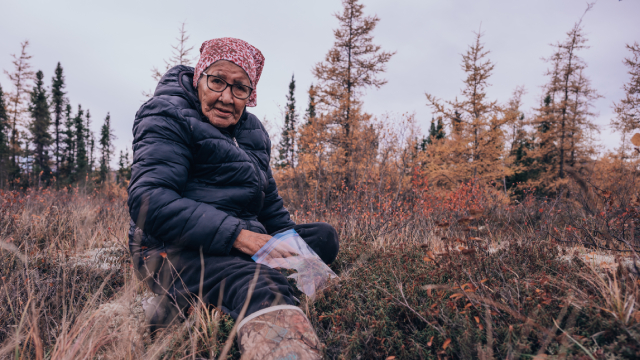
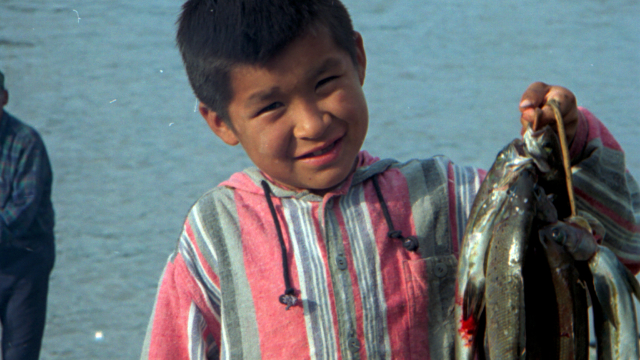
© Arlyn Charlie, Gwich’in Tribal Council Department of Culture & Heritage
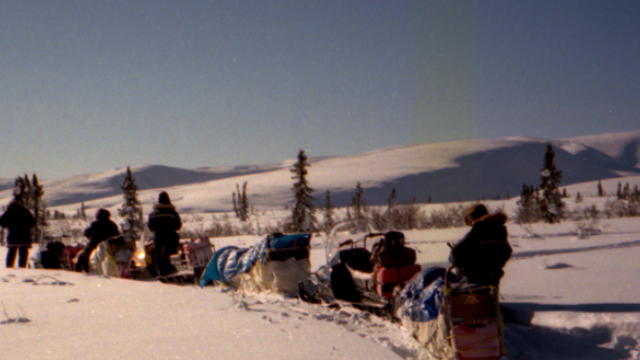
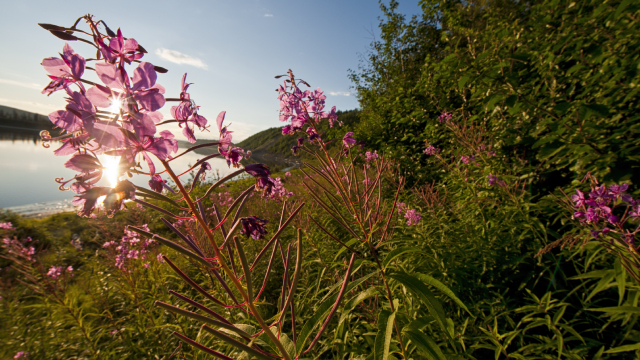
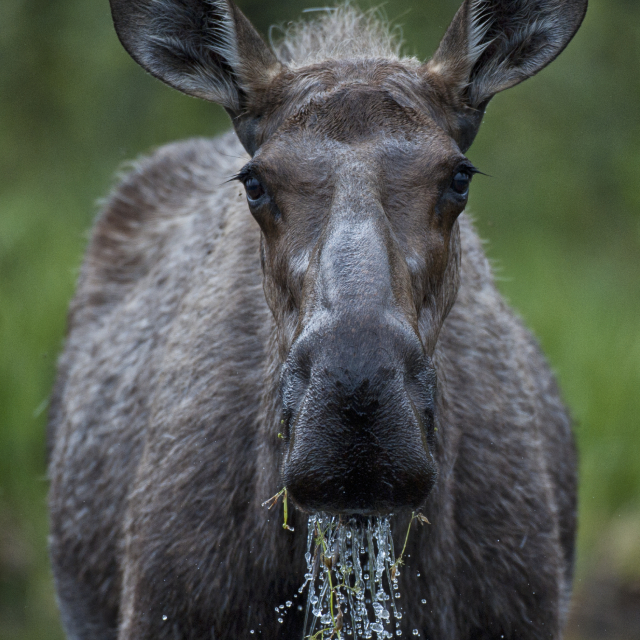
The Teetł’it Gwinjik (Peel River) Watershed is in northeast Yukon, next to the Yukon-Northwest Territories border. This is a diverse and rugged landscape, home to caribou, moose, bears, birds, and fish. It has great natural beauty and high biodiversity. It also contains important habitat for species at risk.
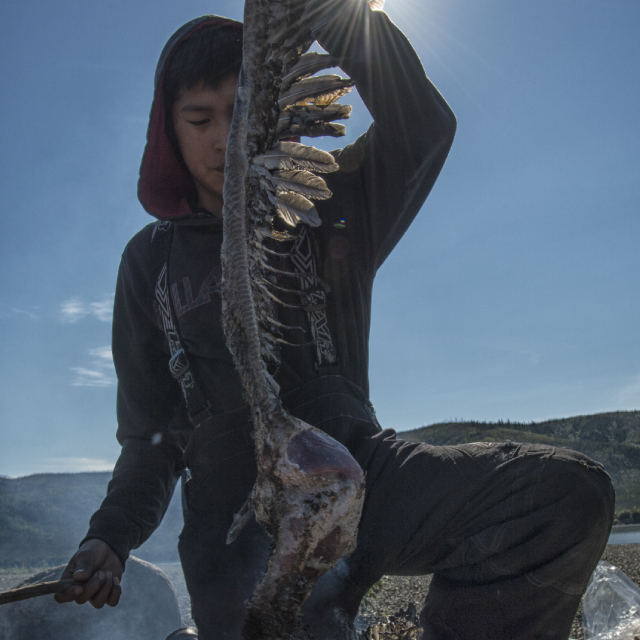
The Gwich’in and Na-Cho Nyäk Dun have cared for these lands and waters since time immemorial. They have lived in and travelled through this region for thousands of years. Their communities are sustained by the water, plants, animals, and a deep, ongoing connection to the land. They continue to exercise their traditional ways of living on these lands.
This area is mostly intact and undisturbed. It has few roads, limited development, and no permanent residents.
Teetł’it Gwinjik means “Head of the waters-along the course of” in the Teetł’it Gwich’in language. Teetł’it Gwich’in people are named for their strong association with this area, having their homeland at the “head of the waters”, or in the upper Teetł’it Gwinjik (Peel River) area. This homeland extended from the head of the Peel River at the northern Ogilvie River and into the Richardson Mountains, including all of the major mountain rivers that flow into Teetł’it Gwinjik (Peel River).
Image gallery
Study area
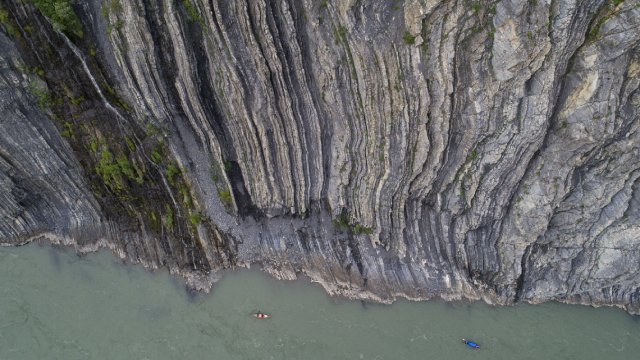
© Peter Mather
The study area is almost 3,000 square kilometres in size. That’s about half the size of Prince Edward Island.
It is located in the northeast part of the Teetł’it Gwinjik (Peel River) Watershed within the Gwich’in Settlement Region, specifically in the Gwich’in Primary Use Area. It includes Nihtal Gyit (Turner Lake Wetlands), the Edigii Njik (Caribou River) area, and a large section of the Teetł’it Gwinjik (Peel River) Corridor.
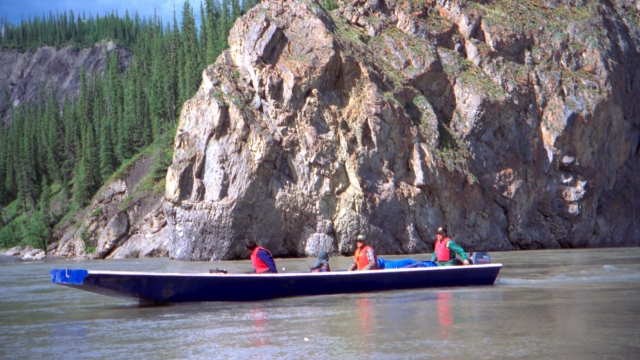
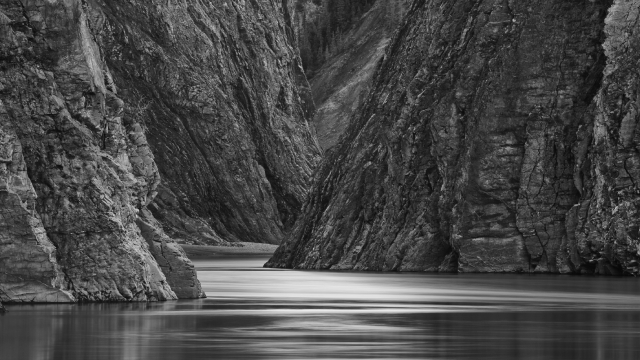
This area features river canyons, scattered lakes and riparian forests. These wetland and forest habitats are important for caribou, fish and other animals. It is also an area of great cultural and spiritual value to the Gwich’in and Na-Cho Nyäk Dun.
Map A: Study area for the proposed national park in the Teetł’it Gwinjik (Peel River) Watershed
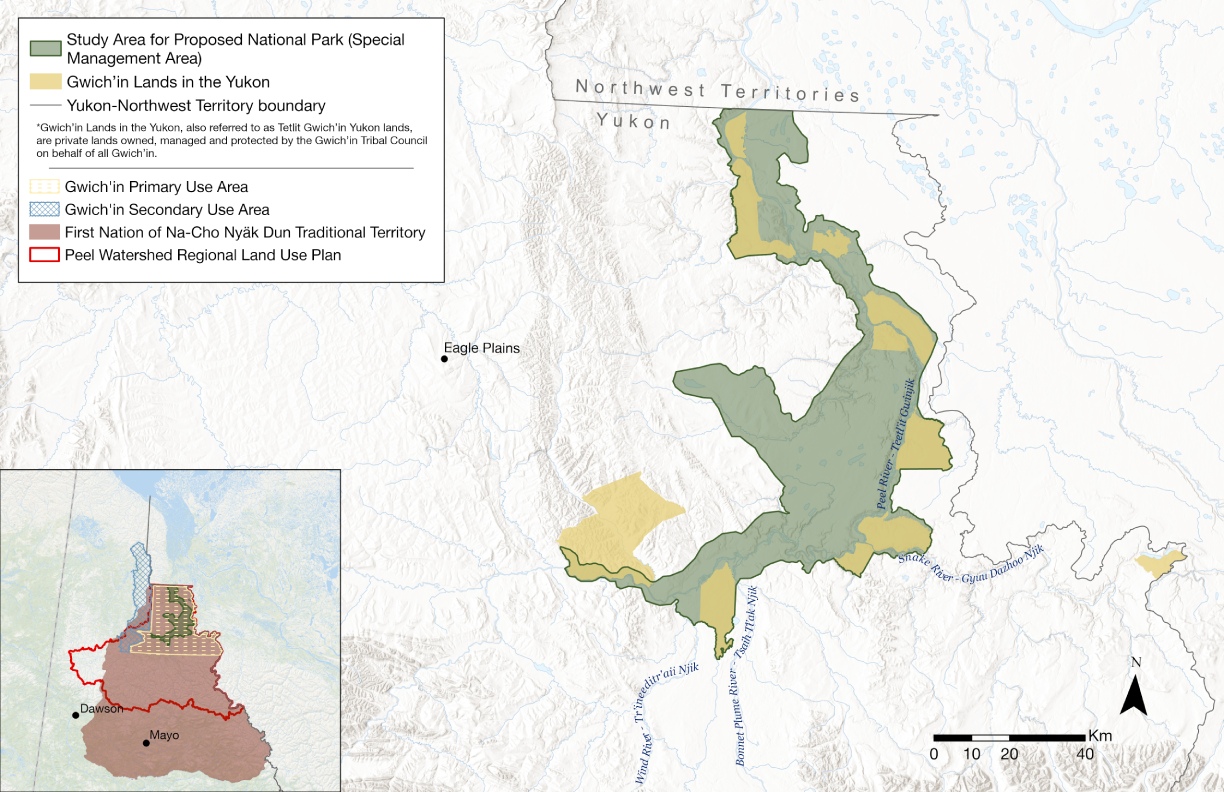
*Gwich’in Lands in the Yukon, also referred to as Tetlit Gwich’in Yukon lands, are private lands owned, managed and protected by the Gwich’in Tribal Council on behalf of all Gwich’in.
Map A: Study area for the proposed national park in the Teetł’it Gwinjik (Peel River) Watershed — Text version
This map features the study area for a proposed national park in the Teetł’it Gwinjik (Peel River) Watershed.
The map extent includes a northeastern portion of Yukon and northwestern portion of the Northwest Territories. The map extends north to an area just south of Teetł’it Zheh (Fort McPherson) and Tsiigehtchic, and south to include Teetł’it Gwinjik (Peel River), Tr’ineeditr’aii Njik (Wind River), Tsaih Tł’ak Njik (Bonnet Plume River) and Gyuu Dazhoo Njik (Snake River).
A legend box in the upper left contains several features of the primary map – the Special Management Area & national park study area (green polygon), Gwich’in Lands in the Yukon (yellow polygons), and the Yukon-Northwest Territory boundary.
The Special Management Area & national park study area is shown as an irregular green polygon on the map. It is entirely located in the Yukon. Its northern extent reaches the Yukon-Northwest Territories border. It extends south to the confluence of Teetł’it Gwinjik (Peel River) and Gyuu Dazhoo Njik (Snake River) and west following Teetł’it Gwinjik (Peel River). The Special Management Area & national park study area is overlapped in some areas by Gwich’in Lands in the Yukon (shown as yellow polygons).
The map contains a ‘key map’ in the lower left corner locating the extents of the primary map in the broader context of the Yukon and Northwest Territories. The legend box shows several features of the key map –Gwich’in Primary Use Area (yellow cross-hatched polygon), Gwich’in Secondary Use Area (blue cross-hatched polygon), First Nation of Na-Cho Nyäk Dun Traditional Territory (maroon polygon), and the Peel Watershed Regional Land Use Plan (red outline).
The Peel Watershed Land Use Plan is shown as a red outlined polygon that follows the Teetł’it Gwinjik (Peel River) watershed boundaries in northeast Yukon.
The Gwich’in Primary Use Area is shown as an irregular yellow cross-hatched polygon. It overlaps the northern portion of the First Nation of Na-Cho Nyäk Dun Traditional Territory and the northern portion of the Peel Watershed Land Use Plan.
The Gwich’in Secondary Use Area is shown as an irregular blue cross-hatched polygon. It overlaps northwest portions of First Nation of Na-Cho Nyäk Dun Traditional Territory and the northern portion of the Peel Watershed Land Use Plan and extends northward toward the Mackenzie Bay.
First Nation of Na-Cho Nyäk Dun Traditional Territory is shown as an irregular maroon polygon that extends over much of the northeast Yukon. Two parcels of First Nation of Na-Cho Nyäk Dun Settlement Lands overlap the study area near the confluence of Teetł’it Gwinjik (Peel River) and Tr’ineeditr’aii Njik (Wind River) but are not shown at this map scale.
The Peel Watershed Land Use Plan, the Gwich’in Primary Use Area and First Nation of Na-Cho Nyäk Dun Traditional Territory fully overlap the Special Management Area & national park study area (green polygon).
A 0 to 40 km scale bar is included in the lower right corner of the main map along with a north arrow.
Background — Peel Watershed Regional Land Use Plan
A potential new national park would align with the Peel Watershed Regional Land Use Plan.
The Peel Watershed Regional Land Use Plan was approved in 2019. The Plan was developed by the Peel Watershed Planning Commission, which was comprised of six members of the public nominated by the First Nation of Na-Cho Nyäk Dun, the Gwich’in Tribal Council, the Vuntut Gwitchin First Nation, Tr’ondëk Hwëch’in and the Government of Yukon.
The Plan sets out a vision and goals for land management in the watershed. The Plan identifies the study area as a Special Management Area. This means that it will be permanently protected. The goal is to legally designate it as a protected area and manage it jointly.
One possible way to achieve this goal is to designate the area as a national park. The Gwich’in Tribal Council and the First Nation of Na-Cho Nyäk Dun, the two First Nation parties to the Plan whose traditional areas overlap the study area, have chosen to work with Parks Canada and the Government of Yukon to explore this possibility.
Background - Feasibility assessment
On April 19, 2024, the Gwich’in Tribal Council, the First Nation of Na-Cho Nyäk Dun, Parks Canada and the Government of Yukon signed a Collaboration Accord. They announced that they would be working together on a feasibility assessment for a proposed national park in the Teetł’it Gwinjik (Peel River) Watershed.
Completion of the feasibility assessment
From April 2024 to March 2025, the Parties undertook the feasibility assessment. It was an information-gathering process that included:
- careful consideration of the spiritual, cultural, environmental and socio-economic values in this area
- consultation with Gwich’in leadership and participants, Na-Cho Nyäk leadership and citizens, stakeholders and the public
The consultation process provided an opportunity for all those interested to share their input on key considerations in establishing the proposed national park.
Based on the results of the feasibility assessment, the Parties concluded that the creation of a new national park in this area is practical and desirable.
The outcomes of the feasibility assessment are summarized in the feasibility assessment report (PDF, 9.8 mb).
Next steps
On September 10, 2025, the Gwich’in Tribal Council, the First Nation of Na-Cho Nyäk Dun, Parks Canada and the Government of Yukon announced that negotiations toward establishment of the proposed national park will proceed. This is the next stage of the process for creating a national park.
Indigenous rightsholders would continue to be able to access this area to uphold their traditional rights, responsibilities and relationship with the land, including the right to harvest.
The process of exploring a new national park is Indigenous-led, and a national park would only be created with the full support of all the Parties. If created, it would be jointly managed by the Gwich’in Tribal Council, the First Nation of Na-Cho Nyäk Dun and Parks Canada.
Images
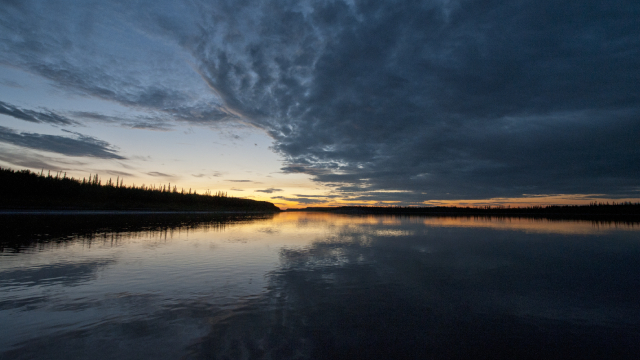

Video of the study area
Discover the Teetł’it Gwinjik (Peel River) Watershed for yourself through a video of the Teetł’it Gwinjik (Peel River).
Contact us
Email the Parties (care of Parks Canada) at teetlit-gwinjik@pc.gc.ca.
Related links
- News release: Partners Confirm Feasibility for Proposed National Park in the Teetł’it Gwinjik (Peel River) Watershed
- Daiiniidadhan gwinjik nan hai’ gwits’an àatsih/ Dan k'éhte mahsi ts'ę nan (Giving Thanks to the Land Our Way) Feasibility Assessment Report for the Proposed National Park in the Teetł’it Gwinjik (Peel River) Watershed (PDF, 9.8 mb)
- News release: A new national park in the Yukon being explored by the Gwich’in Tribal Council, the First Nation of Na-Cho Nyäk Dun, and the Governments of Canada and Yukon
- News release (Gwich’in translation): Yukon gwizhit nan kàk tthak zhuu nahtr’ahdidal gwideek’it jii Gwich’in Jìlch’eiinat gik’itr’ihaandal, jii Tr’oochit Dinjii Zhuh Na-Cho Nyäk Dun,Yukon ts’àt Canada Iisrits’at Chit Kàt guuvah’
- Gwich’in Tribal Council
- First Nation of Na-Cho Nyäk Dun
- Government of Yukon
- Creating new national parks
- Peel Watershed Regional Land Use Plan
- We Rise Together Achieving Pathway to Canada Target 1 through the creation of Indigenous Protected and Conserved Areas in the spirit and practice of reconciliation
- Date modified :