
Ski touring in Rogers Pass and the Winter Permit System
Winter
The Winter Permit System has ended for the 2025/26 season. Avalanche control can still be required and will be managed with specific area closure, before heading out, check the important bulletins for the latest update. The Winter Permit System goes into effect annually from November 15 until the end of the avalanche control season.
Rogers Pass in Glacier National Park is a popular backcountry ski touring destination with an average of 14 metres of snowfall a year. It is also home to the world's largest mobile avalanche control program. This means that explosive artillery fire is regularly used on mountain slopes to protect highway and railway traffic from natural avalanches. The Winter Permit System separates skiers from these explosives and the resulting avalanches.
2025/26 updates: Winter Permit changes and more!
- Winter Permits are now required for all backcountry access, including Winter Unrestricted Areas in Glacier National Park. If you are intending to leave the highway or parking areas, you need a Winter Permit.
- Winter Permits and Parking Permits are now required for both unrestricted parking areas when accessing the backcountry: Illecillewaet Valley Parking and Rogers Pass Centre Parking.
- Quiz required for all permit holders.
- Both Annual and Daily permit users must now complete a short quiz before getting a permit. The quizzes have been redesigned with accessibility in mind.
- New visitor facility: Summit Station.
- The Rogers Pass Centre (RPC) is closed for rehabilitation. Summit Station will be the new spot for park passes, permits, and merchandise. Space is limited and we suggest carpooling! Summit Station won’t offer the same services or meeting space as the RPC.
On this page
- Learn the Winter Permit System New information for winter users
- Get your Winter Permit
- Frequently asked questions
- Where can I ski today?
- Plan your touring route
The Winter Permit System
Learn it. Get your permit.
Due to the avalanche control program, all slopes in Glacier National Park adjacent to the transportation corridor are officially closed in winter. The Winter Permit System was implemented in 1995 to allow Parks Canada to open some of these areas for skiers and snowboarders when avalanche control is not planned or anticipated.
Avalanche control work is conducted to keep the transportation corridor open, not to make slopes safe for skiers or boarders. Anyone travelling into the backcountry must have a Winter Permit, avalanche training and appropriate safety equipment. You must know where you can ski and ride to be safe from artillery fire.
The Winter Permit System divides Glacier National Park into three types of areas. Access to Winter Restricted Areas and Winter Unrestricted Areas requires a Winter Permit.
Winter Restricted Areas
These areas may open or remain closed on any given day depending on planned artillery gunfire.
To enter these areas:
- The area must be open
- You must have a Winter Permit
- You must carry a valid photo ID
- You must have a national park pass
Winter Unrestricted Areas
A Winter Permit is required for these areas to ensure users do not accidentally enter into a restricted area without a permit.
To enter these areas:
- NEW You must have a Winter Permit
- NEW You must carry a valid photo ID
- You must have a national park pass
Winter Prohibited Areas
These areas are closed to visitors all winter and illegal to enter. They are not open for skiing at any time.
Reasons for prohibited access:
- Skier-triggered avalanches in these areas could reach the highway
- Snowpack must be preserved for avalanche forecasting and snow science research
You DO need a Winter Permit to:
- enter Winter Unrestricted Areas
- enter Winter Restricted Areas
You DON'T need a Winter Permit to:
- stop at Summit Station parking area
- visit restrooms
- visit information centres, such as Summit Station
Rogers Pass checklist
Before you ski Rogers Pass:
- Get your Winter Permit. We encourage all users to plan ahead and obtain an Annual Winter Permit online. Daily Winter Permits are only available at Summit Station.
- Every member of your group must carry their Winter Permit alongside a valid piece of government-issued photo identification when entering Winter Restricted Areas and Winter Unrestricted Areas. Digital permits are accepted if you are unable to print a copy.
- You must display a legible printed Winter Parking Permit on the dashboard of the vehicle(s) you will be using. The license plate number on the displayed Winter Parking Permit must match the vehicle that is parked. A Winter Parking Permit is provided with your annual or daily winter permit.
- Get a national park pass for every member of your group.
- Daily passes: Available at the Parks Canada administration office (301B 3 St. W in Revelstoke), or at Summit Station.
- Annual passes: Available at the Parks Canada administration office, Summit Station, by phone at 250-837-7500, or online.
- Check which areas are open today on the Rogers Pass Backcountry Access interactive map.
- Understand the risks of backcountry recreation, how to travel in avalanche terrain and how to practice self-rescue techniques.
- Have an avalanche transceiver, shovel, and probe for every member of the group.
- Check today's Avalanche Bulletin to determine the current conditions.
- Carefully plan your route using online resources, maps, guidebooks and information from Parks Canada.
- Find a buddy - space is limited at Summit Station and carpooling will help reduce congestion at parking lots.
- Know before you go. Check DriveBC for highway conditions and updates.
Get your Winter Permit
As of the 2025/26 season, a Winter Permit is mandatory to enter any backcountry terrain. This means Winter Restricted Areas AND Winter Unrestricted Areas.
Annual Winter Permit
Apply online in advance for your Annual Winter Permit! You will receive your Winter Permit and Winter Parking Permit by email. An Annual Winter Permit allows you to access open Winter Restricted Areas and Winter Unrestricted Areas without visiting Summit Station each morning.
Apply for your Annual Winter Permit
Please plan ahead! Turn-around times for Annual Winter Permits can be up to a week or more depending on the volume of applications received. If you don't have enough time to acquire an Annual Winter Permit, your only option for skiing at Rogers Pass is to get a Daily Winter Permit from Summit Station.
Daily Winter Permit
Daily Winter Permit holders will now be required to complete a quiz.
Complete the quiz before you pick up your Daily Winter Permit at Summit Station. If your trip is a week or more away, you should take the Annual Winter Permit quiz instead.
Daily Winter Permits must be obtained on the day you plan to ski or snowboard, and are only valid for that day. Daily Winter Permits are only available at Summit Station.
Frequently Asked Questions
Do I need a Winter Permit?
You need a Winter Permit if you’re entering an open Winter Restricted Area or a Winter Unrestricted Area for any reason. Failure to carry a valid Winter Permit can result in a fine of up to $25,000. Entering a closed area may expose you to artillery fire, explosives, or the resulting avalanches.
Entering any backcountry terrain without a Winter Permit puts the future of the Winter Permit System at risk. In order for backcountry users to continue to have access to restricted slopes, avalanche forecasters and the Canadian Armed Forces need to be confident that NO skiers or snowboarders are in closed areas.
Please note that camping or any other form of overnight use is not permitted at any location within a Winter Restricted Area.
Parking
Parking:
-
Parking at Summit Station and Rogers Pass washroom building is limited to a maximum of 30 minutes. Camping is prohibited. Transport trucks should park on the east of the Rogers Pass Centre between 7:00 a.m. and 8:00 p.m.
- No parking along the service road by Summit Station. This space is essential for safe traffic management during avalanche control closures. Violators may be ticketed or towed.
- Processing Overnight Parking Permits via email can take up to five days. Overnight parking permits are issued for winter camping or overnight hut trips only. Camping in parking lots is prohibited.
- The Illecillewaet parking lot is in a Winter Unrestricted Area. As of the 2025-26 season, you need a Winter Permit if you plan to access the backcountry.
Most parking lots in Rogers Pass require a Winter Parking Permit and open or close daily depending on avalanche control. The Winter Parking Permit comes with your Winter Permit. All restricted parking areas are closed at midnight. It is illegal to enter or park in these areas until they are open. Restricted area status is updated at approximately 7:00 a.m. Pacific Time.
Vehicles may only be left overnight in Glacier National Park in the following designated winter parking areas and only by those overnighting in the backcountry. A backcountry permit and an additional overnight parking permit (free) are required. There is no winter frontcountry camping in Glacier National Park and sleeping in vehicles in parking areas is prohibited. Snow clearing and winter maintenance of parking areas occurs overnight.
Overnight parking permits can only be obtained at Summit Station or by phone at 250-837-7500. You will need your license plate number and ACC hut reservation number or backcountry permit number. Specific exit routes will be explained to you at the time. We cannot guarantee same day service. Plan ahead to avoid disappointment.
If avalanche control has started while you have been away from your vehicle, you may find a card on your windshield at the parking lot. Remain with your parked vehicle until you are notified by Parks Canada staff that the highway is open.
| Parking area: | Requirements: | Overnight parking: |
|---|---|---|
| Summit Station * | National park pass | Yes, only for visitors staying at ACC-operated huts and cabins or backcountry camping in Winter Unrestricted Areas Overnight parking permit and backcountry permit or ACC hut reservation required |
| Illecillewaet Valley | Winter Parking Permit National park pass |
Yes, only for visitors staying at ACC-operated huts and cabins or backcountry camping in Winter Unrestricted Areas Overnight parking permit and backcountry permit or ACC hut reservation required |
| Beaver | Beaver Parking must be open Winter Parking Permit National park pass |
Yes, for visitors backcountry camping in Winter Unrestricted Areas Overnight parking permit and backcountry permit or ACC hut reservation required |
| Bostock | West Rogers Winter Restricted Area must be open Winter Parking Permit National park pass |
Yes, for visitors backcountry camping in Winter Unrestricted Areas Overnight parking permit and backcountry permit or ACC hut reservation required |
| Hermit | East Rogers Winter Restricted Area must be open Winter Parking Permit National park pass |
No |
| Loop Brook | West Rogers Winter Restricted Area must be open Winter Parking Permit National park pass |
No |
| NRC Gully | West Rogers Winter Restricted Area must be open Winter Parking Permit National park pass |
No |
| Stone Arch | East Rogers Winter Restricted Area must be open Winter Parking Permit National park pass |
No |
Due to avalanche hazards and winter road maintenance, parking is only allowed in designated areas. You must park in designated winter parking areas and obtain and display the appropriate permits for that area. If the parking area for your intended objective is full, you will need to change your plans. Overflow parking is not available and parking on the highway shoulder is dangerous, illegal and may result in your vehicle being towed.
* Only a national park pass is required to park during the day at Summit Station parking lot. Keep in mind that this area provides access to both Winter Unrestricted and Winter Restricted areas. It is your responsibility to know where you are going when accessing the backcountry and to have the right permits. If you are staying at an ACC hut accessible from Illecillewaet Valley Trailhead, you also require an overnight parking permit.
Highway safety
The Trans-Canada Highway itself is not part of the Restricted or Prohibited Areas, but highway plowing and avalanche control activities place restrictions on some areas.
- No stopping within signed avalanche areas along the highway.
- You must obtain a Winter Parking Permit (provided with your Daily and Annual Winter Permits) for parking at designated parking areas. See the parking section above.
- Skiers travelling alongside the highway are asked to travel on the side of the snowbank away from the highway rather than on the highway shoulder for safety reasons.
Winter Permit Area maps
- Download Overview map (PDF, 96.3 mb)
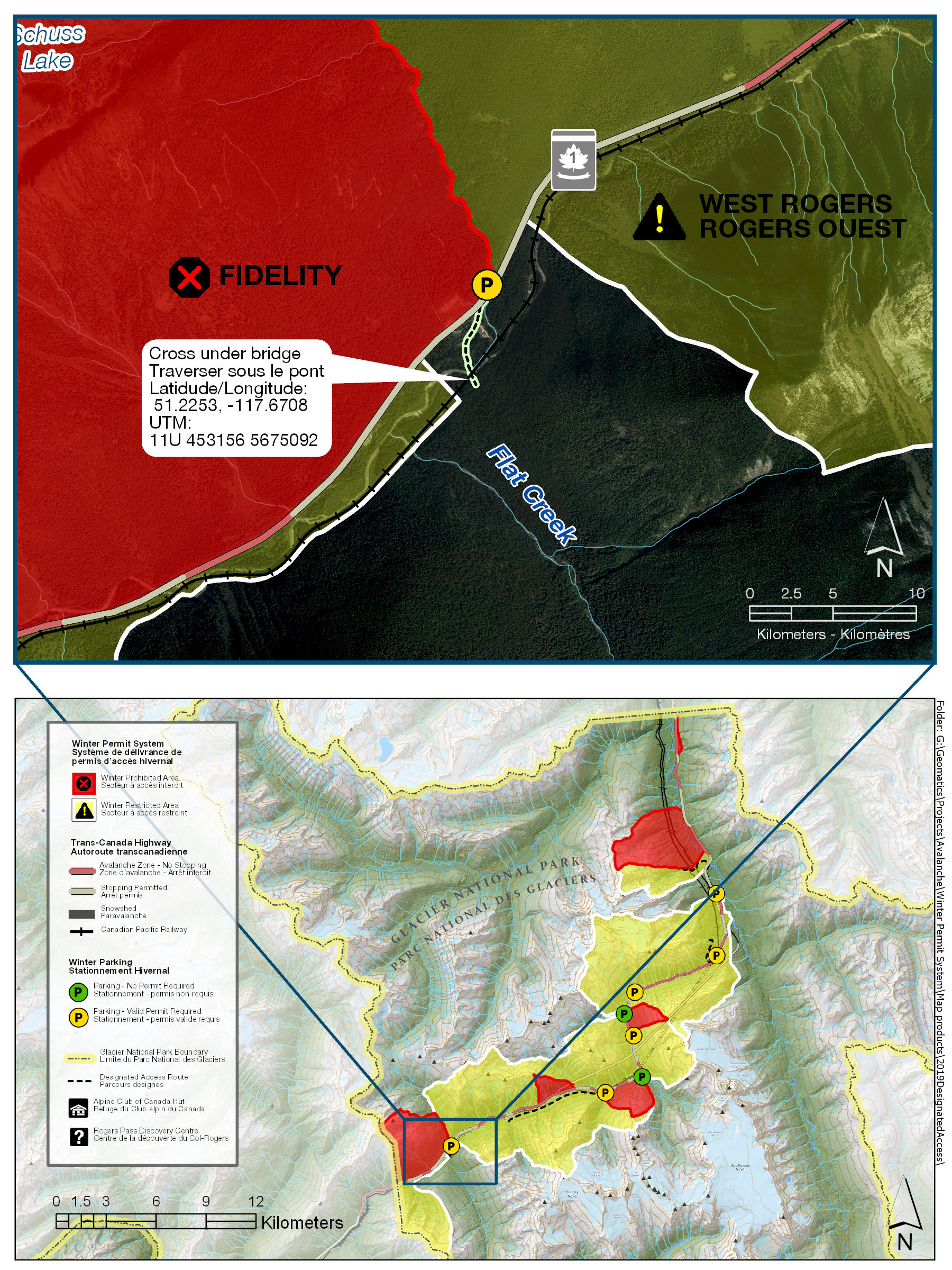
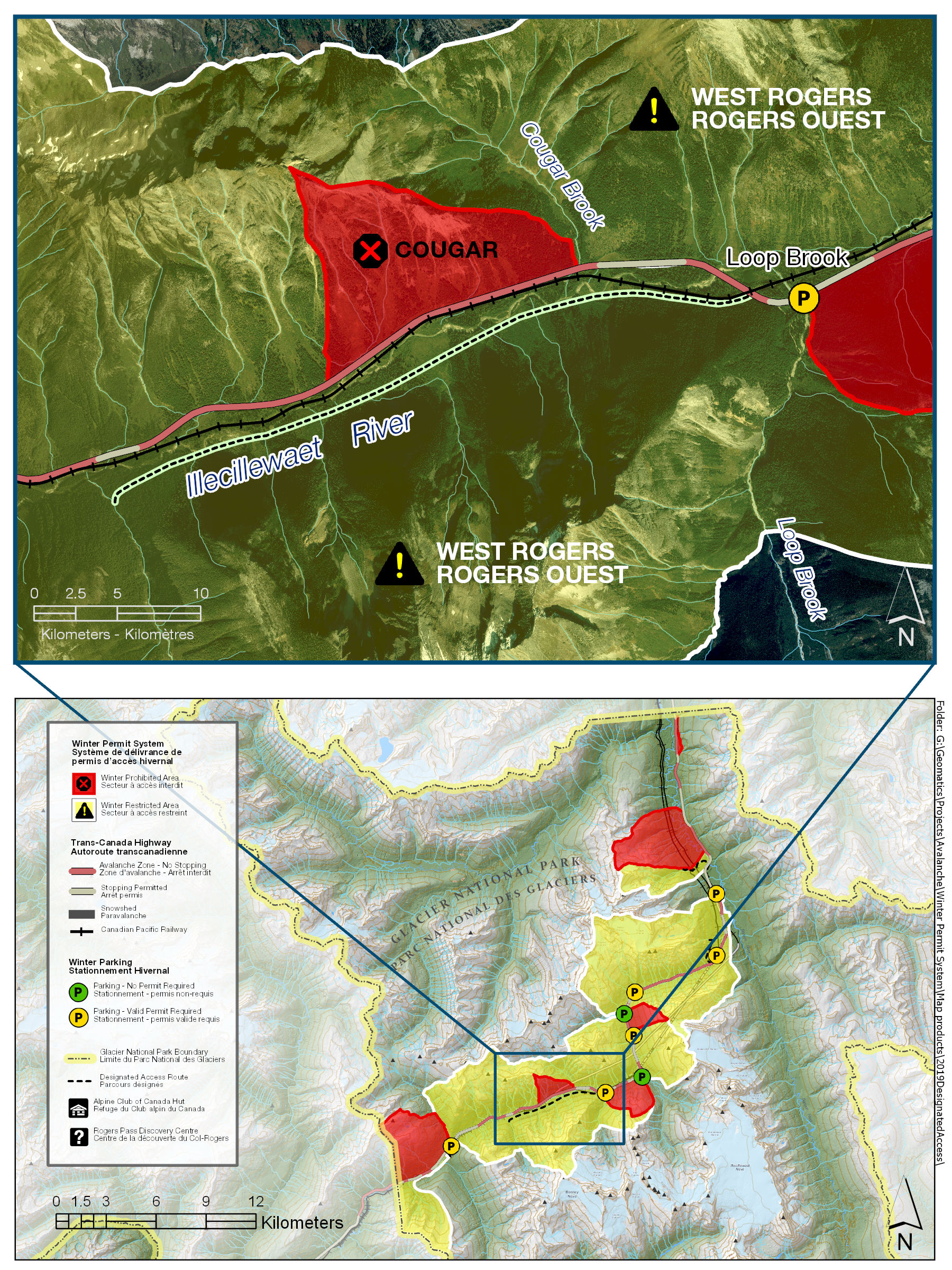
- Download Loop Brook Parking to Hermit Parking (PDF, 62.5 mb)
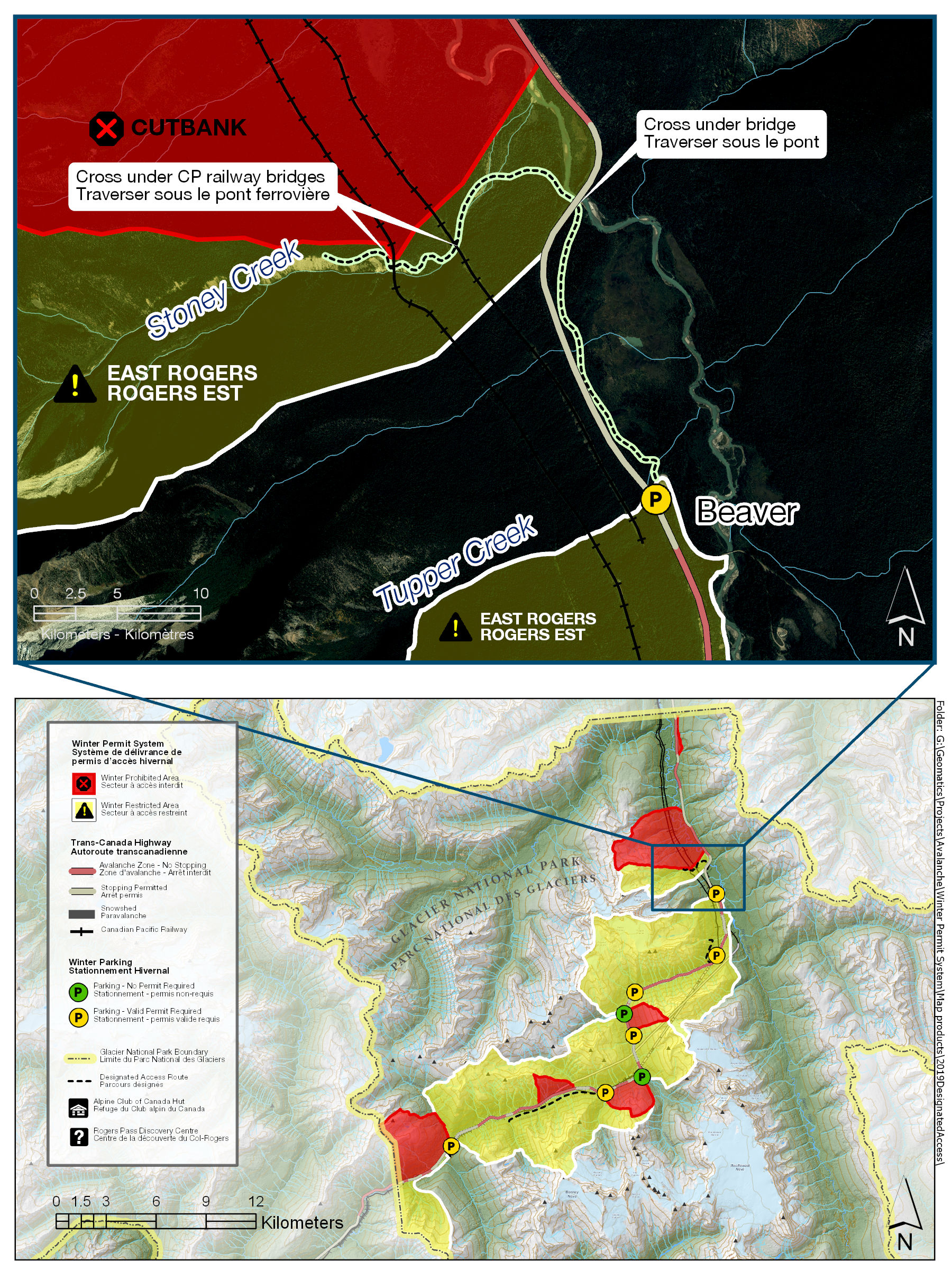
- Download Beaver Valley area (PDF, 62.3 mb)
- Download East Rogers to Cutbank (PDF, 104.9 mb)
Designated access routes
- Download Flat Creek Winter Unrestricted Area, Fortitude and West Rogers Winter Restricted Areas - from Bostock Parking (JPG, 1.2 mb)
- Download West Rogers Winter Restricted Area - Ross Peak from Loop Brook Parking (JPG, 1.4 mb)
- Download Shaughnessy Winter Restricted Area - from Beaver Parking (JPG, 1.2 mb)
- Download East Rogers Winter Restricted Area - Mount Tupper from Stone Arch Parking (JPG, 1.4 mb)
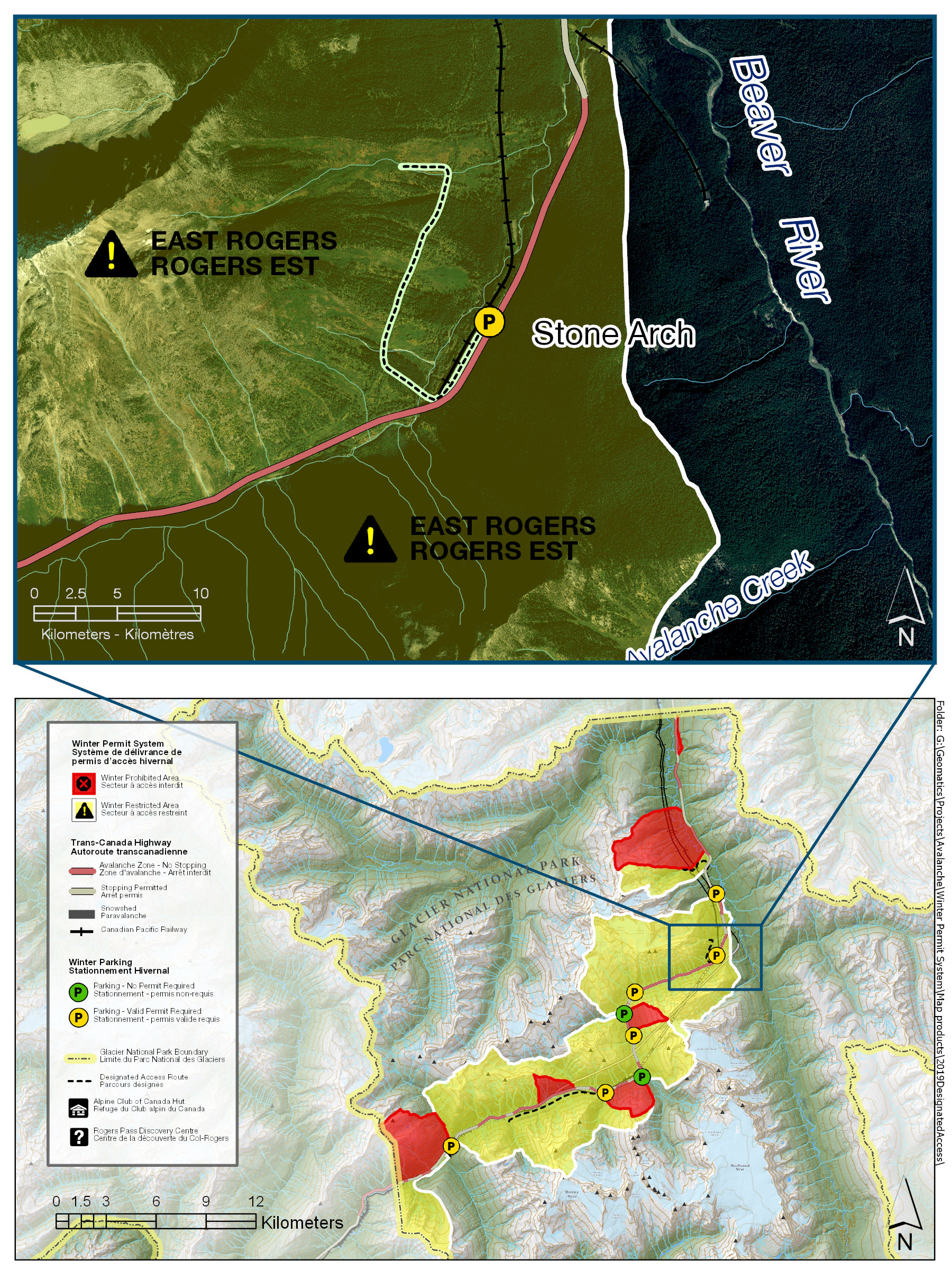
Note: Maps are georeferenced and can be imported into some mapping applications. You can also determine coordinates on maps by saving the PDF onto your desktop.
- Click on Tools Analysis Geospatial Location Tool.
- Choose Easting and Northing, or Latitude and Longitude by clicking on Edit Preferences Measuring (Geo) and choose from drop-down boxes in Geographic Location box.
Winter Permit System boundaries (geographic files)
Check back at the start of each winter season to ensure that you are using the most recent maps. Do not rely solely on these files for navigation as accuracy of mobile GPS devices and mapping applications may vary. It is your responsibility to know where you are and to respect the terms and conditions of the Winter Permit System.
Download Winter Permit System boundaries (KML, 357 kb)
Download Winter Permit System boundaries (GPX, 749 kb)
WARNING: This map file contains information about seasonal Winter Unrestricted Area, Winter Restricted Area, and Winter Prohibited Area boundaries in Glacier National Park and Rogers Pass National Historic Site. This file was prepared by Parks Canada on September 13, 2024 in light of the information available to it and considered to be true at the time of preparation.
The physical boundaries in Glacier National Park and Rogers Pass National Historic Site are neither marked nor maintained in any manner by Parks Canada. It is your responsibility to confirm that you are using the most up-to-date version of the maps. Do not rely solely on these files for navigation as accuracy of mobile GPS devices and mapping applications may vary. In case of discrepancy, the superintendent’s order on avalanche control prohibitions and restrictions posted in the Revelstoke Parks Canada Administration Building, Rogers Pass Discovery Centre, and at trailheads prevails.
Any use you make of these maps and any reliance on or decisions made based on these maps are your own responsibility absolutely. Parks Canada, its employees and its agents accept no responsibility for damages, if any, suffered by you or any third party as a result of decisions made or actions based on these maps. For greater certainty, under no circumstances whatsoever will Parks Canada, its employees, or its agents be held liable for any loss or damage that may occur to you and any person or persons or property by reason of your or their reliance upon these maps.
Designated access routes to cross Canadian Pacific Railway property
Public safety is Parks Canada’s primary concern. Access to the following areas has been established via routes that avoid crossing Canadian Pacific property. Canadian Pacific Police and Park Wardens patrol these sites and may charge individuals trespassing on CP property or tow and impound vehicles illegally parked on railway property.
- Shaughnessy Winter Restricted Area from Beaver Parking
- East Rogers Winter Restricted Area - Mount Tupper from Stone Arch Parking
- West Rogers Winter Restricted Area - Ross Peak from Loop Brook Parking
- Flat Creek Winter Unrestricted Area and Fortitude and West Rogers Winter Restricted Areas - from Bostock Parking
Professional guides
All guides that are planning to operate in Glacier National Park during the winter must:
- hold a valid National Park Business License
- display a valid national park pass, vehicle work permit, or commercial business pass while guiding clients*
Guides planning to enter a Winter Restricted Area (WRA) or a Winter Unrestricted Area (WUA) with clients must:
- apply for a blanket WRA/WUA guided group permit covering their clients under their winter permit for the season (conditions apply), or
- ensure that they, and all their clients, have a valid daily or annual winter permit
WRA/WUA guided group permit application packages are available on the ACMG website or by contacting Parks Canada at permit-MRG-permis@pc.gc.ca or 250-837-7500.
*Guides visiting the park in their personal time must display a valid national park pass in their vehicle. They can't use a vehicle work permit or commercial business pass.
Update for 2024: Glacier National Park has simplified the permit process for guided groups. Guides can now obtain a blanket, season-long permit. However, they must submit a list of clients' names for the day before each trip to comply with the new requirements. This change follows feedback from the guiding community to make the process more efficient.
Please note: As of April 2023, the ACMG group licence is no longer available. All guides or guiding businesses require their own National Park Business Licence. To learn more visit the Guided business licences website.
Youth groups and special events
Custodial (youth) groups
Parks Canada policies and regulations for custodial groups
Special events
If you are planning a workshop, camp, course, race, clinic, competition, festival or other special event in Glacier National Park, you must have a Special Event Permit. The permit is free and easy to obtain.
Please contact us at pc.mrg.information.pc@canada.ca or 250-837-7500 and provide us with the number of participants, number/names of guides and proof of liability insurance.
ACMG guides teaching AST or CAA courses do not require a Special Event Permit.
Film, photography and drones
Drones
The recreational use of drones is prohibited in all national parks. Leave your drone at home or in your vehicle. Find more information on flying drones at Parks Canada places.
Do you plan on filming or taking photos for professional purposes in Glacier National Park? Film and photography productions of any kind require a film permit unless approved through an alternative Parks Canada process.
Emergency contact information
Backcountry
Call 1-877-852-3100. Tell dispatchers you have a backcountry emergency in Glacier National Park and require assistance. Please note that cell service is not always reliable through the park.
Frontcountry
Call 911 for Police, Fire or Ambulance.
Other questions about the Winter Permit System
Please contact us by email at permit-mrg-permis@pc.gc.ca or by phone at 250-837-7500.
Where can I ski today?
Rogers Pass interactive map
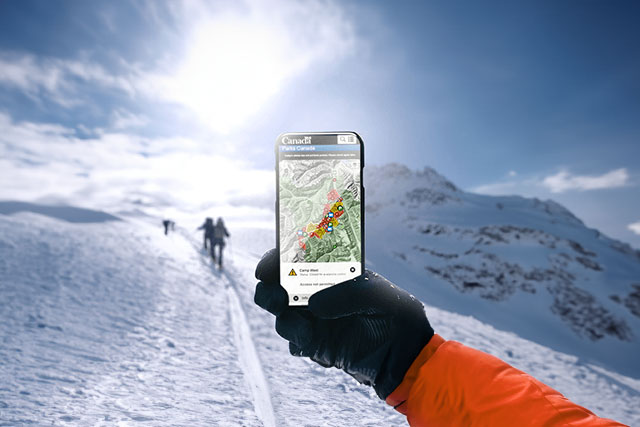
Get real-time updates on which Winter Restricted Areas are open with the Rogers Pass Backcountry Access interactive map. The map also provides geo-location on GPS-enabled devices and access to avalanche forecasts and webcams.
Winter Permit System boundaries (geographic files)
Check back at the start of each winter season to ensure that you are using the most recent maps. Do not rely solely on these files for navigation as accuracy of mobile GPS devices and mapping applications may vary. It is your responsibility to know where you are and to respect the terms and conditions of the Winter Permit System.
Plan your touring route
Avalanche Bulletin
Check today's Avalanche Bulletin before heading into the backcountry.
Designated access routes
Access to certain areas has been established via routes that avoid crossing CP property.
Weather and webcams
See Glacier National Park's webcams and today's weather forecast for Revelstoke and Golden.
Winter Terrain Atlas
The Winter Terrain Atlas provides valuable visual terrain information to backcountry users of Mount Revelstoke and Glacier national parks.
Avalanche terrain maps
These maps outline the major runout zones and terrain traps in 5 popular areas.
Avalanche Terrain Exposure Scale
The Avalanche Terrain Exposure Scale, developed by Parks Canada, offers an avalanche classification system based on the landscape, not the snow.
Related links
- Date modified :