
Caribou research and monitoring
Jasper National Park
On this page
How many caribou are in Jasper National Park? | What can we learn from monitoring caribou? | Counting caribou | Ecological conditions | Research projects
How many caribou are in Jasper National Park?

-
Map description
A map of Jasper National Park and northern Banff National Park, showing the relative proportion of caribou using habitat in the national parks and the approximate population sizes. In the north, the À la Pêche population is estimated at 150 or more caribou. In the south, the Tonquin population is estimated at 50 caribou, and the Brazeau population has less than 10 caribou. No caribou remain in the Maligne or Banff populations.
There are 4 caribou populations with habitat in Jasper National Park: the Maligne, Brazeau, Tonquin and À la Pêche. Since the 1970s, mountain caribou populations in Alberta and British Columbia have gotten smaller and some have disappeared – including the Maligne population.
Parks Canada currently monitors the Brazeau and Tonquin caribou populations. They have had low but stable numbers since 2015. Fewer than 10 caribou have been counted in the Brazeau caribou range for many years. There are an estimated 50 caribou in the Tonquin caribou range (Parks Canada 2022).
The partially migratory À la Pêche population is primarily managed and monitored by the Government of Alberta. There are an estimated 150 caribou in the À la Pêche caribou range (Government of Alberta 2018).
The most recent caribou population estimates in Jasper National Park:
| Tonquin | 47 to 54 (minimum count 44) |
8 to 13 |
| Brazeau | fewer than 10 (minimum count 4) |
0 to 3 |
| Maligne | 0 | 0 |
| À la Pêche | 142 to 162 (minimum count 139) |
No estimate |

Population abundance and trends are expressed as minimum counts for the Brazeau, Maligne and Tonquin caribou ranges 2007–22. Also shown are Tonquin scat estimates and Tonquin population estimates from an Integrated Population Model (IPM) 2007–22. Error bars are 95% confidence intervals and the orange region is 95% credible intervals for the IPM estimate.
What can we learn from monitoring caribou?

In the northern part of the globe, caribou are honoured and respected by many Indigenous peoples. Caribou play a key role in supporting healthy, balanced ecosystems. The old-growth forests and sensitive sub-alpine and alpine habitats where they live have evolved with caribou on the land.
Some Indigenous peoples with historical ties to what is now Jasper National Park have close cultural and spiritual connections to caribou. Indigenous ceremonies and perspectives help guide our understanding of caribou. Parks Canada collaborates with Indigenous partners on caribou recovery and continues to learn from Indigenous ways of knowing.
Parks Canada has an ongoing monitoring program to collect information about wildlife including caribou, deer, elk and wolves. This information helps us understand the interactions between these animals, how they use habitat in the park and trends in their populations over time. Regular reports provide detailed results from the monitoring program.
Counting caribou
Since its establishment, Jasper National Park has monitored caribou and other wildlife populations using tools that were available at the time. A dedicated caribou monitoring program began in 2001 for the Maligne, Brazeau and Tonquin caribou ranges.
Indigenous, archaeological and written records
Indigenous knowledge holders and archaeological researchers have identified the coexistence of humans and caribou in this area for thousands of years. A radiocarbon-dated caribou antler found melted out of an ice patch shows that caribou have existed here for at least 1300 years.
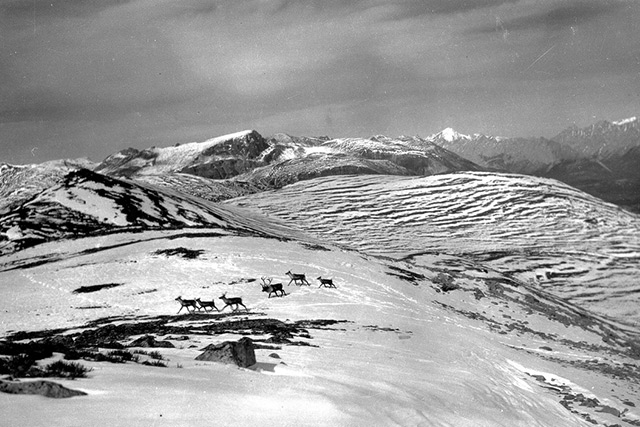
Caribou in the Bald Hills of the Maligne Valley in Jasper National Park (1950).

A caribou antler found near a melted ice patch in a high mountain pass near the Tonquin Valley in Jasper National Park (2018). Credit: Aaron Osicki
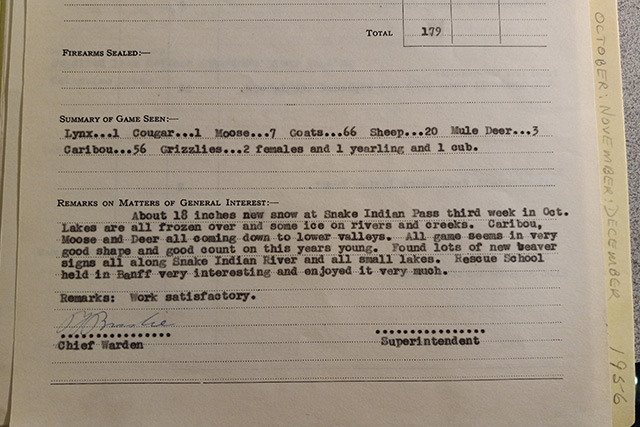
A park warden’s report of wildlife seen in the Snake Indian River Valley (1956). In addition to lynx, cougar, moose, goats, sheep, mule deer and grizzlies, the park warden saw 56 caribou.

Caribou habitat in the Maligne caribou range (1974). Credit: John G. Stelfox and John A. Bindernagel of the Canadian Wildlife Service.
Written records go as far back as 1857. European explorer James Hector of the Palliser Expedition referred to “large bands” of caribou and areas “thick with caribou.” In 1974, John G. Stelfox, a wildlife biologist and researcher for the Canadian Wildlife Service, estimated that there were at least 200 and as many as 650 caribou in the southern areas of Jasper National Park between 1915 and 1973. Occasional surveys in the late 1980s and mid-1990s indicated that there were approximately 150 to 200 caribou in the Jasper and Banff national parks. Since then, the population has dropped to less than 100.
-
Limitations
Some oral and written histories are not known to Parks Canada or have been lost over time.
Aerial survey
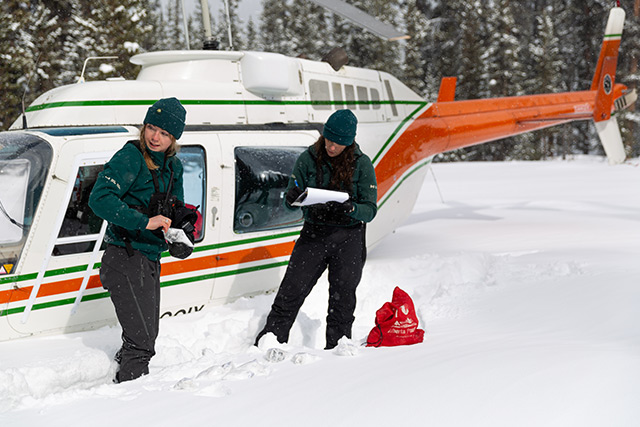
Each year, biologists survey caribou by flying over caribou habitat in a helicopter and counting the number of caribou they see. The survey happens in the fall when caribou gather in larger groups for the rut (mating season). Biologists wait until there is snow on the ground so caribou and their tracks are easier to see.
From this survey, biologists collect information about the minimum number of caribou observed including the number of calves, males, and females. This data is critical to helping us understand how the population is changing.
-
Limitations
When surveying caribou from the air, both weather and geography limit our ability to see caribou in a vast landscape. The small size of the populations also makes them more difficult to find. The area surveyed is typically between the tree line and mountain tops; caribou are more easily found there than below the tree line where they are hidden by the trees. Even with good survey conditions and techniques, it is unlikely we will see 100% of the population. To account for those caribou we do not see, we use statistical techniques to estimate population size.
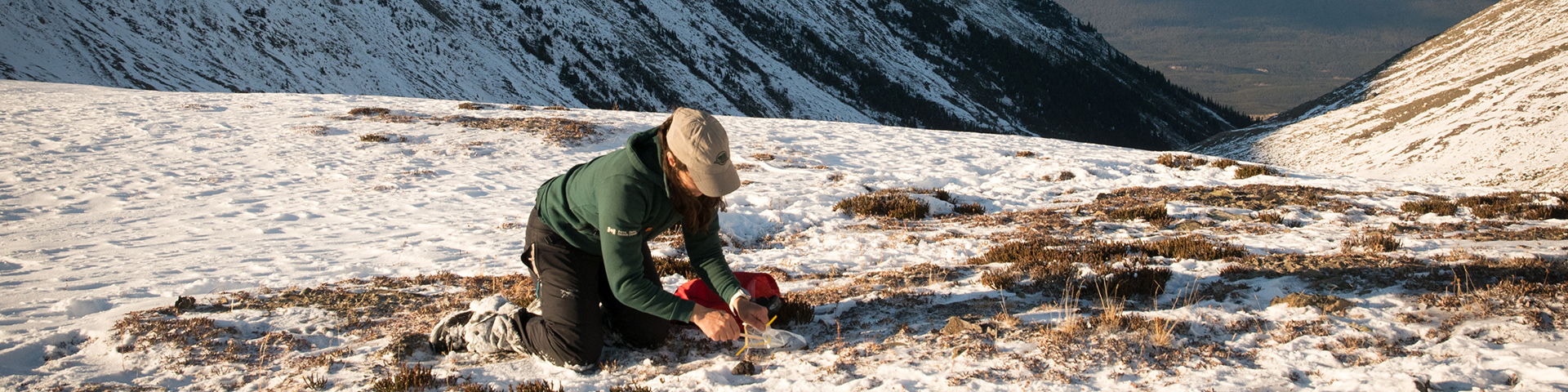
Parks Canada biologists record the location and number of caribou scat samples collected during a winter survey.
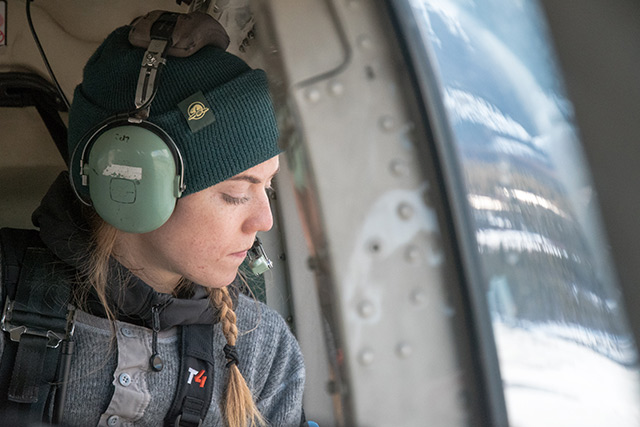
A Parks Canada biologist looks out the window of a helicopter, surveying for caribou from the air.
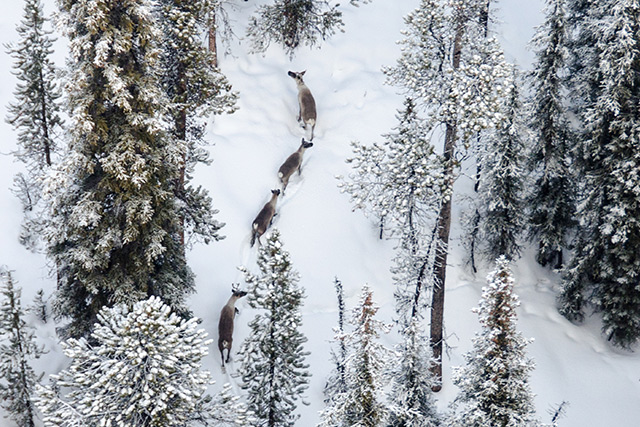
Four mountain caribou seen during an aerial survey. Biologists take photos of the animals to later classify them as male/female and calf/yearling/adult.
Scat collection
Investigating animal scat (or poop) is a great way to get extensive information without bothering the animals much. During the yearly aerial survey, biologists look for tracks and places where caribou have left behind holes or depressions in the snow while foraging for food. They stop to collect samples of caribou scat and then bring them back to a laboratory for analysis. We collect more than 150 caribou scat samples each year.
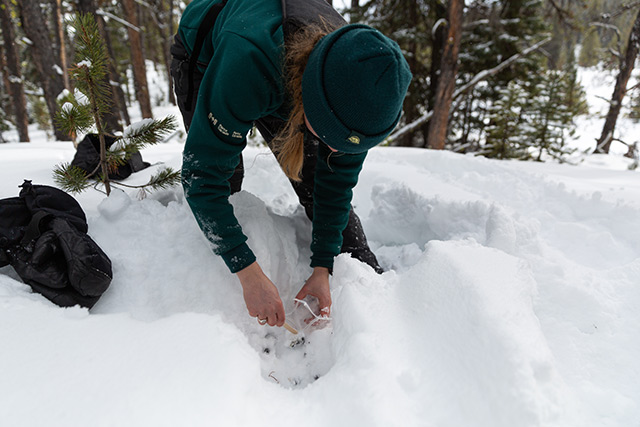
A Parks Canada biologist collects a sample of caribou scat. The biologist uses a popsicle stick to gather caribou scat and snow into a plastic bag. The samples are then flown directly to a freezer to preserve the DNA until the scat can be processed.

A Parks Canada biologist processes caribou scat samples in a lab. The biologist collects a sample of the mucus on the outside of the frozen fecal pellet. Each sample is labelled and sealed, then sent to a partnering lab for analysis.
Extracting DNA from frozen caribou scat allows us to identify individual caribou by analyzing their genetic makeup. Over time, this information is used to estimate with more confidence the number of caribou in the park, their ages, the ratio of males to females and the minimum number of reproductive females. Collecting scat from individual caribou over multiple years also helps us to know about caribou survival, the appearance of new caribou in the park, and movements between different populations.
-
Limitations
Scat DNA takes time to collect, process, genotype and run through statistical models, which means the results are typically delayed by a year. It is possible to miss the scat of individual caribou when collecting scat in the field. To help account for this, we use statistical models to estimate the caribou we are not able to collect scat from.
Radio and satellite collars
Radio telemetry and satellite collars collect location data and send this data to biologists. Jasper National Park used two types of radio telemetry collars to monitor caribou between 2003 and 2010. Parks Canada moved to less invasive monitoring techniques like scat DNA analysis and remote cameras in 2010.
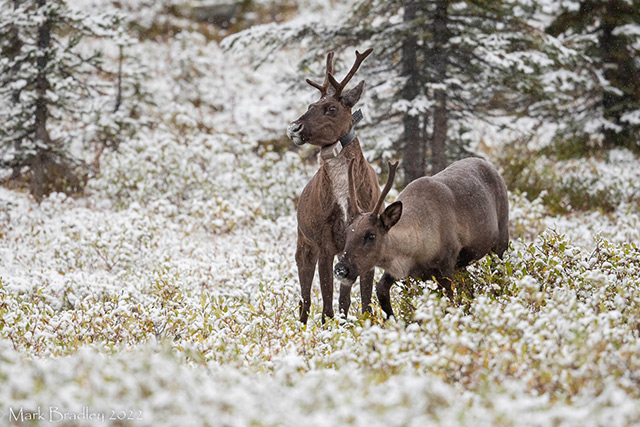
Two antlered caribou in a snowy woodland landscape. One caribou is wearing a satellite-based GPS collar. Credit: Mark Bradley
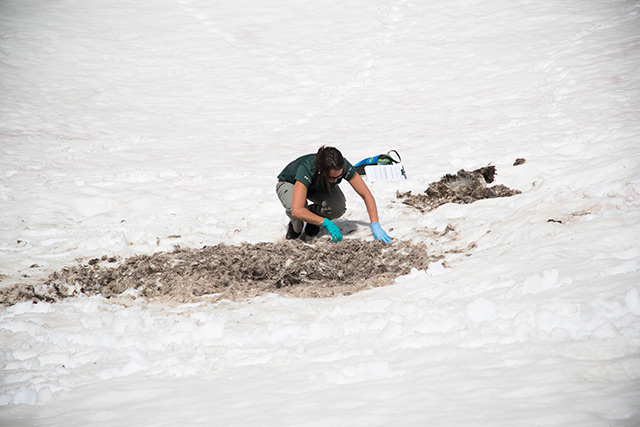
A Parks Canada biologist examines a collared caribou carcass scavenged by a wolverine at a high elevation.
Radio collar technology has continually improved and now has quicker notifications about movements and mortalities. In 2021, Parks Canada began to use satellite-based GPS collars to monitor adult females in the Tonquin population. These collars will help us better understand how, when and where female caribou die. This information could help Parks Canada prevent deaths in a critically small caribou population and will be valuable for Parks Canada’s new conservation breeding program.
-
Limitations
Cameras do not capture images of all animals in an area, since the animal must walk past the camera. It is important to find places for cameras in an area where animals are likely to pass by.
Remote cameras
Jasper National Park has a network of over 100 remote cameras to learn how animals use their habitat and where they spend their time. When wildlife moves past a remote camera, their motion is detected and the camera takes a series of photos.
In addition to monitoring how caribou use their habitat, remote camera images can identify individual females by their antler patterns, confirm the minimum number of female caribou in the park and identify the presence of new caribou calves.
-
Limitations
Cameras do not capture images of all animals in an area, since the animal must walk past the camera. It is important to find places for cameras in an area where animals are likely to pass by.
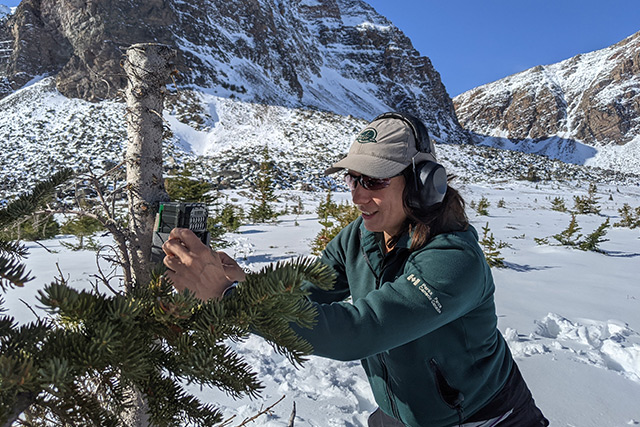
A Parks Canada biologist installs a remote wildlife camera in caribou habitat in Jasper National Park.
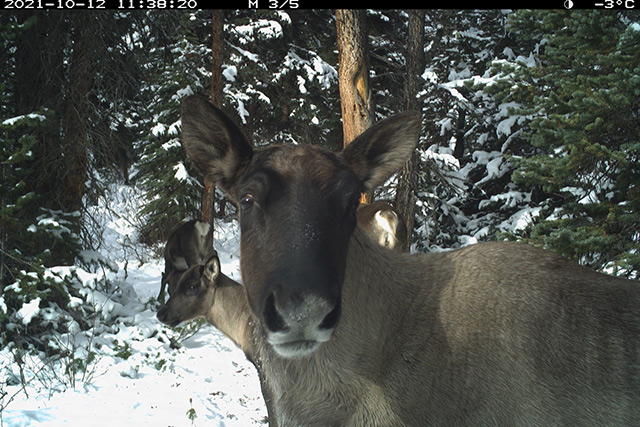
Remote camera image of three mountain caribou in the À la Pêche caribou population in Jasper National Park.
Ecological conditions
Wolf monitoring
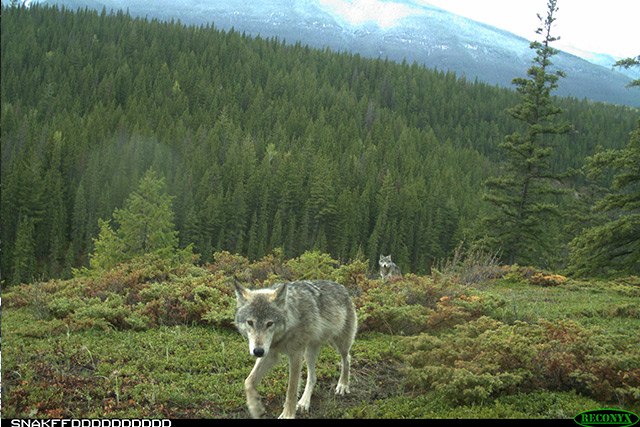
Remote camera image of two wolves in Jasper National Park.
We use remote cameras, radio telemetry and satellite collars in Jasper National Park to monitor wolf density (the number of wolves in a 1000 km2 area). In addition to monitoring how much time wolves spend in caribou habitat, we can also determine the number of wolves in a pack and identify individual wolves and unique wolf packs by the colours and markings on their fur.
Wolf density is a significant factor influencing caribou population trends. Wolf density in Jasper National Park is estimated to be 1.9 wolves per 1000 km² (2021—22 estimate) compared to 3.4 in 2011 and 6.2 in 2004. This number is sufficiently low to support self-sustaining caribou populations.
Investigating the remains of animals killed by wolves helps us understand what wolves are eating and how often they prey on caribou. Several months of GPS location data is collected from collared wolves to identify potential kill sites. Biologists then survey the sites and search for signs of carcasses. Many different carcasses have been found at these sites including deer, elk, moose, caribou, marmots and bears. The most common prey at these sites is deer but this varies among different wolf packs.
Deer monitoring

Remote camera image of a mule deer in Jasper National Park.
Deer and caribou are ungulates that share many of the same predators. Research across Canada has shown that disturbances to the landscape that create more grazing habitat for animals like deer have the potential to lead to increasing populations of deer. This is followed by increasing populations of wolves which eventually negatively impacts caribou populations. Monitoring deer is important to understanding population trends among prey species that might lead to increases in the wolf population.
Remote camera images of mule deer and white-tailed deer are being used to estimate deer density and deer population trends in the area surrounding the Jasper townsite. Parks Canada is studying how deer are using habitat that was heavily disturbed by a mountain pine beetle outbreak, both before and after much of the mature forest was thinned for community protection in 2017 and 2018.
Research projects
-
How many caribou are in the Tonquin population?
University of Montana
Parks Canada collaborated with the University of Montana to develop an Integrated Population Model (IPM) using caribou data from Jasper National Park.
The IPM is an advanced statistical model that combines all of the data Jasper National Park has collected since 2003 to calculate an annual population estimate for Tonquin caribou. By using the model, we can get more exact information about population trends, the number of female and male caribou, their ages, and survival and reproductive rates. The IPM also gives a more precise estimate of population trends than any other population-monitoring method alone.
The Brazeau (and previously Maligne) population is too small to use statistical modelling like the IPM. However, we can use aerial surveys and scat DNA analysis to estimate the minimum number of caribou in these populations.
-
How variable is caribou DNA in Jasper? What populations are most genetically similar?
University of Calgary
Using caribou tissue samples, partnering scientists at the University of Calgary (Maria Cavedon and Marco Musiani) studied the genes of southern mountain caribou in and around the Jasper region. These new methods for studying caribou DNA allow us to understand individual caribou in greater detail. They also provide information about the genetic diversity among southern mountain caribou in Alberta and British Columbia.
Caribou elsewhere in Alberta and British Columbia that share similar genetics and behaviour with caribou in Jasper have the potential to support Parks Canada’s conservation breeding program. Results show that populations like the À la Pêche and Columbia North have medium to high levels of genetic diversity. Parks Canada is working with the governments of Alberta and British Columbia to confirm potential source populations that would be suitable and not significantly affected by a small number of caribou being moved into the conservation breeding program.
-
Why do female caribou have antlers?
University of Cincinnati
Males of nearly every deer species (including moose, elk and mule deer) produce antlers, but female caribou are the only female deer species to also grow antlers. Surprisingly, while most male caribou grow and shed antlers every year, the number of females within a population that grow antlers is highly variable; ranging from 3% to 98% across North America. Does the percentage of antlered females within a single caribou range change through time and, if so, what is driving that change?
Using photographs of caribou taken during annual surveys by Jasper National Park, partnering scientists at the University of Cincinnati (Maddie Gaetano and Joshua Miller) are counting the number of female caribou in Jasper that grow (and do not grow) antlers each year. They then compare the numbers of antlered females to shifts in climate and population demographics to evaluate potential drivers behind annual variability in female caribou antler production. This research adds to our understanding of how female caribou benefit from growing antlers and provides hints as to what promoted their novel evolution in the first place.
-
Do microbes from different diets influence caribou health?
University of Alberta
The microorganisms that live in an animal's gut play an important role in digestion and overall animal health. By comparing the communities of microbes that live in the guts of caribou with different diets, a team of researchers at the University of Alberta is exploring how microbes might influence the relationship between diet and health in these animals.
The team at the University of Alberta is specifically comparing deep-snow caribou from British Columbia (which eat arboreal lichens), caribou from Jasper National Park (which mainly eat terrestrial lichens), and caribou from different penning or captive breeding programs. Their research will hopefully contribute to the conservation of this iconic species.
-
What environmental changes can we discover from artifacts found in melting alpine ice patches?
Archaeological Survey of Alberta, Royal Alberta Museum, University of Alberta and MacEwan University
In 2009, a wooden shaft was discovered near a melting ice patch close to the western boundary of Jasper National Park. Following this discovery, surveys of other ice patches resulted in findings of additional artifacts and remains including a strip of knotted leather, a bison bone and a caribou antler – ranging from 2500–270 years ago. Radiocarbon dates from antlers found in similar situations suggest that caribou have been using ice patches – to keep cool in hot weather and avoid bothersome insects – for thousands of years.
Artifacts frozen in the ice can be thousands of years old yet excellently preserved as if it was left only a year or two ago. Once melted from the ice, exposure to the environment can quickly affect the quality and decomposition of the artifact. For this reason, it is essential to identify key findings soon after they are exposed. Parks Canada is cooperating and collaborating with the Archaeological Survey of Alberta, Royal Alberta Museum, University of Alberta and MacEwan University to better understand ice patch and palaeo-environmental evidence and ecosystem changes through time.
- Date modified :