
Paragliding and hang gliding
Banff National Park
As of May 23, 2025, non-motorized paragliding and hang gliding are permitted in Banff National Park on a three-year trial basis under specific conditions. To support this trial, Banff National Park has established a set of site-specific conditions. These are designed to help pilots enjoy a safe and successful flight experience in the park, while also protecting ecological values, minimizing impacts on wildlife, and avoiding potential conflict with other visitors.
All pilots must review these conditions in advance and follow the relevant procedures and requirements while flying in Banff National Park.
What is paragliding and hang gliding?
Paragliding and hang gliding are forms of mechanically assisted flight using a specialized parachute with a harness or a fixed wing and rigging, as governed by Canadian Aviation Regulations (CARs).
Activity conditions | Areas where launching and landing are permitted | Map | Safety | Emergency
Activity conditions
- Pilots must be certified members of the Hang Gliding and Paragliding Association of Canada (HPAC) to fly in the park and must carry proof of membership when flying in the park.
- Pilots are required to log each flight on the HPAC Banff National Park Pilot Log including the following data points:
- trailheads/trails pilots accessed for the launch site, dates of flights, number of flights if multiple flights were taken by a pilot in a single day, number of pilots when flying in a group, pilot origin, and type of flight (hang gliding or paragliding).
- fllight path (GPX file)
- HPAC will provide amalgamated logs and flight data to Parks Canada annually.
- Motorized or towed launches are not permitted.
- Commercial activities/flights or special events are not permitted.
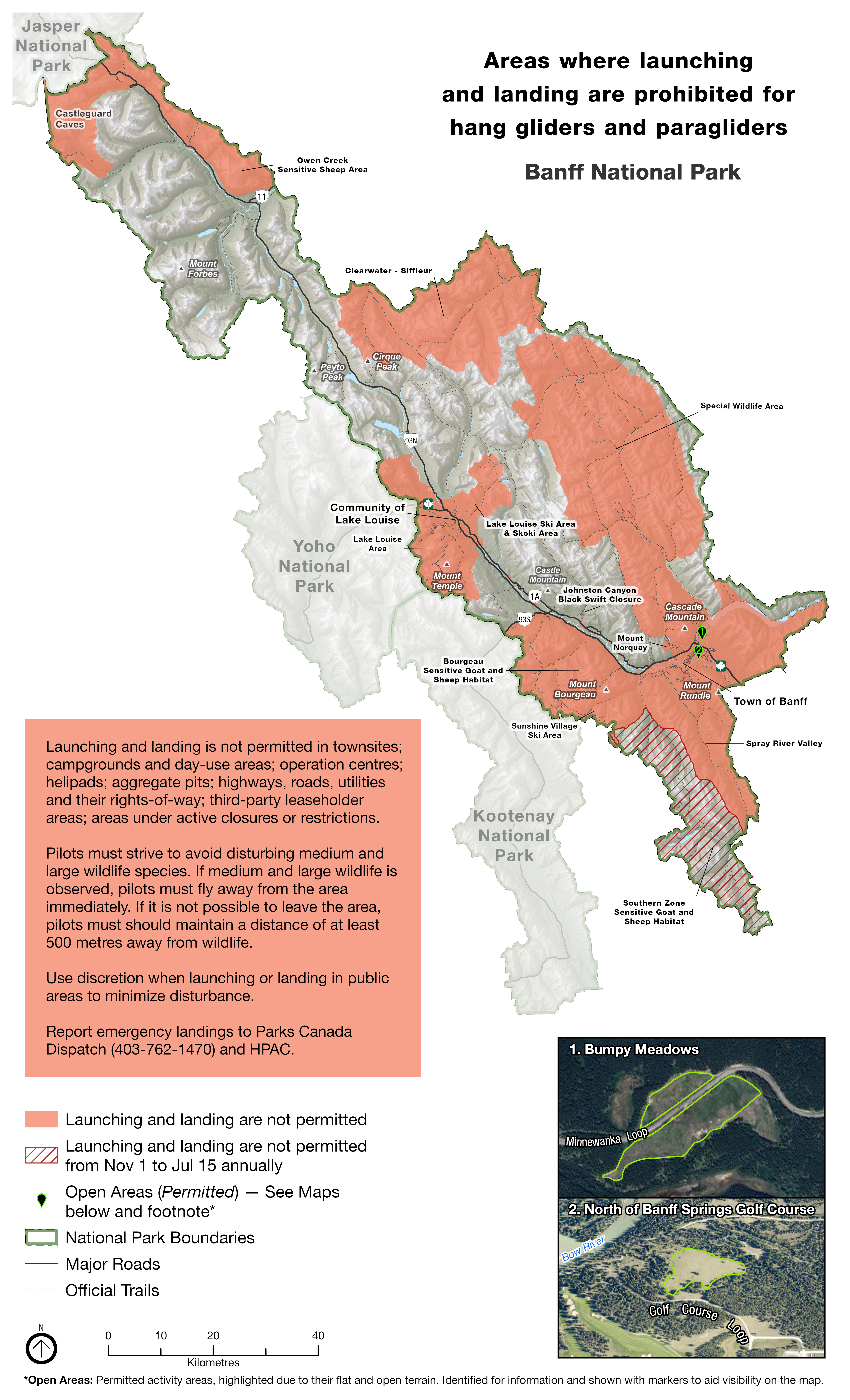
- Some areas of Banff National Park are prohibited to launching and landing, see restricted activity order map.
- Pilots must use designated trails to access launch sites.
- Groups must not exceed 10 individual pilots at one time.
- Pilots should use discretion when launching or landing in public areas and avoid landing in areas that are crowded.
- Pilots must avoid disturbing medium and large wildlife species. If medium and large wildlife is observed, pilots must fly away from the area immediately. If it is not possible to leave the area, pilots must maintain a distance of at least 500 metres away from wildlife.
- Raptors and other birds have been known to fly with paragliders. Pilots must not interfere with or chase airborne birds.
- Pilots may use a helmet camera or other mounted camera during flight. Taking off or landing of a drone is restricted within Banff National Park.
- Emergency landings are permitted in accordance with Transport Canada and Parks Canada regulations. Emergency landings must be reported to Parks Canada Dispatch (403-762-1470) and to HPAC, as per the established HPAC protocol.
Areas where launching and landing are prohibited
Parks Canada has identified areas within Banff National Park that are prohibited to launching and landing by paragliders and hang gliders due to sensitive ecological areas and wildlife, public safety, and/or high visitor use areas.
Launching and landing is not permitted in the following areas in Banff National Park:
- Townsites (Village of Lake Louise, Town of Banff).
- Campgrounds, day-use areas, and parking lots.
- Active aggregate pits, operation centres and helipads.
- Highways, roads, utilities, and their rights-of-ways.
- Third-party leaseholds, including ski areas.
- Zone 1 special preservation areas (included in restriction map).
- Environmentally Sensitive Sites (included in restriction map).
- Important goat and sheep areas (included in restriction map).
- Respecting all active area closures and restrictions (superintendent orders).
Map
Safety
Remember, you are responsible for your own safety.
- Always wear proper safety gear.
- Know your equipment and ensure it is in working condition.
- Plan your flight beforehand and know your flight plan.
- Check for active area closures or restrictions.
- Be aware of the weather forecast and monitor weather conditions.
- Tell someone of your planned route (where you are going) and expected return time.
For more safety information, visit HPAC
Emergency
In case of an emergency, call 911 (will not work on a satellite phone) or call Parks Canada Emergency Dispatch at 403-762-4506. Cell phone reception is unreliable in Banff National Park. Report emergency landings to Parks Canada Dispatch (403-762-1470) and HPAC.
- Date modified :