
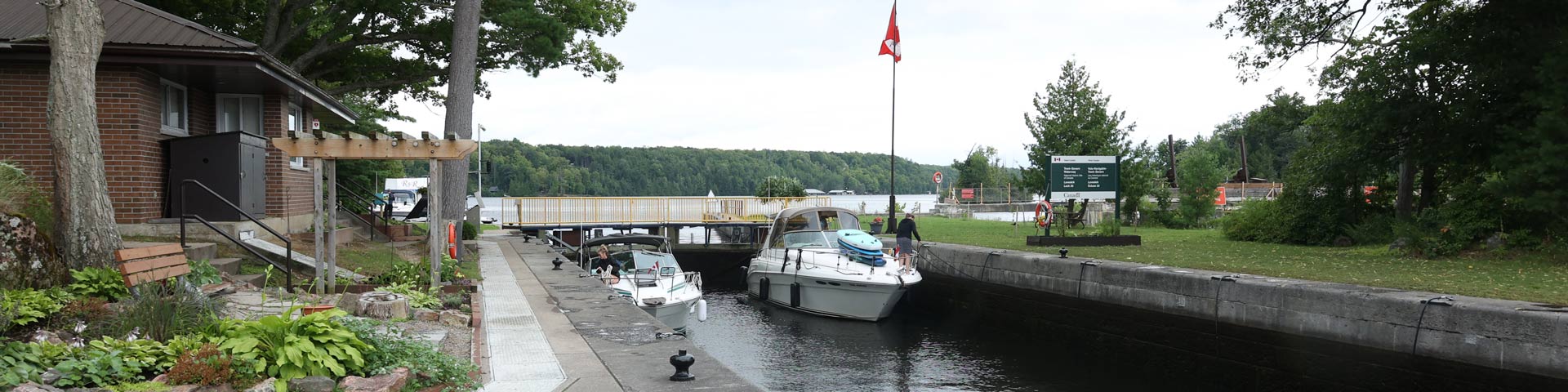
Locking through safely
Trent-Severn Waterway National Historic Site
Learn all the techniques of this historic tradition, including an easy step-by-step process for travelling through the locks.
What is a lock?
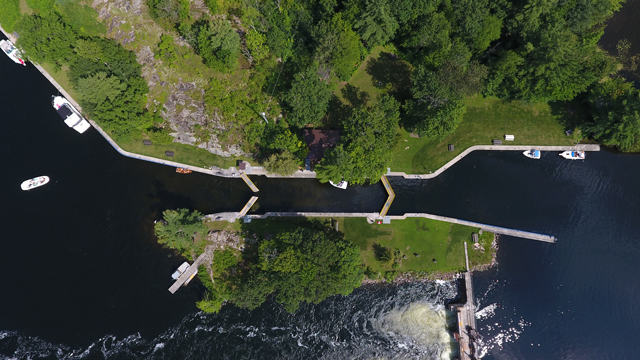
Locks are designed to raise and lower boats from one water level to another. They were built over a hundred years ago, along with a series of dams, to bypass rapids and waterfalls. In some locations, two or more locks are joined together to overcome greater changes in water levels.
At Peterborough and Kirkfield on the Trent–Severn Waterway, hydraulic lift locks raise and lower boats in water-filled chambers counter-balanced on huge pistons. At the Big Chute Marine Railway on the Severn River, a three-storey tall carriage transports boats cradled in specially designed slings over a height of land.
How do locks operate?
- If you are heading upstream, the water in the lock chamber begins at the same level as the downstream channel
- The lock gates are cranked open with either hand winches or electrical power, and then boats proceed into the lock chamber
- Once inside, the lower gates are cranked shut, and the valves in the lower gates are closed; the chamber is now watertight
- The lock staff then open the upper sluice valves to allow water to enter from the upstream side
- This water gradually fills the lock, raising the boats, until they are at the same level as the upstream water
- Finally, the upper gates are opened and you can leave the lock chamber, proceeding slowly (10km/h) and watching out for other boaters and paddlers
- If you are heading downstream, things happen in the reverse order
How to travel through a lock
Transcript
Boating on the historic canals and waterways in Ontario is an unforgettable experience that weaves its way through Canadian history and stunning natural landscapes It makes for the perfect family vacation or peaceful weekend getaway, with charming towns and villages waiting to welcome you around every bend.Locking through is easy to learn and friendly Parks Canada staff are there to guide you.
There are four basic steps to follow when locking through. Approaching the lock. Entering the lock. The procedure to follow once you are inside the lock chamber. And exiting the lock.
Follow these simple steps and be sure your visit to the Trent Severn-Waterway and Rideau Canal is both memorable and safe.
Remember that you must obey any posted speed limits between the locks or on the open water.
You must slow your boat down to a no wake speed when approaching a lock.
There are several reasons for this. Excessive wake can erode the shoreline. It can also create dangerous conditions for lock staff and potentially cause damage to other boats docked at the approach to the lock.
When approaching a lock, be aware that wind or currents may affect the control of your watercraft.
Turbulence may be created below the lower gate of a lock, so stay alert for changing conditions.
The area indicated by the painted blue line above and below each lock is the temporary holding area for boats wanting to lock through.
Tie up here only if you intend to pass through the lock as soon as possible, and the lock is not open.
The lock staff have many duties to perform throughout their day.
Please be patient if they are not able to lock you through immediately.
You may be directed to proceed directly into the lock chamber by lock staff.
It is important to remember that during the entire locking through process, you are under the direction of the Lock operations staff.
Please watch for their hand signals and listen for their verbal commands.
When directed by the lock staff.
Enter the lock straight and under control. Use a paddle or boat hook to keep off the side of the lock.
Never use your hands or feet to fend off your boat from the lock, as serious injury may occur.
If possible, have a crew member at both the bow and stern with mooring lines ready.
The lines should be free of knots.
Once your boat is in position in the lock chamber, loop the bow and stern lines around the black drop cables.
Do not tie the lines to the cables. Once you are in position in the lock chamber with your lines looped. Follow these procedures as indicated by the posted signs.
Turn off all ignition switches, such as engines and generators.
Extinguish all open flame appliances, including pilot lights, gas burners, and barbecues. Do not smoke above or below deck.
Leave the bilge pump blower on throughout the locking procedure.
Tend your lines carefully while locking through.
Never leave your lines unattended.
When the lock operation is completed, wait for the lock staff to direct you to restart your engine.
Bring all bow and stern lines back onto your vessel and make sure they are secure.
Exit slowly according to the directions of the lock staff.
This will usually be done in order, but lock staff may issue other instructions when exiting the lock chamber.
Be aware of other boats in the area.
Also, be aware that wind and currents can affect the control of your watercraft.
Maintain control at all times.
throughout your boating adventure, there may be times when you encounter a unique lockage situation.
At swing bridges, wait until the bridge is fully open before proceeding.
Travel slowly and single file.
Always giving way to vessels traveling downstream.
Flight locks, lift locks and marine railways may also be part of your journey.
These special pieces of historic engineering captivate the imagination.
But don't be intimidated.
For the most part, boaters follow the same locking procedures.
And if you need assistance.
Parks Canada lock staff will be there to welcome you through.
Again, watch and listen for their instructions upon arrival.
Following these basic instructions will help make sure your journey on the historic canals and waterways in Ontario is both safe and memorable.
Bon voyage!
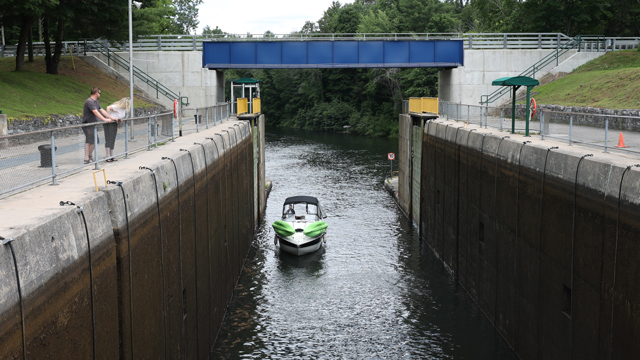
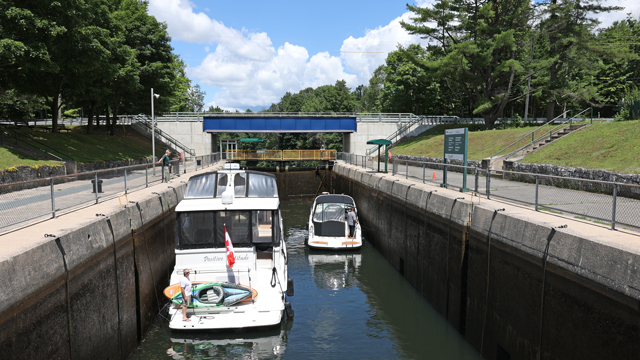
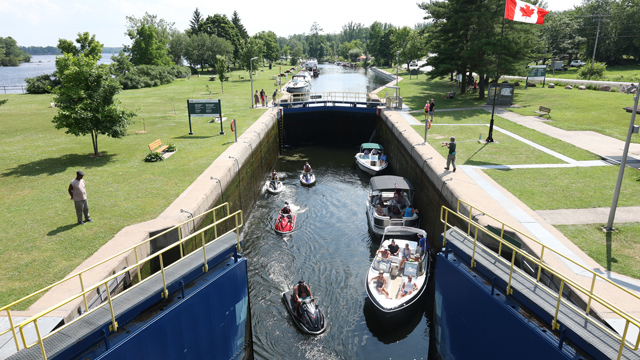
Locking through safely involves four basic steps outlined below. Friendly lock staff are also available on site to help make your locking experience an easy and enjoyable one. At some lock stations, and especially at Big Chute, instructions are often given over a P.A. system. Wait at the blue line until directed to proceed and then follow the operator’s instructions.
Step 1: Approaching the lock
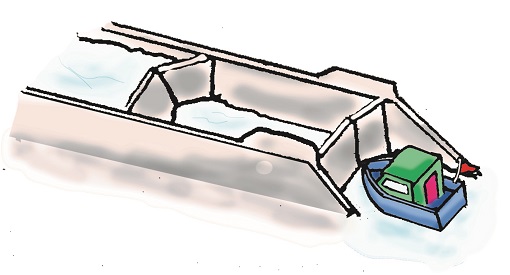
Obey any posted speed limits between locks or out on the open water. Slow your boat down to a ‘no wake’ speed. Excessive wake can erode the shoreline, damage docked boats and endanger the safety of others. Keep the channel clear near the lock gates to allow boats departing or entering the lock a safe and easy passage.
When approaching locks or swing bridges, the signal to request to enter the lock or to have the bridge opened is three long blasts of five seconds duration from a whistle, horn or siren.
During a lockage, one or both lock gates may be opened for incoming and departing vessels depending on: the size and number of vessels, proficiency of the vessel operators, or wind and wave conditions. In addition, lock staff will open both lock gates when requested to do so by a vessel operator.
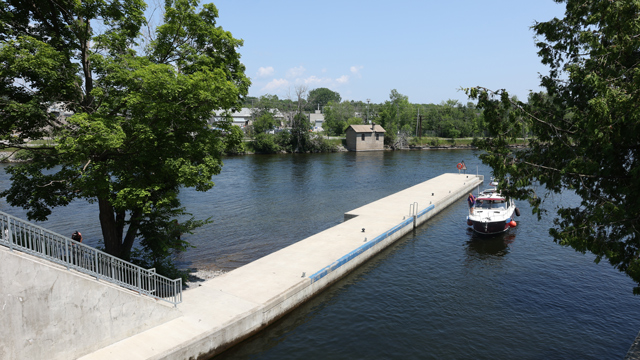
The painted blue strip (blue line) above and below each lock is a temporary holding area for boaters wanting to lock through. Tie up at this blue line only if you wish passage through the lock. To avoid the risk of injury: step slowly, do not jump, from the boat to the dock/wall and only after the boat has stopped. Be cautious of uneven surfaces or ‘sink holes’ along the canal walls.
Please be patient if lock staff are not ready to lock you through immediately. They do their best to coordinate upbound with downbound lockages and may have water management duties at nearby dams as a first priority.
Step 2: Entering the lock
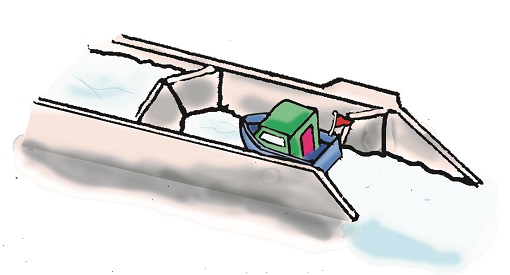
It is very important to remember that during the entire locking through process, you are under the direction of lock operations staff, so please watch for their hand signals, traffic signals or verbal commands.
After the lock gates are opened and departing vessels are clear, lock staff will direct you to enter the lock. At some Trent–Severn Waterway lock stations, a green traffic light is your signal to proceed. Approach the lock chamber cautiously and follow the instructions of staff. Be aware of wind speed, wind direction and possible cross currents. Concentrate on coming in straight and under control, using reverse gear to slow the boat down.
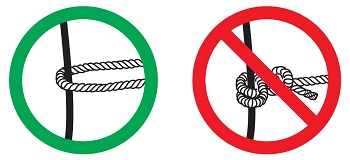
As you approach an appropriate position inside the lock, have your crew members ready to loop their vessel lines around the black drop cables. Crew members should wear their PFDs while attempting this manoeuvre; unexpected movement of the vessel could cause them to fall overboard.
Should your vessel get too close to the lock wall, use a boat hook to push yourself off. Never use your hands or feet to fend a moving boat off a lock wall. Your crew (adults if possible) should be posted at the bow and stern of your boat with mooring lines free of knots and ready to use.
Step 3: Inside the lock chamber
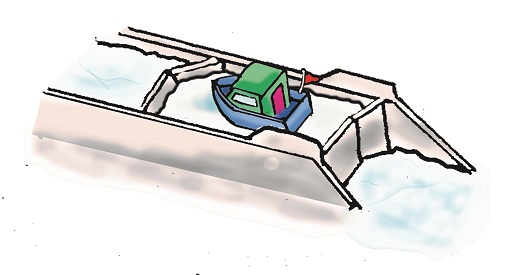
Once you have safely positioned your vessel inside the lock chamber, and looped the bow and stern lines around the black drop cables, follow these fire safety steps:
-

Turn off all ignition switches (engine, generators etc.). Do not restart or idle your engine during the lockage procedure.
-

Turn off all open-flame appliances, including pilot lights, gas powered generators and barbeques.
-

Do not smoke above or below vessel deck.
-

Leave the bilge blower on throughout the lockage procedure.
Note: These symbols appear on lock gate signs at the lock station
Tend your lines carefully during the lockage. Never leave your bow or stern line unattended. Always be prepared to show your lockage permit to staff or be ready to purchase one from them.
Step 4: Exiting lock
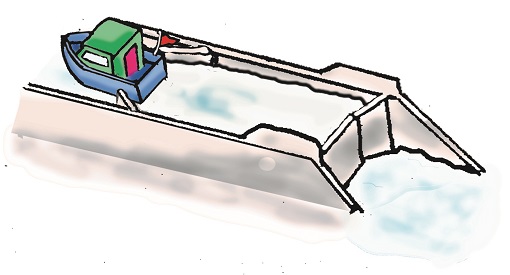
When the lock operation is completed and lock gate(s) are opened, for safety reasons, please do not restart your engine until directed to do so by lock staff. Check to make sure bow and stern lines are back on your boat and please exit slowly. Exit in order if necessary, or as directed by staff, and remember to watch out for winds, currents and other boats.
What to do at swing bridges
Follow the same rules for approaching a lock and wait until the bridge is fully open before proceeding. Travel slowly, in single file, giving way to vessels travelling downstream.
- Date modified :