
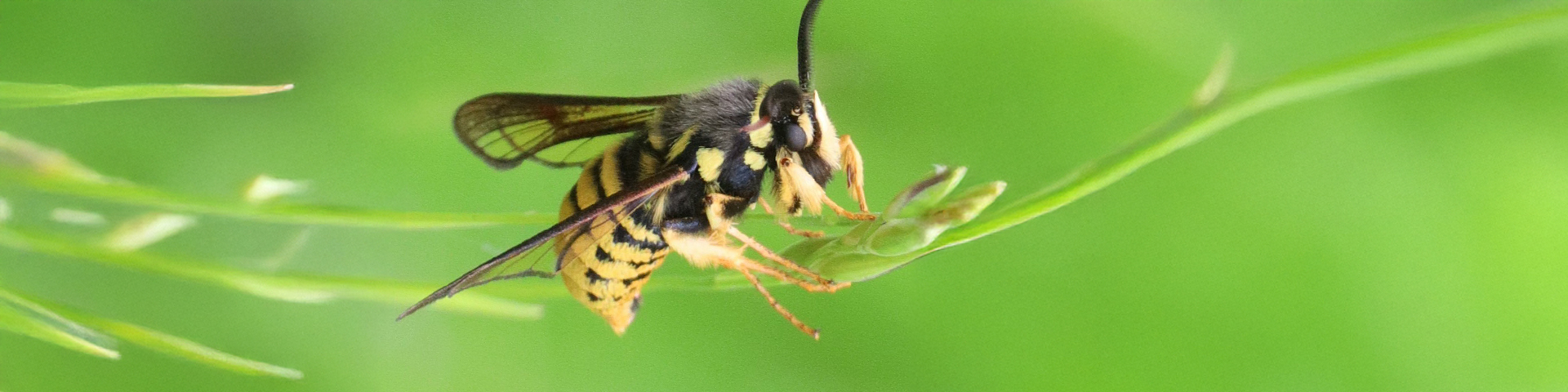
Wait…that’s a moth?!
Fort St. Joseph National Historic Site
By: Michael Bohms
Jack and Trent have been contributing to iNaturalist for several years, but in 2025 they teamed up to conduct focused moth surveys at Fort St. Joseph. While some plant and animal observations are easy to identify, others can be much more challenging. In one instance, Trent believed he had photographed a hornet or a wasp before it flew away. A closer look at the image, however, revealed furry legs, feathery antennae, and the absence of the characteristic “wasp waist”. Sure enough, it was not a wasp at all, but a Clearwing moth. This fascinating group of moths has evolved over millions of years to closely mimic other species, helping them avoid predators and survive in plain sight.
This discovery was just one of nearly 300 moth species that Jack and Trent recorded and contributed to the Fort St. Joseph iNaturalist project. During the 2025 season, they visited the site several times to conduct live moth surveys at all hours – at dusk, dawn, and in between. Because moths are often easiest to observe before sunrise, their efforts expanded to include both daytime and nighttime searches, with multiple hours spent carefully documenting species. Jack notes that Fort St. Joseph, located on the southern tip of St. Joseph Island, is a particularly unique location. Native species are far more common there than in urban areas, where invasive species dominate. The island also represents the northernmost range for many deciduous forest species, a habitat that is relatively rare in Northern Ontario. During one evening survey, Jack and Trent even extended the known range of two moth species: the Swordsman Dart (Agrotis gladiaria) and the Wooly Grass-veneer (Thaumatopsis pexellus).
Building on their successful 2025 outings, Jack and Trent plan to continue moth surveys at Fort St. Joseph in 2026. Because many moth species spend only a few days or weeks as flying adults, more frequent surveys throughout the operating season have the potential to reveal even more of the site’s hidden biodiversity. These kind of detailed observations – whether of moths, birds, plants, or other wildlife – play an important role in Parks Canada’s mandate to protect natural and cultural resources for present and future generations. By contributing to iNaturalist, visitors and community scientists alike help deepen our understanding of the ecosystems that make Fort St. Joseph unique and support ongoing resource conservation work at the site. Anyone can take part by sharing their own observations or exploring the wide range of species already documented at Parks Canada sites across Northern Ontario on iNaturalist. Check out Parks Canada’s iNaturalist project here: https://inaturalist.ca/projects/parks-canada-parcs-canada.Related links
- Date modified :