
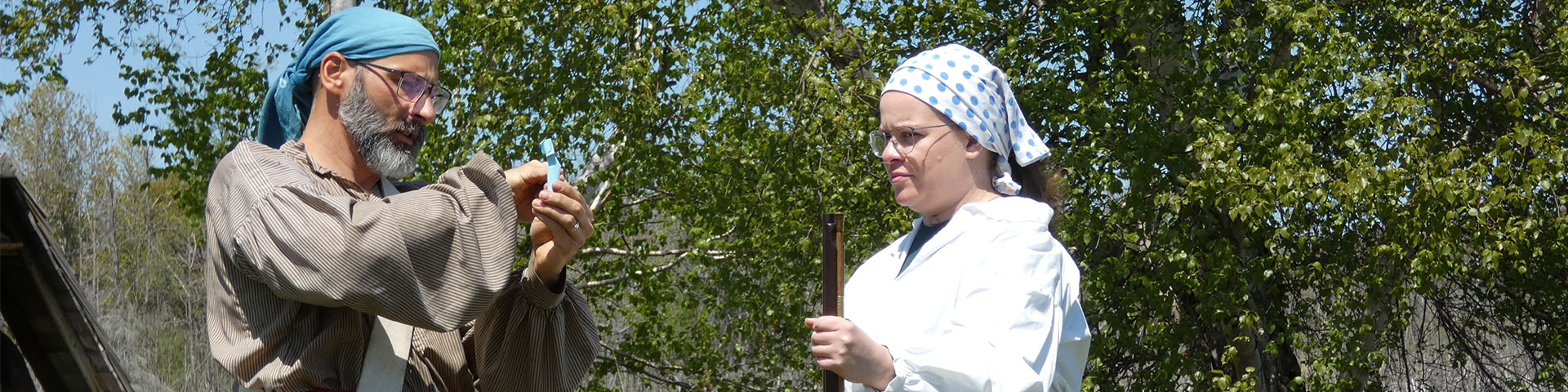
Before the flash of a flintlock
Fort St. Joseph National Historic Site
By Mike Bohms
The successful bang of a flintlock firearm is a memorable experience for both visitors and demonstrators at Fort St. Joseph National Historic Site (NHS). But before there can be a flash in the pan, staff complete hours of Historic Weapons training to ensure safety isn’t lost in a cloud of smoke.
Fort St. Joseph, like many other Parks Canada sites across the country, often relies on students to fill its summer positions. While new staff may bring a variety of skill sets with them, other skills are a little more unique and must be learned on site.
One of the most notable training opportunities at Fort St. Joseph is learning to use and maintain flintlock firearms. As flintlock firing demonstrations are part of daily programming during the summer season, it is necessary to have well-trained and experienced demonstrators. Fortunately, Parks Canada has an Historic Weapons program, so that qualified staff provide this training on-site to summer students, who in turn share their knowledge and experience with visitors.
In a typical season, the Visitor Experience students start their Historic Weapons training in May, before the site is open to the public. This ensures students have the time to gain needed experience in a supervised and controlled environment. Since it has been a few generations since these types of firearms were commonly used, everyone benefits from this dedicated learning opportunity.
To begin, all demonstrators are introduced to muzzle-loading small arms, as well as basic and site-specific range safety. Additionally, staff learn to inspect flintlocks to ensure they are safe for use, and dismantle, clean and reassemble them properly. Special attention is given to how the lock mechanism is seated in the stock, making sure that loose black powder doesn’t accumulate in unwanted crevices. Then comes the drill. Much like historical military units, each Parks Canada site has specific drills that demonstrators must follow. This isn’t just because we like to yell orders, but rather because we like predictability and safe repeatability. At Fort St. Joseph NHS, our drill is based upon the British military’s 1807 Platoon Exercise, to be both historically accurate and to incorporate purposeful safety measures. Each year, new and returning staff members complete this training with a Demonstration Supervisor before any black powder is introduced.
But even with all these preparations, misfires still happen and things don’t always go off with a bang. Welcome to the reality of the flintlock. Sometimes, it’s as simple as waiting for a lull in the wind to pull the trigger or adjusting the flint in the jaws of the firing mechanism. Other times, it may be too wet out for the black powder to ignite. As black powder dissolves in water, rainy conditions can bring complications. However, with the experience gained through flintlock training, staff at Fort St. Joseph can handle all these situations in a safe and reliable manner. If seeing a flintlock firing demonstration is in your sights, hopefully your next visit to Fort St. Joseph will hit the mark.
Related links
- Date modified :