
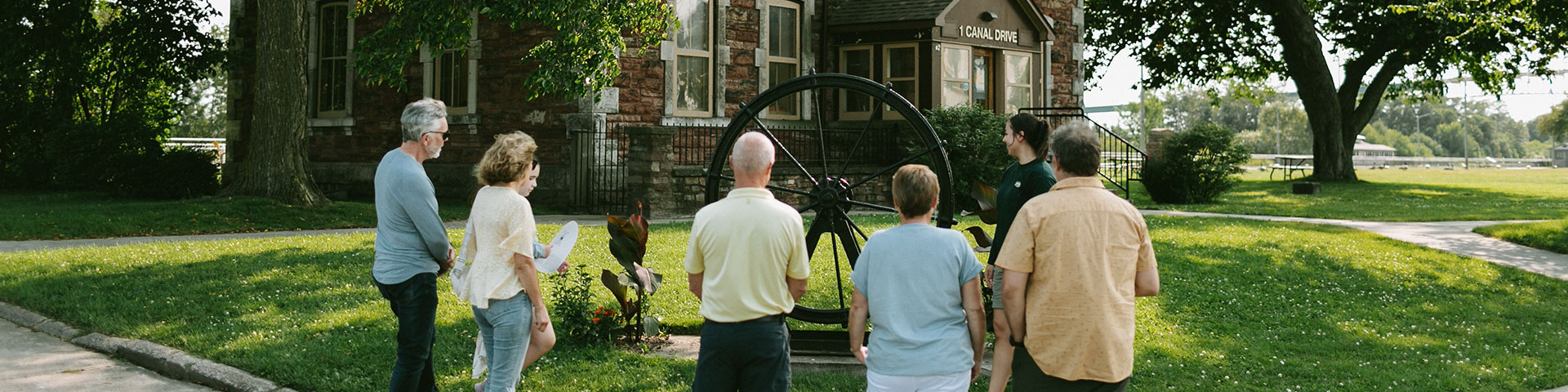
Echoes of the Rapids, an Attikamek Trail Tour
Sault Ste. Marie Canal National Historic Site
By Sophie Grawbarger
Coming soon to the Sault Ste. Marie Canal! Echoes of the Rapids is a one-hour guided tour designed to immerse visitors in the deep history and enduring culture of the Indigenous peoples of Bawaating. The tour explores how geographical environments shape communities and cultures, focusing on the Anishinaabe people and their relationship with the land and waterways.
Visitors will learn about the seasonal cycles of sustainable living, the significance of the rapids as a central meeting and trading place, and the traditional clan-based governance systems. The tour also examines the profound impact of European contact, including the fur trade, the introduction of treaties like the 1850 Robinson-Huron Treaty, and the eventual loss and reclamation of traditional lands, such as Whitefish Island. Participants will gain insight into the resilience of Indigenous communities and the importance of land, water, and traditional knowledge. The experience encourages reflection on our shared treaty responsibilities and the ongoing importance of Indigenous stewardship and cultural preservation.
The rapids provided abundant resources and accessibility, fostering a thriving social, cultural, and economic hub among the Anishinaabe and other Indigenous peoples. Their governance, trade networks, and alliances highlight how geography influenced the development of complex societies. However, forced changes brought by European colonization—such as the fur trade, treaties, and industrialization—altered both the natural landscape and Indigenous ways of life. Land dispossession and economic shifts disrupted traditional practices, while the introduction of new industries transformed the environment and social fabric.
The story of St. Mary’s Rapids underscores the dynamic relationship between geography, culture, and history. It shows that natural environments do not just provide a backdrop but actively shape communities and their cultures over time. Furthermore, it highlights Indigenous resilience in maintaining their connection to the land despite colonization’s impacts. Understanding this history is crucial to appreciating the deep-rooted connection Indigenous peoples have to their territories, the importance of treaties, and the ongoing effects of environmental and social change. It reminds us changes continuously reshape societies, emphasizing the need to honor Indigenous rights and stewardship.
This summer marks my fourth year working at the Sault Ste. Marie Canal National Historic Site, a place rich with history and significance. Recently, I graduated from university with a specialization in Indigenous Studies and a minor in History, an educational path that has deepened my understanding of Indigenous cultures and histories. As a proud member of Garden River First Nation, I feel a strong connection to the land and its stories. My role at the Canal allows me to share this connection and my knowledge with visitors from all walks of life. It is an honor to contribute to educating others about Indigenous histories and perspectives—stories that have often been overlooked or misunderstood. Working here has reinforced for me the importance of preserving and sharing cultural heritage, and I am grateful for the opportunity to be a bridge between my community’s traditions and the broader public. Through this work, I hope to foster greater respect, understanding, and reconciliation.
- Date modified :