
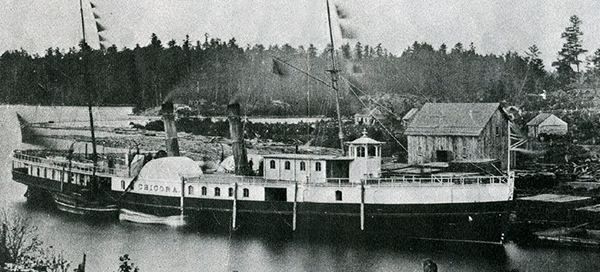
© Sault Ste. Marie Museum
From Incident to Innovation
Sault Ste. Marie Canal National Historic Site
By Carly Wetzl
The Chicora incident, 150 years ago, prompted the newly formed Canadian government to construct the Sault Ste. Marie Canal in 1889, at a cost of nearly $4 million (the equivalent of $120 million today). The lock had a profound effect on technology and industrial growth in Sault Ste. Marie, as its population of roughly 2000 increased tenfold.
In the mid-1800s, research and preliminary surveys had been conducted in hopes of constructing a lock in Sault Ste. Marie on the Canadian side of the river. The area had long been a natural meeting point at the junction of Lake Superior and Lake Huron, recognized by Indigenous people prior to colonization and later by the Hudson Bay Company with a trading post. As industry and settlement advanced, it was important to have a route for large vessels to pass from one body of water to the other; however, the Bawating rapids presented a major obstacle.
Since establishment of the Dominion of Canada as an independent nation was underway, the construction of a lock was not deemed a high priority. Furthermore, in 1855, the Americans were already building a large lock on the St. Marys River.
1867 brought Canadian Confederation, and Prime Minister John A. MacDonald went to work organizing the new country. In 1868, Rupert’s Land, the former Hudson’s Bay Company territory, had been transferred to the Dominion of Canada and an English speaking governor appointed, without first negotiating with the region’s inhabitants.
At the heart of this territory lay modern day Manitoba, which was comprised of mostly Métis inhabitants, who did not accept MacDonald’s government. Instead they formed the Red River Colony and appointed their own provisional government, led by Louis Riel.
In May of 1870, MacDonald sent a military expedition, led by Colonel Garnet Wolseley, to quell the Red River Resistance and establish Canadian authority in the new province of Manitoba. Colonel Wolseley and his troops travelled west aboard the steamship Chicora. When the vessel reached the Sault, it was refused passage through the American lock due to its military cargo and history as a blockade runner during the American Civil War. So, the Chicora unloaded its passengers, equipment, and provisions on the Canadian side of the river. It was eventually allowed to pass through the lock empty, and was reloaded at Lake Superior with everything that had been portaged around the rapids—resulting in several weeks’ delay. Known as “the Chicora incident”, this was the final push for Canada to build its own canal on the St. Mary’s River.
Construction of the all-Canadian waterway between Lake Superior and the Atlantic was completed in 1895 when the Sault Ste. Marie Canal opened. The lock was at the height of innovation and technology—the first electrically operated lock and, at the time, the longest lock—it even included a lighting system long before the city of Sault Ste. Marie had electricity.
The lock undoubtedly helped with the expansion of industries throughout the community, and by 1913 was part of the busiest lock system in the world.
- Date modified :