
Alexander Morris (1826-1889) National Historic Person
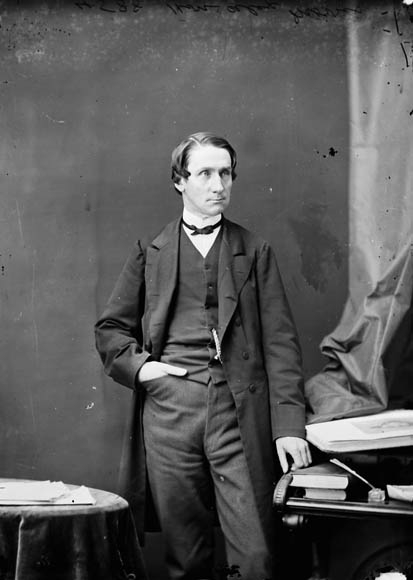
© William James Topley / Library and Archives Canada / PA-025468
Alexander Morris was designated as a national historic person in 1971.
The Historic Sites and Monuments Board of Canada reviewed this designation in 2024.
Reasons for designation
Beginning in the 1850s, Morris wrote speeches and essays promoting the extension of the United Province of Canada’s territory into the North-West. Morris believed that Canada had a responsibility to the Indigenous Peoples who inhabited these territories, a rare consideration for a Canadian expansionist.
First elected to the Legislative Assembly of the Province of Canada in 1861, he was a strong supporter of Confederation who helped to form the Great Coalition of 1864, uniting reformers and conservatives behind the idea of the union. He was a political ally of Prime Minister Sir John A. Macdonald, who appointed Morris to his cabinet in 1869.
As Manitoba’s first Chief Justice from 1872 to 1873 and as lieutenant-governor of Manitoba and the North-West Territories after 1873, Morris presided over and influenced the creation of foundational laws and institutions for the new jurisdictions. His attempts to administer a system which would provide guarantees of lands promised to the Métis in the Manitoba Act (1870), however, were largely ineffective.
From 1873 to 1876 he served as treaty commissioner in the negotiation of Numbered Treaties 3, 4, 5, and 6, with First Nations. Whereas First Nations negotiators sought a relationship of reciprocity with the Crown and a means to safeguard their communities’ autonomy and long-term future, the primary goal of the Government of Canada was territorial expansion for the benefit of settlers. Morris found himself at times caught between these different priorities, and by the end of his tenure, government colleagues were criticizing him for being too “generous” in the negotiations. After the treaties were made, Morris called for the government to deliver more rapidly on their promises. He played a major role in ensuring the government included the promises spoken during Treaty 1 and 2 negotiations in the treaty documents. His 1880 work, The Treaties of Canada with the Indians, had a major influence on early written histories of the Numbered Treaties in Canada.
Review of designation
The Historic Sites and Monuments Board of Canada is reviewing designated national historic persons, events and sites for their connection to the history and legacy of the residential school system. This review responds to the Truth and Reconciliation Commission’s Call to Action 79, which calls on the federal government to commemorate the history and legacy of residential schools.
Reviews are undertaken on an ongoing basis to ensure that designations reflect current scholarship, shifts in historical understandings, and a range of voices, perspectives and experiences in Canadian society.
In 2024, this designation was reviewed due to colonial assumptions and an absence of a significant layer of history in the commemorative plaque text. The original text, approved in 1972, recognized Morris as a prominent lawyer, writer, and politician, and referenced his role in consolidating Canada’s hold over the West. The original text only briefly referenced that he negotiated five treaties.
New reasons for designation were developed that elaborate on Morris’s role in negotiating the Numbered Treaties. The original plaque will be removed. A new plaque will not be prepared as the limited text of a plaque does not allow for adequately communicating this complex history.
Sources: Historic Sites and Monuments Board of Canada, Minutes, December 2022; June 2023.
The National Program of Historical Commemoration relies on the participation of Canadians in the identification of places, events and persons of national historic significance. Any member of the public can nominate a topic for consideration by the Historic Sites and Monuments Board of Canada.
- Date modified :