
Alexander Graham Bell (1847-1922) National Historic Person
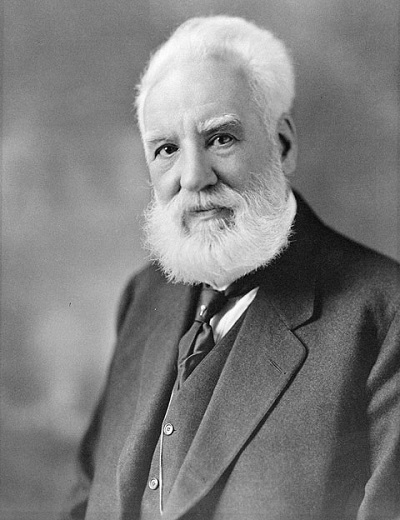
© Moffett Studio, Library and Archives Canada, C-017335
Alexander Graham Bell was designated as a national historic person in 1977.
The Historic Sites and Monuments Board of Canada reviewed this designation in 2025.
Commemorative plaque: 559 Chebucto Street, Baddeck, Nova ScotiaFootnote 1
Alexander Graham Bell (1847-1922)
Teacher, scientist and inventor, Bell devoted his life, with unusual success, to the benefit of mankind. Known chiefly as the inventor of the telephone, he also produced important inventions and discoveries in medicine, aeronautics, marine engineering, genetics and electrical science, and greatly advanced the methods and practices of teaching the deaf. Born in Scotland, citizen of the United States and longtime resident of Canada, Bell is himself a symbol of the international impact of his achievements. He died near here at his summer home, Beinn Bhreagh.
Reasons for designation
An inventor, teacher, and scientist, Alexander Graham Bell is best known for the invention of the telephone. His inventions and discoveries reflected his infinite curiosity and broad range of interests in communications, medicine, marine engineering, genetics, electrical science, and aeronautics. In 1907, he and his wife Mabel co-founded the Aerial Experiment Association, which led to the flight of the Silver Dart, the first powered, heavier-than-air craft to fly in Canada. He successfully registered 30 patents, either individually or as part of group, and his many inventions and innovations have had far-reaching impacts.
As a teacher of Deaf people, he developed oralist methods of instruction and discouraged the use of sign language among the Deaf community. Due to his eugenics beliefs, Bell argued against the intermarriage of congenitally Deaf people. At the same time, he opposed measures such as segregation, institutionalization, sterilization, and legislative bans on intermarriage for Deaf people, and eventually abandoned formal involvement in eugenics organizations.
Review of designation
Reviews are undertaken on an ongoing basis to ensure that designations reflect current scholarship, shifts in historical understandings, and a range of voices, perspectives and experiences in Canadian society.
In 2025, this designation was reviewed to understand Bell’s connection to the eugenics movement. The reasons for designation were broadened to include mention of his views and actions as a teacher in support of eugenics.
Sources: Historic Sites and Monuments Board of Canada, Minutes, december 2024, june 2025, december 2025.
The National Program of Historical Commemoration relies on the participation of Canadians in the identification of places, events and persons of national historic significance. Any member of the public can nominate a topic for consideration by the Historic Sites and Monuments Board of Canada.
Related links
- National historic designations
- National historic persons
- National historic sites designations
- National historic events
- Submit a nomination
- Alexander Graham Bell National Historic Site
- Beinn Bhreagh Hall National Historic Site
- Bell Homestead National Historic Site
- First Aeroplane Flying in Canada National Historic Event
- Mabel Hubbard Bell National Historic Person
- This Week in History
- Date modified :