
For the week of August 11, 2025.
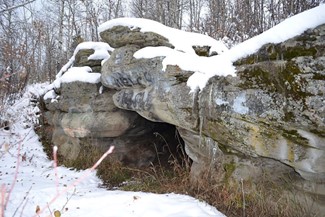
On August 16, 2019, the Government of Canada designated T̲s̲e’ K’wą a national historic site. Formerly known as Charlie Lake Cave, this cultural and archaeological site is located northwest of Fort St. John and east of the Rocky Mountains in British Columbia, within the traditional territory of Dane-zaa (Beaver People) First Nations. T̲s̲e’ K’wą is among the oldest archaeological sites in Canada, reflecting thousands of years of environmental and Indigenous history.
Sedimentary layers containing archaeological evidence at T̲s̲e’ K’wą are more than four metres deep and reflect Indigenous use of the site, starting 12,500 years ago and continuing to recent times. Archaeology has provided important insights into these cultures. The nearly intact remains of two raven skeletons seem to have been buried deliberately roughly 12,000 and 11,000 years ago. These are the oldest bird burials known in the Americas. Ravens continue to play a significant role in Dane-zaa spirituality, and their oral histories connect the modern culture to these ancient people.
Evidence from the earliest site layers following the last Ice Age indicate a grassland environment that covered the Peace River region. By roughly 10,000 years ago boreal forest had replaced much of the grassland, and animal remains suggest a way of life based on hunting, fishing, and trapping a wide range of species. Those remains are plentiful at T̲s̲e’ K’wą. Bird, fish, and bison bones show evidence of hunting with stone tools and suggest food had been transported to the site from other locations. Genetic analysis of the oldest bison remains has also shed new light on early species and the direction of human and animal migrations at the end of the Ice Age.
The Dane-zaa First Nations are the stewards of this sacred place, which they named T̲s̲e’ K’wą, meaning “rock house” in the Dane-zaa Zaage language. Dane-zaa groups hunted large game and moved through the landscape to harvest resources as they became available in different places during different seasons. Beginning in the late 18th century, colonization ended this way of life for the Dane-zaa, leading to restrictions on their movement and bans on ceremony and gatherings. Still, the Dane-zaa held onto their knowledge of the spiritual and cultural importance of T̲s̲e’ K’wą.
In 2012 three Dane-zaa First Nations (Doig River, Prophet River, and West Moberly) came together to form the T̲s̲e’ K’wą Heritage Society. All artifacts excavated at the site were repatriated from Simon Fraser University in 2024. The site, which includes the cave, an interpretive trail, outdoor gathering spaces, exhibits, a healing garden, and Kwą̂-ẕâa watsáádzéʔ (old campsite), is now owned and managed by the T̲s̲e’ K’wą Heritage Society and open to visitors.
T̲s̲e’ K’wą was designated a national historic site in 2019. The Historic Sites and Monuments Board of Canada advises the Government of Canada on the commemoration of national historic sites, which can include a wide range of historic places such as gardens, complexes of buildings, and cultural landscapes.
The National Program of Historical Commemoration relies on the participation of Canadians in the identification of places, persons, and events of national historic significance. Any member of the public can submit a subject to the Historic Sites and Monuments Board of Canada. Learn how to participate in this process.