
Tse'K'wa National Historic Site
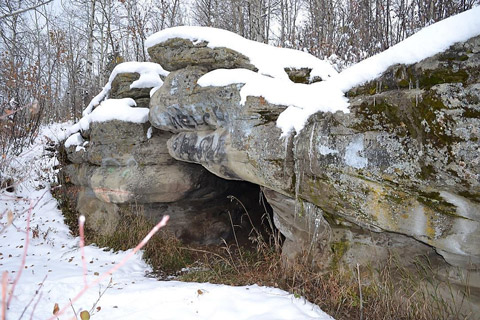
© Parks Canada / M. Stopp
Tse’k’wa was designated as a national historic site in 2019.
Commemorative plaque: no plaque installedFootnote 1
Tse’K’wa, Fort St. John, British Columbia
Tse’k’wa is an exceptional archaeological site in northeastern British Columbia that has contributed to the understanding of environmental changes and human settlement from the end of the last glacial period (12,500 years ago) to 1,000 years ago. Also known as Charlie Lake Cave, it features a sequence of radiocarbon dated and relatively undisturbed soil layers that is rare in North America. The site is important for what it has revealed about the earliest humans and their movement over time, their way of life, about the cultures that followed, and about post-glacial environmental change.
Tse’K’wa lies in the rolling terrain of the Peace River District to the east of the Rocky Mountains, nine kilometres northwest of Fort St. John. The site is within the traditional territory of the Dane-zaa First Nations, and for these First Nations groups, who are stewards of this site, it is a spiritual place and a touchstone to their lengthy presence in the Peace River region, to nearby Charlie Lake, and to the site itself. The site has become an integral element of Dane-zaa identity and continuing traditions maintained through oral histories, stories, and songs.
The lowermost soil layers at Tse’K’wa held a combination of undisturbed evidence of Canada’s earliest inhabitants, known by archaeologists as Palaeo-Indian peoples. This evidence included stone tools and bones of late glacial animals. Analysis of ancient bison bone remains showed that these animals were hunted, and the high number of leg bones over other skeletal parts suggests that preferred meats were brought to this camp from elsewhere. In addition, genetic analysis of the bison bones has contributed to the understanding of bison speciation and has helped to understand bison and human migration patterns at the end of the Ice Age. Two nearly-complete raven skeletons were also found in lower layers. They may be deliberate interments tied to early belief systems and may be the earliest such evidence in the country.
The upper soil layers held artifacts and animal bones of cultures that followed, showing nearly continuous human presence following the Palaeo-Indian period up to 1,000 years ago. This material has provided key comparative data for the study of cultural change in western Canada.
This press backgrounder was prepared at the time of the Ministerial announcement in 2019.
Description of historic place
Tse’K’wa National Historic Site of Canada is an archaeological site situated just north of the community of Fort St. John in the Peace River Regional District of British Columbia. The site is within the traditional territory of the Dane-zaa First Nations. It consists of a wooded boreal terrain, and a cave feature fronted by a large standing sandstone boulder (or “parapet”) set in a bedrock escarpment. The property overlooks Stoddart Creek and Charlie Lake. The boundaries for Tse’K’wa are defined as the legal limits of the property, covering an area of 20,564 square metres.
Heritage value
Tse’K’wa was designated a National Historic Site of Canada in 2019. It is recognized because:
- its sequence of dated and relatively undisturbed soil layers is rare in North America and has contributed to an understanding of human settlement and environmental change from the end of the last glacial period 12,500 years ago to 1,000 years ago;
- the lowermost soil layers held a combination of evidence not found elsewhere in Canada, including Palaeo-Indian stone tools, bones of late glacial animals, indicators that bison were hunted, and two nearly-complete raven skeletons that may reflect early belief systems. The upper soil layers showed nearly continuous human presence after the Palaeo-Indian period and provide key comparative data for the study of the early settlement of western Canada;
- genetic analysis of the bison remains led to new knowledge of bison speciation, and of the direction of human and animal migrations at the end of the Ice Age. The site’s northerly location suggests that it held a position along an early route of northward migration;
- for the Dane-zaa First Nations, who are stewards of this site, it is a spiritual place, and a touchstone to their lengthy occupation in the Peace River region.
Tse’K’wa, also known as Charlie Lake Cave, is an exceptional archaeological site and a rare Canadian example of a Palaeo-Indian site with an unusually well-preserved stratigraphic record containing a sequence of archaeological remains that have been radiocarbon dated from ca. 12,500 to 1,000 years ago. This sequence provides a timeline for the postglacial environmental changes to the area over 10 000 years, from an open grassland to a forested environment, as well as evidence of continuous human occupation of the area. DNA evidence from bison bones recovered in the earliest layers of the site shows genetically distinct populations from north and south of the ice sheets during glaciation, now sharing the same area. The presence of a fluted projectile point similar to those found further south suggests that humans had migrated to the region from the south, rather than migrating from the north. Furthermore, the discovery of two relatively undisturbed raven skeletons suggests they may have been deliberately buried and thus may be associated with very early belief-based practices. This has further enhanced the importance of this site for the region’s First Nations since the raven is an important character who conveys life-lessons in many First Peoples histories.
Source: Historic Sites and Monuments Board of Canada, Minutes, June 2019.
The National Program of Historical Commemoration relies on the participation of Canadians in the identification of places, events and persons of national historic significance. Any member of the public can nominate a topic for consideration by the Historic Sites and Monuments Board of Canada.
- Date modified :