
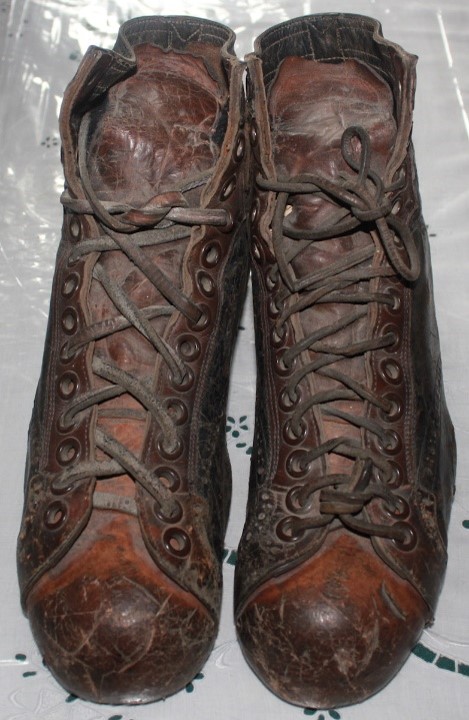
For the week of May 6, 2024.
On May 6, 1874, George E. Tackaberry was born in Dresden, Ontario. He went on to open a shoe repair business in Brandon, Manitoba, and designed one of the most popular types of ice hockey skates ever manufactured in Canada.
Tackaberry got into the shoe repair business as a teenager. He moved to Brandon in 1892 and established himself as the local specialist in making orthopedic shoes for people living with physical disabilities. By the turn of the century, his business was thriving and he had become known in the community for quality footwear. His next-door neighbour was Joe Hall, a 23-year-old hockey player with the Portage Lakes during the 1905–1906 season, who later became a two-time Stanley Cup Champion with the Quebec Bulldogs. Hall complained to Tackaberry about his inability to find boots that were tough enough to withstand the rigours of professional hockey. At the time, ice skates were made of blades attached by leather straps to a player’s boots.
Tackaberry built a strong, sturdy boot that proved capable of withstanding the rigours of a full hockey season. The design was based on a careful measurement of Hall’s foot, guaranteeing a snug fit that prevented rubbing or chafing. Additionally, Tackaberry used kangaroo leather that would not stretch, ensuring the boot would maintain its perfect fit. He also lowered the top of the boot by two inches, added a tight-fitting reinforced heel and toe, improved the arch support, and used a thicker tongue. Word of the new design spread in Brandon, and up-and-coming players were soon asking Tackaberry for new boots. Hall raved to his teammates about the design, who then sent him back to Brandon with orders of their own. As word spread, Tackaberry’s business took off and he patented the design of his boot, which became known as “the Tackaberry.”
In 1927, Tackaberry partnered with Canada Cycle and Motor Company (CCM). CCM had first used leftover metal from its manufacture of bicycles to produce ice skates in 1904. When the Bauer family’s Western Shoe Co. of Kitchener, Ontario, started selling blades attached to boots, CCM reached a deal to take over Tackaberry’s shop. In the years that followed, CCM experimented with different manufacturing techniques and materials. For example, in 1934 it introduced heat-treated blades made from high-quality Sheffield steel. These “CCM Tacks” soon gained iconic status within the world of ice hockey, worn by NHL all-stars, such as Jean Béliveau and Bobby Orr, and casual skaters everywhere, dominating the market for years to come.
Tackaberry Skates was designated as a national historic event in 2022. The Historic Sites and Monuments Board of Canada advises the Government of Canada on the commemoration of national historic events, which evoke significant moments, episodes, movements, or experiences in the history of Canada.
The National Program of Historical Commemoration relies on the participation of Canadians in the identification of places, events, and persons of national historic significance. Any member of the public can nominate a topic for consideration by the Historic Sites and Monuments Board of Canada. Learn how to participate in this process.