For the week of November 13, 2023
On November 13, 1981, the Government of Canada recognized Peter Pitseolak as a national historic person. Pitseolak (“guillemot” in Inuktitut) was an artist, photographer, and historian of the area around Kinngait on South Baffin Island, also known as Sikusilaq and Cape Dorset. He played an important role in documenting the lived experiences and cultural practices of Eastern Inuit at a time of significant change.
Peter Pitseolak was born on Tujjaat (Nottingham Island) in Hudson Strait around 1902. As a young man, he worked for the Hudson’s Bay Company. He left the company in 1946 to build a home at Kiattuuq, north of Kinngait, with his wife Aggeok. In winter, Inuit lived in snowhouses and hunted seal and walrus. In summer, they moved inland, setting up skin tents, fishing, trapping, and caribou hunting and then drying what they caught to sustain them in leaner months.
In the 1950s and 1960s, Inuit in the region began centralizing in Kinngait as part of a push by the federal government to relocate them. Many parents moved because they were told their children had to go to school and they did not want to be apart from them. Others moved to Kinngait at this time to join the recently founded what is now the Kinngait Co-operative, which enabled Inuit to organize and teach the commercial production of art and start other businesses. Centralization came with consequences, however, as the government imposed regulation on the area. New game laws were implemented without Inuit consultation that restricted the ability of Inuit to hunt freely on their homeland and without a treaty. Inuit who moved to Kinngait also had to adapt to an unstable wage economy that could not adequately provide for everyone year-round, driving many to government assistance to survive.
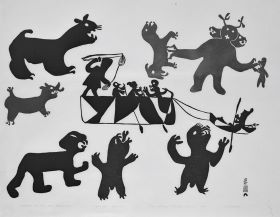
Pitseolak retired to Kinngait in 1961, so he could focus on his art. For years he had been sculpting stone and incising ivory to create carvings of humans, animals, and supernatural beings. Traditionally, Inuit had carved soapstone, ivory, and other materials to make tools, amulets, game pieces, or toys. Pitseolak began experimenting with printmaking in 1939, after introduced to this medium by John Buchan, son of the Governor General of Canada, who lived on Baffin Island in 1938–1939. Pitseolak produced a wide range of prints. Some brought traditional Inuit stories to life through a combination of images and Inuktitut text, while others depicted changes to life in the North in the mid-20th century, with the growing presence of Euro-Canadians and their technologies.
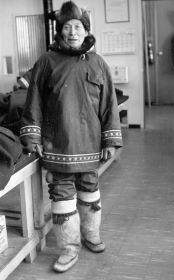
One of those technologies was photography, which Pitseolak used to document Inuit life on the land. Beginning in the 1930s, he took photographs of himself and his family in traditional Inuit clothing. He created innovative methods of developing still photographs inside an iglu (“house” in Inuktitut) using seal-oil lamps with a filter he fashioned from a pair of sunglasses. He created another lasting record of Inuit customs and beliefs in People From Our Side, which was part memoir and part history of the Kinngait region. It was published two years after his death in 1973, with the assistance of Dorothy Eber, an arts writer and oral historian from Montréal.
By the early 1980s, Pitseolak had become well-known in southern Canada for his art and photography. His work was given prominent recognition in 1980, with the presentation of a major travelling exhibition by the McCord Museum of Montréal, entitled “Peter Pitseolak (1902–1973) Inuit Historian of Seekooseelak,” which received critical acclaim. Today, Peter Pitseolak is still revered in Kinngait, where the high school bears his name.