
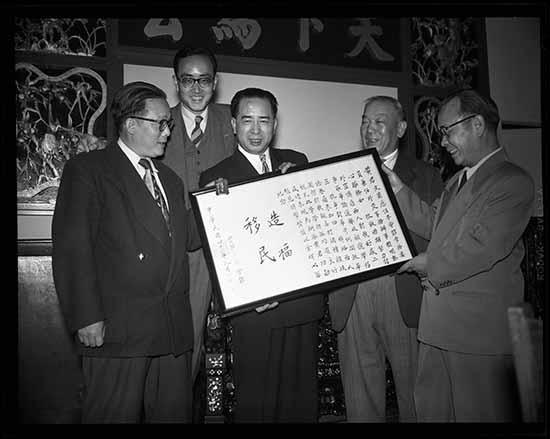
For the week of August 21, 2023.
On August 26, 2008, the Government of Canada designated Wong Foon Sien as a national historic person for his significant leadership and activism within the Chinese Canadian community.
Wong Foon Sien was born in Guangdong, China in 1899 and, in 1908, immigrated with his family to Cumberland, British Columbia, where his father became a successful merchant. Wong studied at the University of British Columbia, where he was one of the first students of Chinese descent. He later studied international law in Chicago.
Despite his education, he was not allowed to practice law in British Columbia, where people of Asian descent were denied many of the rights and freedoms of full citizenship. They could not vote, hold public office, become lawyers or pharmacists, work in the public service, or serve on juries, for example. Denied entry into his chosen profession, Wong worked as a court interpreter for the Attorney General, providing translation services when required by people of Chinese descent.
Wong’s rise to prominence began in 1937, when he was appointed publicity agent for the Chinese Benevolent Association in Vancouver. He worked for the betterment of his community, founding for example the Chinese Trade Workers’ Association in 1942 and leading a petition for Chinese voting rights in 1944. He was part of a broader movement that won Chinese Canadians the right to vote in provincial elections in 1947 and at the federal level in 1949.
Wong worked briefly as a reporter for the New Republic Chinese Daily in Victoria before taking up the position of president of the Chinese Benevolent Association in Vancouver from 1948 to 1959. He travelled to Ottawa many times to lobby the federal government to end severe restrictions on Chinese immigration to Canada. In 1947, the government had repealed the Chinese Immigration Act, 1923 (also known as the Chinese Exclusion Act), which had barred the entry of almost all Chinese people and required Chinese Canadians to carry registration certificates, with penalties for non-compliance ranging from fines to deportation. However, after 1947, Canada still limited Chinese immigration, as only the spouses and children (under the age of 18) of Canadian citizens could enter the country. Wong fought this decision and continued to advocate for the liberalization of immigration in the years that followed. Wong retired as president in 1959, the same year he was named “Citizen of the Year” by the Vancouver City Council.
Wong Foon Sien was designated as a national historic person in 2008 and the Exclusion of Chinese Immigrants (1923–1947) was designated as a national historic event in 2023. The Historic Sites and Monuments Board of Canada (HSMBC) advises the Government of Canada on the commemoration of national historic persons—individuals who have made unique and enduring contributions to the history of Canada and national historic events, which evoke significant moments, episodes, movements, or experiences in the history of Canada.
The National Program of Historical Commemoration relies on the participation of Canadians in the identification of places, persons and events of national historic significance. Any member of the public can submit a subject to the Historic Sites and Monuments Board of Canada. Learn how to participate in this process.