
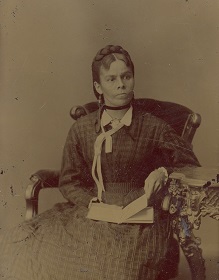
For the week of Monday, June 19, 2023.
On June 19, 1860, Nahnebahwequay met Queen Victoria in London, England, to appeal the discriminatory treatment of Chippewas of Nawash Unceded First Nation in Canada West (now Ontario). Her transatlantic journey brought attention to the erosion of the cultural, political, and economic rights of Indigenous Peoples under British colonial rule.
Nahnebahwequay was born in 1824 to Myawekeshigoqua (Mary or Polly) of the Otter clan and Tyatiquob (Bunch Sunegoo) of the Eagle clan in the Credit River Flats (present-day Mississauga) in Upper Canada. Nahnebahwequay, meaning “Upright Woman,” was also given the Christian name Catherine Brown. From the age of two, she lived in the newly established Credit Mission—a settlement of about 200 people, including Ojibwe who had converted to Methodism and missionaries.
Nahnebahwequay married a preacher named William Sutton in 1839 and started a family at the Credit Mission before moving to Saugeen Peninsula, where they settled on 200 acres (roughly 81 hectares) of land granted to them by the Chippewas of Nawash Unceded First Nation. In doing so, Nahnebahwequay relinquished her status as a member of New Credit Mississauga and joined the Nawash First Nation.
Between 1852 and 1857, Nahnebahwequay and her family moved around the Great Lakes region before returning to Saugeen Peninsula. By the time she returned, the Indian Department had pressured members of the band to cede the 10,000-acre (4,047-hectare) Nawash Reserve on the western coast of Owen Sound Bay. Nahnebahwequay strongly believed that they had no authority to surrender these lands, as they belonged to the First Nation. The Indian Department refused to sell the land back to First Nations people and later denied Nahnebahwequay the right to collect band annuities, on the grounds that she had lost her “Indian” status through marriage to a man of European descent. After an unsuccessful appeal to the Legislative Assembly of Canada, Nahnebahwequay decided to petition Queen Victoria.
Nahnebahwequay went to London as the delegate of the Anishanaabe of Lake Superior and Georgian Bay, who elected her as their diplomatic representative in 1859. Her strength and courage were highlighted by her determination to embark on this dangerous journey despite being nearly nine months pregnant. Nahnebahwequay appealed to British cultural norms during her meeting with Queen Victoria, dressing in European clothing and emphasizing her Christian beliefs, for example. Although Nahnebahwequay received assurances that the Crown would investigate the treatment of First Nations in Canada West, nothing came of these promises.
Undeterred, Nahnebahwequay continued to fight for First Nations’ land and fishing rights. Eventually the Indian Department allowed Nahnebahwequay and her family to purchase their land on the Saugeen Peninsula, but only in William Sutton’s name. Other members of the Nawash First Nation were not granted the same opportunity, however, and she viewed this as an attempt to silence her. Despite achieving success in her personal struggle, Nahnebahwequay continued advocating for Indigenous land rights up until her death in September 1865 in Sarawak Township, Grey County, Ontario.
Nahnebahwequay was designated as a national historic person in 2021. The Historic Sites and Monuments Board of Canada (HSMBC) advises the Government of Canada on the commemoration of national historic persons—individuals who have made unique and enduring contributions to the history of Canada.
The National Program of Historical Commemoration relies on the participation of Canadians in the identification of places, events and persons of national historic significance. Any member of the public can nominate a topic for consideration by the Historic Sites and Monuments Board of Canada. Learn how to participate in this process.