
Indigenous Stewardship Circle: Indigenous voices in Parks Canada’s future direction
Green elements: these four interconnected elements are understood to be central components of Indigenous stewardship. They include Indigenous knowledge and Indigenous knowledge systems; shared governance; cultural continuity; and economic opportunities. Blue elements: these three elements are considered to be foundations for Indigenous stewardship: broader efforts to build and maintain strong relationships between Indigenous Peoples and Parks Canada; a willingness to work with Indigenous Peoples to examine Parks Canada’s past and acknowledge, apologize for, and redress those actions that have impacted Indigenous Peoples; and learning and understanding among Parks Canada employees and visitors of the rights, roles and responsibilities of Indigenous Peoples in the stewardship of lands, waters and ice.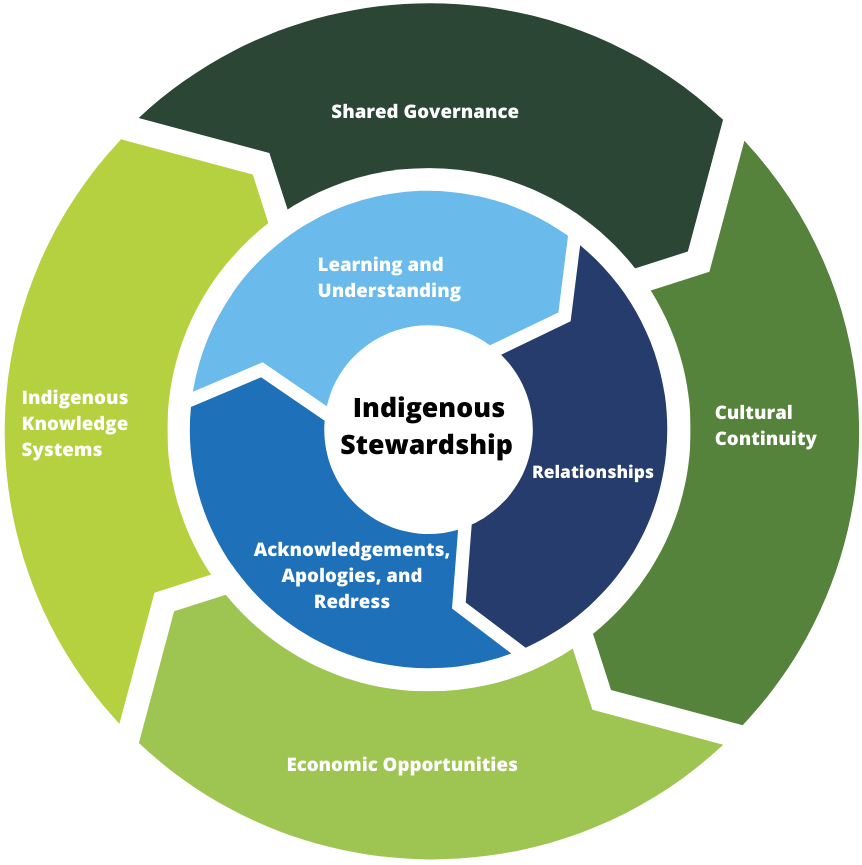
Indigenous Stewardship Framework — Text version
May 2025 — Indigenous peoples are stewards of lands, water and ice, and have been since time immemorial. However, in many places Parks Canada’s actions have severed Indigenous peoples’ long-standing relationships and responsibilities for the places that have determined their identities and influenced their cultures and languages. Parks Canada has embarked on a renewal process centered around a vision of heritage place management that is respectfully aligned with Indigenous stewardship with an approach that:
- strengthens (re)connections to lands, waters and ice
- amplifies Indigenous voices, supports Indigenous leadership
- respects Indigenous knowledge systems and ways of knowing
Established in 2023, the Indigenous Stewardship Circle is a diverse group of Indigenous thought leaders that guides Parks Canada in the development and renewal of policies that support Indigenous stewardship. It provides ongoing guidance to Parks Canada’s work in support of Indigenous stewardship and does not replace engagement and/or consultation requirements with Indigenous communities. The work of the Circle is grounded in the values of trust, respect and reciprocity, and the accompanying principles of honouring rights, duties and responsibilities; fostering Ethical Space; nurturing healthy, respectful relationships; and ensuring continuity of Indigenous culture and language. In 2024, the Circle co-developed the Indigenous Stewardship Policy with Parks Canada team members and enacted it in ceremony with the Minister in October 2024. The Circle is currently working with Parks Canada to help advance United Nations Declaration on the Rights of Indigenous Peoples Act Action Plan Measures implicating Parks Canada.
Indigenous Stewardship Circle composition
The Circle is currently comprised of twelve (12) individuals who identify as Métis, Inuit or First Nations; two (2) representatives from National Indigenous Organizations (NIOs), one each from the Assembly of First Nations and Métis National Council; and two (2) Parks Canada representatives - the Vice-President of Indigenous Stewardship & Cultural Heritage and Senior Vice-President of Operations - who participate as equal voting members. One seat is also reserved for Inuit Tapiriit Kanatami. The Circle is supported by a Secretariat function that sits with the Executive Director, Indigenous Stewardship, Parks Canada.
Circle membership
- Adeline Jonasson, Łutsël K’é Dene First Nation, Northwest Territories
- Anastasia Qupee, Sheshatshiu Innu Nation, Labrador
- Brent Laroque, Métis, Saskatchewan
- Carmen Wells, Métis, Alberta
- Cynthia Boyko (Chair), Haida Nation,British Columbia
- Curtis Scurr, Assembly of First Nations representative
- Jaime Vienneau, Ktunaxa Nation, British Columbia
- Jennifer Kilabuk, Iqaluit, Nunavut
- Kelsey Scarfone, Métis National Council representative
- Dr. Michael Bruised Head - Ninna Piiksii, Blood Tribe/Kainai, Alberta
- Okalik Eegeesiak, Iqaluit, Nunavut
- Peter Garrow, Mohawks of Akwesasne, Ontario
- Suzie O’Bomsawin, Abenaki First Nation of Odanak, Quebec
- Zabrina Whitman (Vice-Chair), Mi'kmaq, Glooscap First Nation, Nova Scotia
Members were appointed to the Circle by Parks Canada’s President & Chief Executive Officer following a process where members were selected for their knowledge and experience across the seven interconnected elements of the Indigenous Stewardship Framework (Relationships, Education and Understanding, and Acknowledgements, Shared Governance, Indigenous Knowledge Systems, Economic Opportunities and Cultural Continuity). Circle members are appointed for four-year renewable terms, except for NIO representatives who will remain in their role for as long as the responsible NIO’s wish to extend the appointment.
Members of the Circle contribute their experience and expertise to the work of the Circle independently and not on behalf of any community, political body, firm or other organization to which they may belong, with the exception of the NIO representatives. The role of the Circle or any of its members does not replace the legal responsibility the Agency has with Indigenous peoples and their communities and is not intended to fulfil Parks Canada’s section 35 legal duty to consult. Rather, all work of the Circle is advisory in nature. Parks Canada continues to engage and consult with other Indigenous peoples, communities, and organizations on various files, as appropriate.
The Circle will ensure the path forward is informed by Indigenous leadership, values, and perspectives. By working together, we will learn to respect our differences, strengthen our commons goals and values, and celebrate our shared success. This, in itself, is the definition of true partnerships.
For enquiries about the Indigenous Stewardship Circle, contact the Indigenous Stewardship Circle Secretariat at intendanceautochtone-indigenousstewardship@pc.gc.ca.
- Date modified :