
Planning the Evolution of the Rouge – Bats Included
Rouge National Urban Park
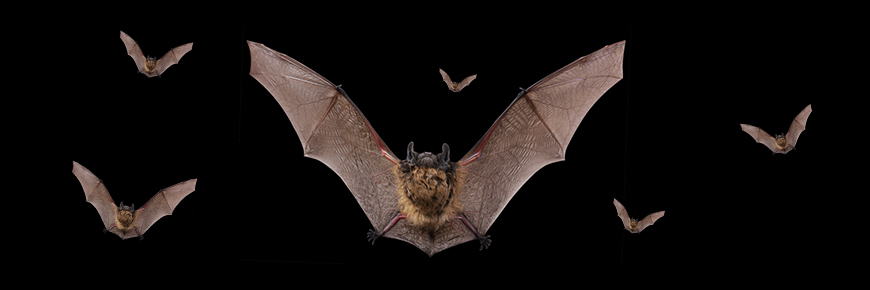
Bats are the only mammals that can fly. And they do this in the dark!
Using a process called echolocation, bats send out sound pulses that bounce off surfaces like buildings and trees. In this way, bats orient themselves is space. They ‘see’ in the dark, navigating their way around obstacles and finding their prey.
Three of the eight bat species found in Ontario – little brown myotis, northern myotis and tri-coloured bat, are protected under the federal Species at Risk Act. (These three bats, along with eastern small-footed myotis are also listed under the Ontario Endangered Species Act). Bat research in Rouge National Urban Park, a collaboration between the Toronto Zoo’s Native Bat Conservation Program and Parks Canada, aims to preserve the diversity of bats found throughout the park. Toby Thorne, a Bat Researcher at the Zoo explains:
“These species became endangered because of white nose syndrome – a fungus found in caves in Europe.” The fungus was introduced to North America in 2006 in Albany, New York State and, by 2010, had made its way to Ontario.
The Northern myotis and tri-coloured bat enjoy natural roosts – holes in or behind the peeling bark of trees. Some, like the little brown myotis, like barns and other buildings. These human-made structures are sometimes a better alternative to a hole in a tree. The space is dark, quiet, protected and also large enough for many of them to huddle together and stay warm.
Research goals
One of the goals of the Parks Canada and Toronto Zoo collaboration is to locate actual and potential habitats and food sources for bats in the park. These areas include forest patches spanning the length of Rouge National Urban Park, as well as wetlands and marshes.
The two teams work together to keep track of bat populations. Parks Canada staff use acoustic monitoring and sightings. Staff at the Toronto Zoo monitor the bats using nets and radio telemetry.
“The research done by the Toronto Zoo provides important information that allows Parks Canada to plan the evolution of Rouge National Urban Park,” says Juliana Skuza, Resource Management Officer. “Research into numbers, locations, potential habitats or foraging areas allows us to create maps that help us with planning future land and asset management projects.”
Projects must consider, for example, how best to manage the decommissioning of an old and dilapidated building in the park that is a current or potential habitat for these species at risk.
“Rouge National Urban Park is an amazing place for bats,” says Thorne. “It has seven of Ontario’s eight species present within its boundaries. While bats are less visible than some other wildlife, they are an important part of our ecosystem and truly remarkable animals.”
Related links
- Date modified :