
Fences in the Sand
Sable Island National Park Reserve
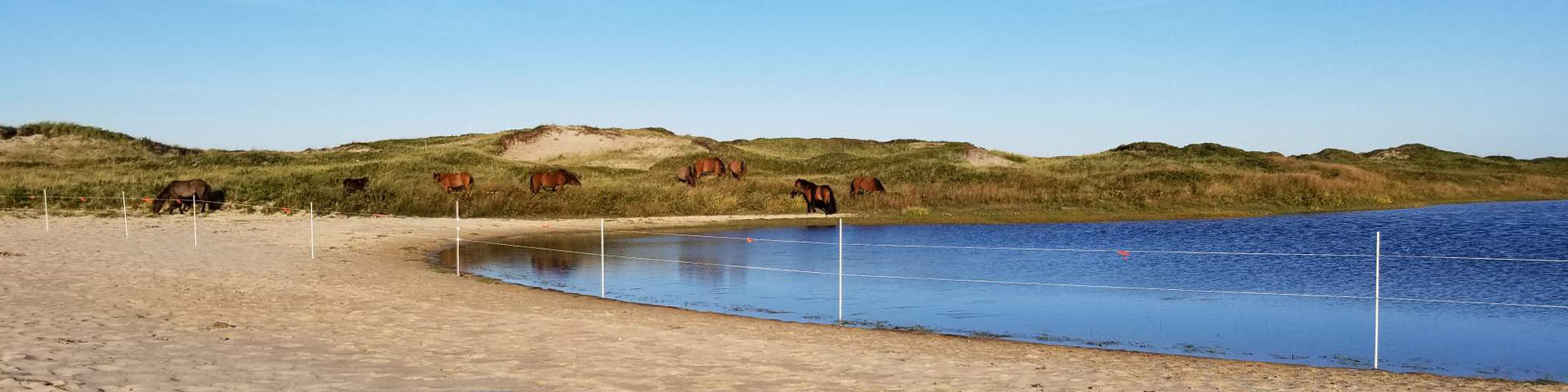
Fences in the Sand was a five-year project (2020-2025) by Parks Canada and the Sable Island Institute. The project used fenced exclosures to study how the wild horses influence the dune ecosystems of Sable Island National Park Reserve.
On this page:
- Videos
- Digital exhibit
- Objectives
- Observations
- Results
- Methods
- Collaboration and funding
- Image gallery
- Related links
Videos
Studying the Sable Island horses | Fences in the Sand | Parks Canada
Transcript
[Gentle piano music]
[Aerial view of blue ocean]
[Ruth] When you're arriving to Sable Island, you're flying out over the ocean. And all of a sudden, this tiny sliver of land appears out of the blue.
[Sable Island, a thin crescent of sand, seen from plane window]
Sable Island National Park Reserve, Nova Scotia
[Aerial view of grassy dunes]
You suddenly realize there's quite a bit of land there, quite a bit of sand and quite a bit of grass.
[Terns diving into a pond]
Every year, landing on the island, it feels like you're coming to a different place, because there's been some small amount of change or bigger changes to dunes and to vegetation.
[A group of horses walking along the beach]
Fences in the Sand
Dr. Ruth Greuel
Project Manager, Sable Island Institute
[Interview with a woman wearing a black sweater and striped wool scarf, sitting in front of reference library shelves]
Dan Kehler
Park Ecologist, Sable Island National Park Reserve
[Interview with a man in Parks Canada uniform, sitting in a Parks Canada museum exhibit]
[Dan] I'm Dan Kehler, the park ecologist for Sable Island National Park Reserve.
[Animation zooming in on Sable Island from a map of the world. Copyright Google Earth]
Sable Island National Park Reserve is the emergent part of a great big pile of sand. This pile of sand sits almost entirely underwater, far off shore in the northwest Atlantic.
[Aerial view of vast sand dune]
The island has existed since the retreat of the glaciers during the last ice age.
[Freshwater pond surrounded by area of fencing]
Today, Parks Canada manages this landscape of towering coastal dunes of intriguing freshwater ponds and broad sandy flats.
[Aerial view of a large group of seals on the beach]
The island is home to thousands of seals, birds, to some globally rare insects, and the only unmanaged population of wild horses in eastern North America.
[Black-and-white archival photos showing settlements and horses on Sable Island]
Humans have had a permanent presence here on Sable Island since 1801, but the horses have been here even longer. Since the mid-1700s, when they were dropped off by some merchants.
[Ruth walking through a tall field of grass]
[Ruth] The Fences in the Sand study is a multi-disciplinary project. That's something that Parks Canada has wanted to do for ages, and the Sable Island Institute has wanted to do for ages as well.
[Sparrow perched on fence]
[Researchers walking along fence line, past freshwater pond]
[Upbeat music]
How does the study work?
[Horses grazing outside of an exclosure]
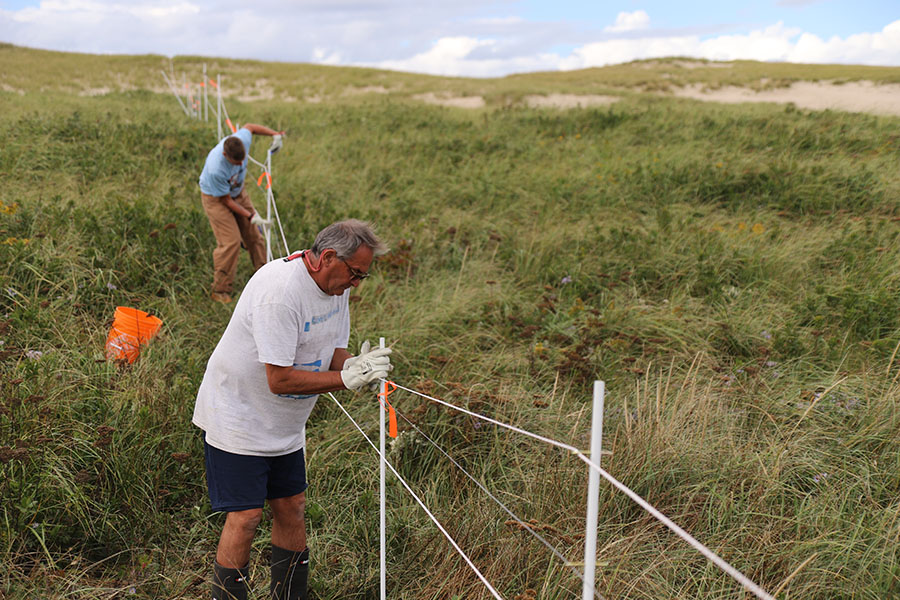
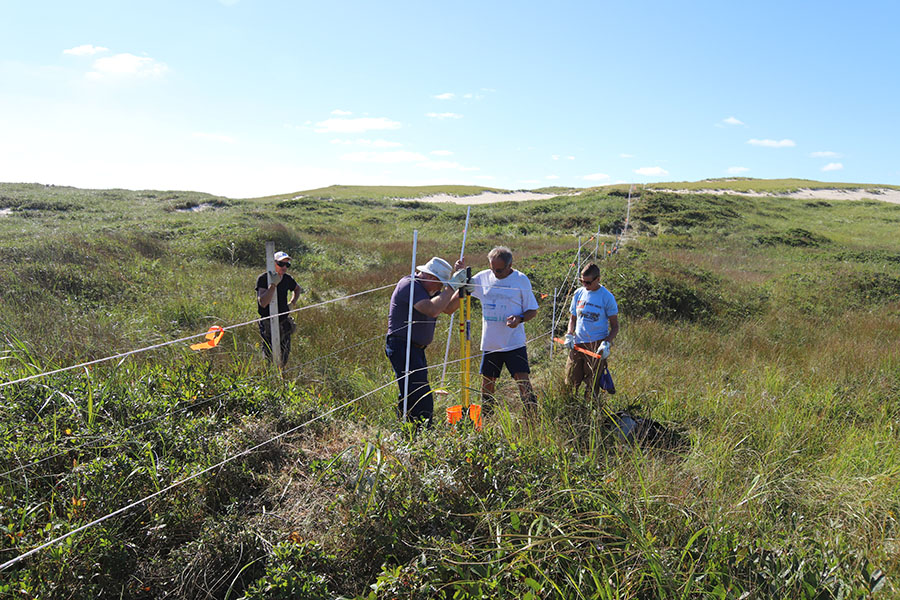
[Parks Canada staff wiring a low electric fence]
[Dan] Exclosures are the foundation of the Fences in the Sand project. We chose electric fencing because it was safest for horses, had the least impact on the environment and was the most cost-effective.
[Ruth] I think grazing exclosures are kind of the ultimate science experiment. It's a really technologically simple way to look at a lot of different processes.
[Photos of volunteers constructing fencing]
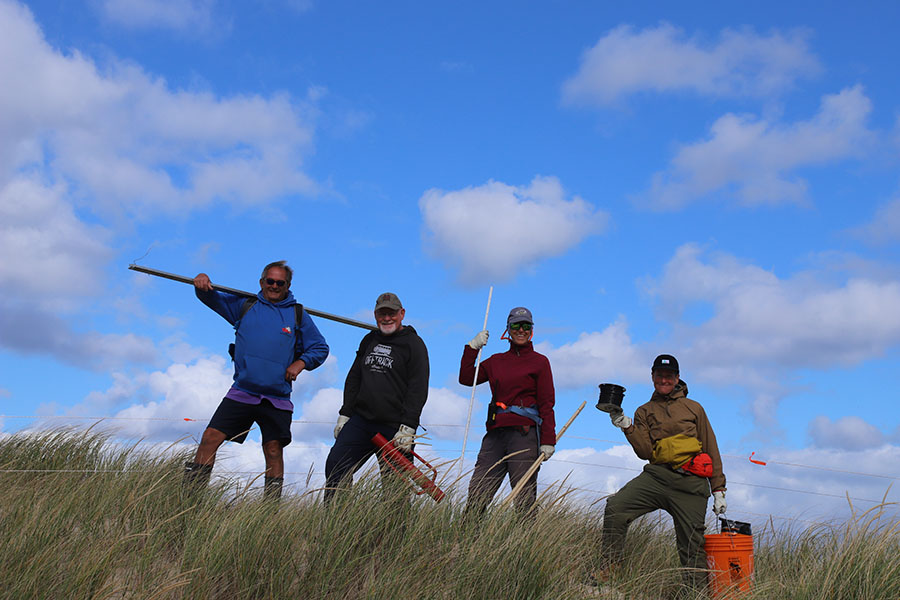
[Dan] With the help of volunteers, we fenced off eight areas across the island that represented different erosional patterns and also included some of the vulnerable freshwater ponds.
[Ruth] Beside each enclosure, there is kind of an area that we treat as the control.
[Dan and Ruth measuring vegetation]
[Montage of researchers studying grassland area]
[Upbeat acoustic music]
[Researcher standing in freshwater pond and collecting water sample]
We were lucky enough to have researchers from all across Canada involved in this project. We have experts in fields as varied as geomorphology, pond ecology, vegetation ecology, horse ecology and entomology.
[Researcher in lab inspecting insect with a microscope]
[Researchers conducting vegetation surveys]
[Dan] Each year, researchers come to the island to carry out projects related to the Fences in the Sand study. However, it's not always the easiest place to work. There are some challenges due to its isolated nature.
[Parks Canada vehicle seen from the window of an airplane that has just landed on Sable Island]
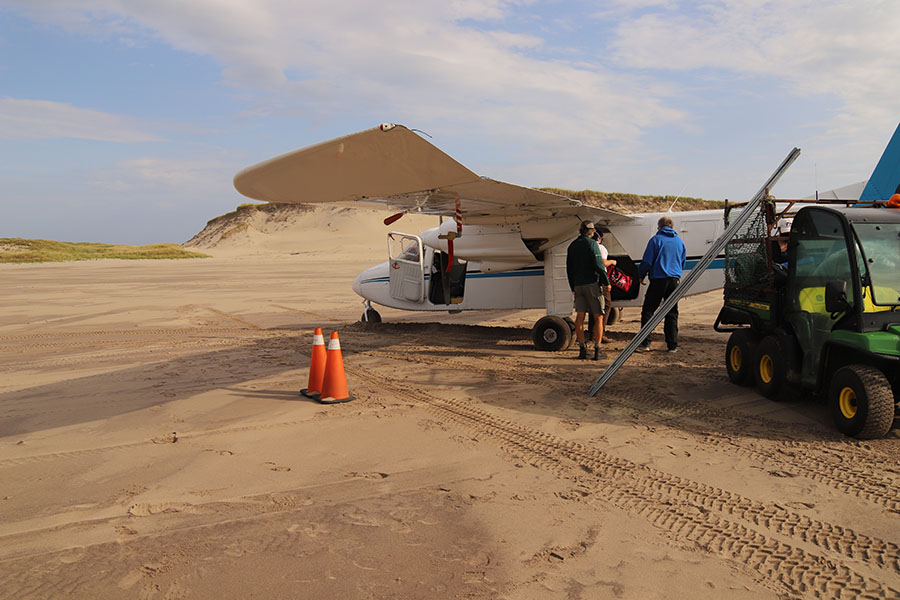
[Aerial view of small airplane landed on the beach]
[Ruth] You have to plan things well in advance to be able to get the supplies you need onto the island. You know, I've worked on the island for many years and I still run up against this problem.
[Researchers walking through field with equipment]
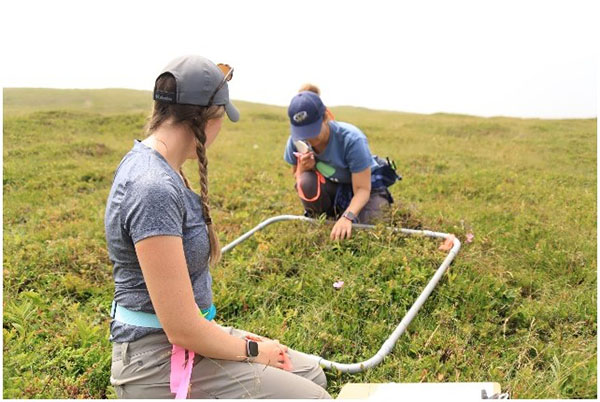
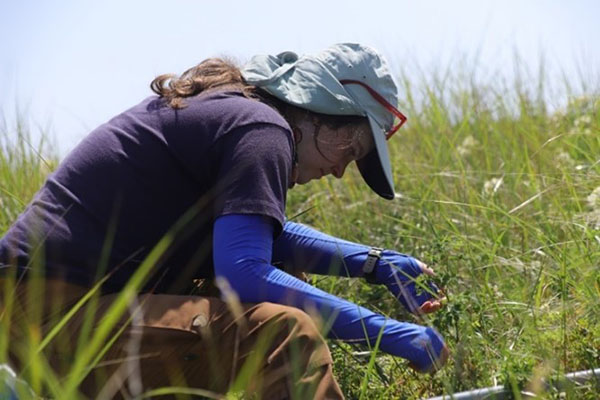
When we're out in the field, we're doing things as diverse as sampling vegetation quadrats, taking soil measurements, collecting pond water samples, or you know, collecting insects.
[Ruth looking at tide chart]
We check the forecast, we check the tides, and then integrate that into our day plan. You don't want to get stranded out on one tip of the island because you might be out there, you know, for 12 hours more than you planned.
[Waves lapping on partially flooded beach at tip of Sable Island]
[Seals bobbing in the water]
[Aerial view of vibrant freshwater pond and grass]
It's a beautiful place to work. When you land there, it's like being on a different planet.
[Aerial view of fog sweeping over the island]
[Dan] We are so lucky to have a great group of scientists interested in helping Parks Canada answer some of the fundamental questions about the ecology of the island.
[Dan, Ruth and a group of researchers gather around a laptop]
[Close-up of map of Sable Island]
In order to better protect Sable Island, it's important to understand how all the elements of the system are connected.
[Family of horses on the beach]
Through this study, we’ll gain some important insights into how the horses are modifying the environment around them, and in turn, how that environment is affecting the horses.
Learn more at parks.canada.ca/fences-in-the-sand
How did Sable Island form? | Fences in the Sand | Parks Canada
Transcript
[Gentle piano music]
[Aerial shot of waves lapping on the shore of a thin sandy island]
Sable Island National Park Reserve, Nova Scotia
[Jordan] Sable Island is just a narrow strip of sand, out in the middle of the North Atlantic ocean.
[Sable Island seen from a plane]
It’s a striking place when you first land on it. You might ask yourself why it exists and how it persists.
[Tall sand dunes]
Geomorphology is the study of the landforms on the earth, how they came to be and the processes that formed them.
Fences in the Sand
Part II: Geomorphology
Jordan Eamer
Scientist, Geological Survey of Canada
[Interview of a man with brown hair, a beard and lip piercing, sitting in front of a green shingle wall]
[Jordan] I'm a research scientist with the Geological Survey of Canada, working on coastal geomorphology and marine geology.
[Jordan shoveling sand from a dune on Sable Island]
I'm a science advisor and project manager for the Sable Island Institute.
The project that I'm managing is the Fences in the Sand project.
[Aerial view of researcher walking along a fence line in an area of grassland on Sable Island]
In 2021, Parks Canada and the Sable Island Institute began a five-year study to examine the influence of horses on their environment: the Fences in the Sand (FITS) project.
Danica van Proosdij
Professor, Saint Mary’s University
[Interview with a woman with white hair, wearing an orange sweater and sitting in a university science lab]
[Danica] I'm Dr. Danica van Proosdij.
I'm a professor in the department of Geography and Environmental Studies at Saint Mary's University, and I'm a coastal geomorphologist on this program.
[Photos showing Danica and Jordan doing field work on the beach on Sable Island]
[Upbeat music]
[Aerial view of dramatic sand dune landscape]
How do dunes form?
[Animated illustration showing waves lapping on the shore and increasing the height of the beach]
Sand arrives at the beach from what's referred to as the nearshore. That's the area which is really close to the water's edge.
And every time the waves are moving over sandbars in that area, they're pushing the sand closer and closer to the beach.
Dune formation is really an interaction of a number of different forces.
[Wind blowing sand across a large, flat beach]
You have wind blowing over the sand body – the beach – that then transports that sand into a vegetated dune.
So the plants trap the sand within it, forming the dune.
[Jordan] In the absence of the vegetation, generally,
there's nothing stopping that sand from continuing on its journey – probably, on Sable Island, to the other side of the island and back into the ocean.
[Rough waves crashing against the beach]
[Danica] Dunes are affected by a variety of different factors.
One would be, definitely, storm surge coming in and eating away at the base of the dune.
The second one would be human impacts like ATV tracks or trampling.
And the third would be the horses, through both their trails and their grazing.
[A group of horses walking through sand dunes]
Horse grazing essentially will reduce the amount of vegetation that's on the dune, which can make the sand more susceptible to being moved by wind.
[Close-up of sand falling from the base of a dune]
[Jordan] The first stop for most of the sand grains coming off the beach is a dune that's on the back of the beach called a foredune.
[Aerial view of beach transitioning to grassland]
But sometimes there's these pathways through those foredunes, that allow sand to go through and into the dunes that lie behind that foredune.
And that pathway is very typically called a blowout.
[Animated illustration showing an eroded area forming in a sand dune, and water entering grassland through the eroded area]
[Danica] - Blowouts basically form a door between dune systems.
And if they're close to the beach, that means that during a storm event, that water can then move through that hallway or that door, and get further into the island.
[Aerial view of large flooded area of beach, where the tops of dunes appear as small islands]
It will wash away whatever is in its path.
[Stormy waves]
With climate change,
there is a greater opportunity for these storms to form and happen more frequently.
[Parks Canada employee walking along the fence line]
[Jordan] - The Fences in the Sand project’s very interesting, because we can control one of the things that's affecting the vegetation.
And by creating these fences and excluding horses from certain parts of the island,
[Horses grazing around the fenced exclosure]
we're able to look at how the dunes might evolve and how the geomorphology of those dunes can change in the absence of horse activity.
[Danica] Exclosures are a really good research tool
because they're physical and they're very visual.
The Fences in the Sand project is one way of us helping to tease out the effects of horses from the natural dynamics of the dune systems.
[Horses canter in front of a grassy dune]
[Parks Canada staff maintaining the electric fence]
So the project provides a really unique opportunity to bring together government, so Parks Canada, as well as researchers from a range of academic institutions,
into the same playground.
[Aerial view of researchers walking along the fence]
And the exclosures really provide that playground space, where we're able to look at the complex interactions from a variety of different lenses.
[Aerial view of waves crashing on the beach]
Sable Island provides us a really unique opportunity to help understand how the sandy systems can and will be responding to sea level rise.
It’s effectively a natural laboratory, if you will.
Learn more at parks.canada.ca/fences-in-the-sand
Grazing on Sable Island | Fences in the Sand | Parks Canada
Transcript
[Gentle piano music]
[Aerial view of Sable Island]
[Wild horses grazing in grassland]
Sable Island National Park Reserve, Nova Scotia
Dr. Ruth Greuel, Project Manager, Sable Island Institute
[Interview with a woman in a black sweater and striped scarf, in front of a bookshelf of reference materials]
[Ruth] I think grazing is just one of the coolest biological processes out there. Grazing herbivores, they shape the landscape and the vegetation by eating it and trampling on it, and then in turn, they're shaped by the landscape.
[Horses walk along a broad sand beach]
Fences in the Sand
Part III: Grazing
Dr. Phil McLoughlin, Professor, University of Saskatchewan
[Video call interview with a man in a white shirt and glasses, seated in an office]
[Phil] The horses, as best as we can tell, were introduced to the island sometime around the middle of the 1700s, and they've been free-ranging and wild ever since.
[Stallions leaping]
[Acoustic guitar]
In 2021, Parks Canada and the Sable Island Institute began a five-year study to examine the influence of horses on their environment:
the Fences in the Sand (FITS) project.
[Wild horses grazing in grasslands]
[Phil] The horses survive on Sable Island by grazing on the plants that are there. In particular, marram grass.
[Shots of marram grass, a flat green grass]
[Ruth] It's a beach grass, tough and hardy, and it is a pioneer grass that really shapes dune ecosystems. It holds them together. It's often thought of as the spine of Sable Island.
[Aerial view of Sable Island showing grass atop the sand dunes]
Not every plant is as hardy as marram grass is.
[Horse eating vegetation in a pond]
Areas where grazing occurs, these areas are very, very trampled. They're grazed right down to the ground.
[Parks Canada staff string wire along a low electric fence running through grassland]
On Sable Island, if you remove, if you cut out an area and horses aren't allowed to go in there, you can see what that removal of grazing does for the plants.
Inside the exclosures, we're seeing quite a bit of that vegetation bounce back, getting a little bit taller, getting a little bit more diverse.
[Montage of different heath vegetation found on Sable Island]
I found an orchid that I've seen a few times on Sable, but it's not terribly common. And this one was as tall as my forearm. It was a 40 cm tall orchid, and that to me felt like a pretty red letter day.
[Aerial view of Sable Island showing a metal lighthouse]
[Phil] One thing that we're really curious about is how, after 250 years on the island, we see major changes in the island. Maybe a third of the plant species are exotic. They're not native to the island.
[Closeup of red clover plants]
[Closeup of horse grazing on short vegetation]
Which species of plants thrive without horses and which species actually need horses?
[Large pile of horse dung in the grass]
[Horse dung in foreground and three horses walking in background]
[Ruth] When horses defecate, urinate or die, that provides nutrients to the plants for them to grow. So by removing that from the exclosures, we are changing how the plants access those nutrients.
[Pile of bones in the sand]
[Parks Canada staff walking along electric fence]
With this study, we're also able to examine if that's going to have an impact on plant growth and nutrient content in the soil.
[Aerial view of Sable Island, showing a large area of beach flooded by seawater]
Sable Island’s a really unique coastal dune ecosystem, and it's subject to a lot of different disturbances.
[Four horses walking along a partially flooded beach]
So being able to understand the interactions between those disturbances is very important.
[Phil] There's really no place else – certainly in Canada, I think – where we can study this.
[Main Station, a group of white buildings surrounded by grass, at sunset]
We get that advantage because it's a protected area and because the horses themselves are protected.
[Marram grass at sunset]
[Ruth] A lot of people have had these questions for a very long time. Being able to have some of these answers and stitch this together in a multidisciplinary way is a really great way to get at some of these really important ecological questions.
[Sunset over the beach]
Learn more at parks.canada.ca/fences-in-the-sand
Transcript
[Gentle piano music]
[Aerial view of researchers walking through grass-covered sand dunes]
Sable Island National Park Reserve, Nova Scotia
[A Parks Canada researcher, sitting in a grassy area, picks up a small bee with a tube and examines it]
[Sherman] When you get on Sable Island and you have a look below your feet and around close up, there's a whole other world that reveals itself. Small insects, invertebrates, tiny flowering plants. A really diverse abundance of life in that ecosystem.
Fences in the Sand
Part IV: Insects
Dr. Sherman Boates
Professor of Science, Acadia University
[Interview with a man with a white beard and glasses, wearing a black sweater]
[Sherman] Sable Island is a relatively small island, only about 30km². Even though it's a small island, we've already discovered about 600 different species of insects and invertebrates.
[Pinned and labelled insects]
[Photo montage showing Sable Island sweat bee, a small black bee]
Sable Island sweat bee
On Sable Island, there are at least six species of endemic insects. An endemic insect is one that occurs on Sable Island and nowhere else in the world.
But what we don't understand is the lifestyle of these insects on this isolated island, where much of the plants that they're dependent on are grazed by horses.
[Group of horses grazing next to a pond]
So we're hoping to understand that better with the FITS project.
[Aerial view of wetland area on Sable Island]
In 2021, Parks Canada and the Sable Island Institute began a five-year study to examine the influence of horses on their environment:
the Fences in the Sand (FITS) project.
[Sherman] There are insects almost everywhere on the island, in the sand dune system, the marram grass and the beach grass,
[Sandy dune area with seals in the distance]
[Closeup of marram grass roots with an insect]
and the important freshwater and heath habitats around the freshwater ponds.
[Aerial view of freshwater pond on Sable Island]
Dr. Andrew Medeiros
Professor of Science, Dalhousie University
[Interview with a man with a grey shirt, short hair and glasses, seated in front of a window with a houseplant]
[Andrew] The ponds on Sable Island are an important water source for all of the wildlife on Sable Island, including the horses.
[Horses on a flat grassy area next to a pond]
So normally there's quite a bit of heath vegetation surrounding these ponds, and that would actually act as a barrier for other things eroding into these landscapes.
[Pile of horse dung in the sand]
There's quite a large amount of fertilizer that's coming into these systems around their surrounding catchments. And all of those nutrients enter the freshwater ponds.
[Surface of pond with algae]
[Andrew in a lab, inspecting insect larva with microscope]
Because they're shallow and have a lot of nutrients in them, they have quite a large number of insects that are in their larval stage.
[Illustration showing insects in the freshwater pond horses are drinking from]
[Sherman] The relationship between the insect population and the horse population is probably very complicated. We're just working now to disentangle it.
[Parks Canada staff coiling wire from electric fencing around exclosures]
[Andrew] The Fences in the Sand project erected a number of fences that exclosed areas on the island from horse activity. So there's going to be less grazing and less trampling of that vegetation.
The vegetation should have an opportunity to regrow. And as that vegetation regrows, you'll have the water quality of the ponds hopefully improve as there won't be as many nutrients entering the system as there once was.
[Large group of horses grazing in grassy field]
[Sherman] One thing to keep in mind is that horses are grazers, vegetarians eating many plants, but also the life cycles of many insects are also tied to particular types of vegetation.
[Illustration showing Sable Island sweat bee in the vegetation next to where horses are grazing]
A very interesting insect, a moth, on Sable Island, is the sand dune wainscot moth.
[Illustration showing moth in marram grassland]
This moth feeds entirely on marram grass roots and creates large patches where they've eaten the roots of marram grass.
[Group of horses moving through marram grass]
[Horse grazing on short grass]
This might have an impact on horses by removing some of the food for horses, but horses also eat a lot of the grass and may remove the habitat for the moth.
[Parks Canada researcher sorting collected insects]
We're measuring the diversity and the abundance of insects inside, where there's no horse grazing, and outside where horses are grazing.
[Parks Canada researcher setting up light trap]
We're doing a number of different studies. One involves light traps, which we use to catch and look at nocturnal insects.
[Close-up of researchers pouring water into a cup to make a pitfall trap]
Another method we employ is called a pitfall trap, which is just a small plastic cup which is placed in the sand, and insects walk along and fall into the trap and then we can look at them.
[Closeup of pinned white moth under a microscope]
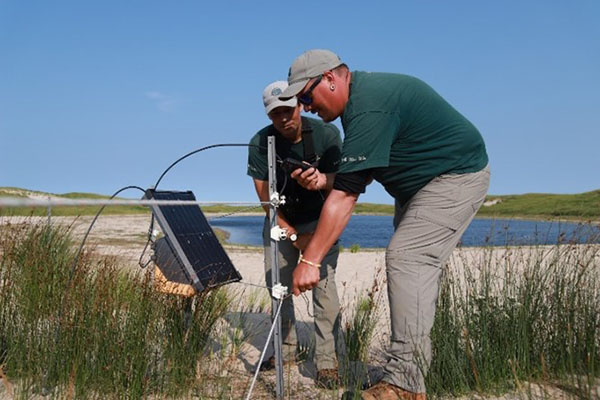
[Researcher installing recording device on wooden stake]
We're also putting recording devices out and recording the sounds of insects, and we can use those recordings to detect differences in the insect abundance where there are horses and where there aren’t horses.
[Closeup of pinned moths]
[Parks Canada researcher collecting water sample from large freshwater pond]
[Andrew] So when we sample the freshwater ponds on Sable Island, we collect a small amount of water and sediment from the bottom of the pond to understand the biology of the system in its current state, as well as the past.
[Horse drinking from pond]
[Illustration showing cross-section of freshwater pond]
When you have nutrients added to these systems over time, some of those nutrients will end up in the sediments below as sediments build up over time. And that can actually create a storybook archive of what happened at the point when they were deposited.
[Aerial view of vibrant Sable Island beach]
[Sherman] - Doing research on Sable Island, of course, it's a visually magical island with all kinds of beauty. But to me, the most fascinating part is how on this small crescent of sand, there are so many unique, beautiful insects that we know very little about.
[Closeup of pinned insects]
[Closeup of spider-web in the grass]
The Fences in the Sand project is important because we want to not just have the names of all the plants and animals that live on the island,
[Bee on flower]
but we want to understand how they're interconnected and how one affects another.
[Horse and foal grazing on sand dunes]
[Aerial view of crashing waves on beach]
It's important to understand unique ecosystems like Sable Island, because they are one of a kind in the world.
Learn more at parks.canada.ca/fences-in-the-sand
Digital exhibit
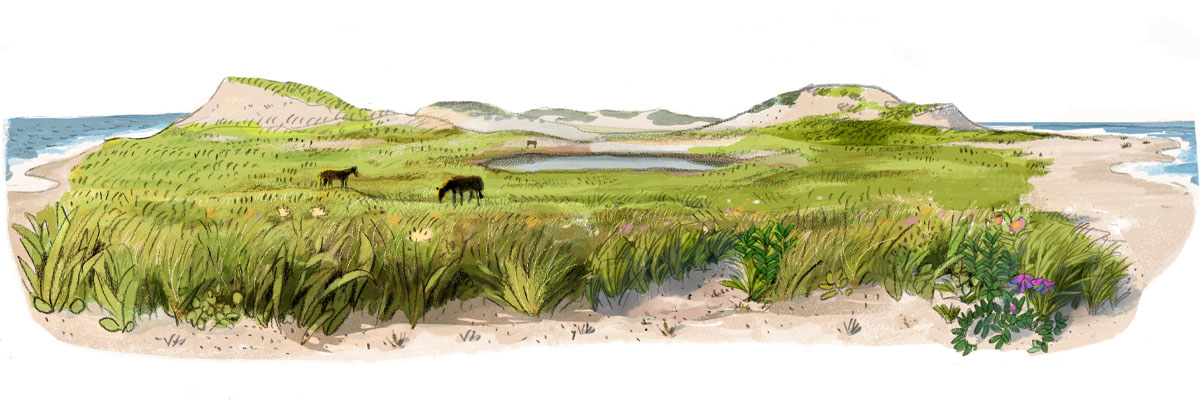
Dive into this Google Arts & Culture: Fences in the Sand exhibit to learn more about the research project through photos, artwork and 360-degree video footage.
Objectives
The goal of the study was to understand the direct and/or indirect influences of the wild horses on:
- Dune processes (like erosion)
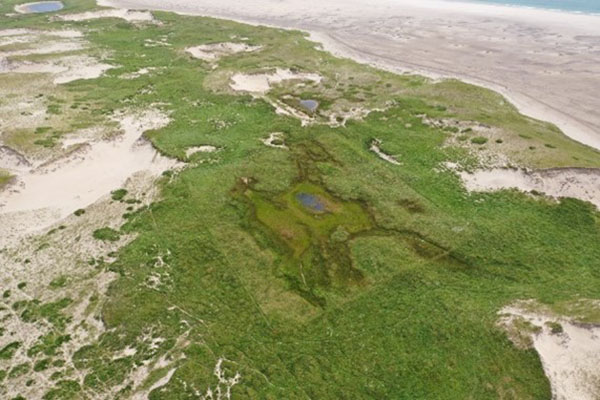
- Ecological integrity of freshwater ponds, including rare plants, water quality and invertebrates
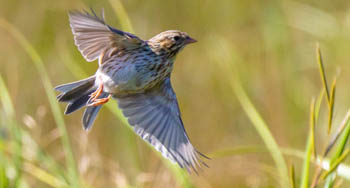
- Rare species and their habitats, including Roseate terns, Ipswich Sparrows and rare or endemic insects – including observing changes in plant and soil characteristics
This important work enables Parks Canada to deliver on its commitments to maintain ecological integrity at Sable Island National Park Reserve.
Observations
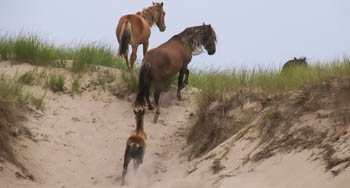
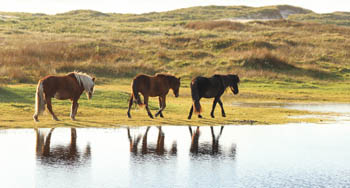
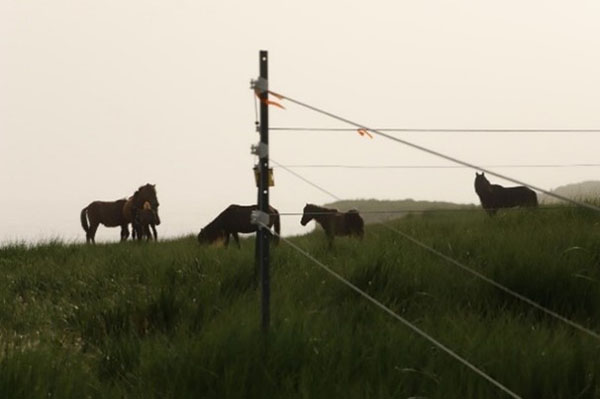
The exclosures have been effective in keeping the horses excluded.
Vegetation has visibly changed within the exclosures:
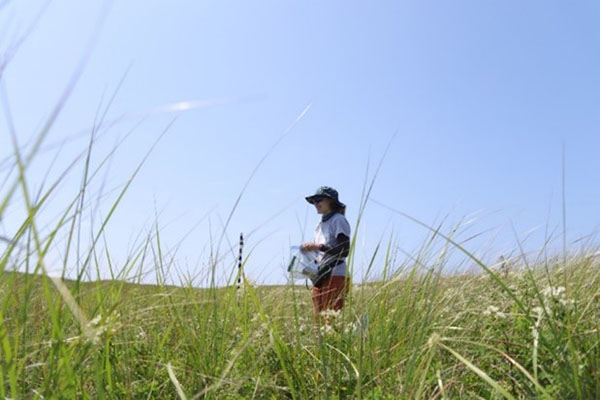
- Plants grow taller and denser
- Areas previously bare of vegetation have filled in
- Changes are more subtle in the summer months
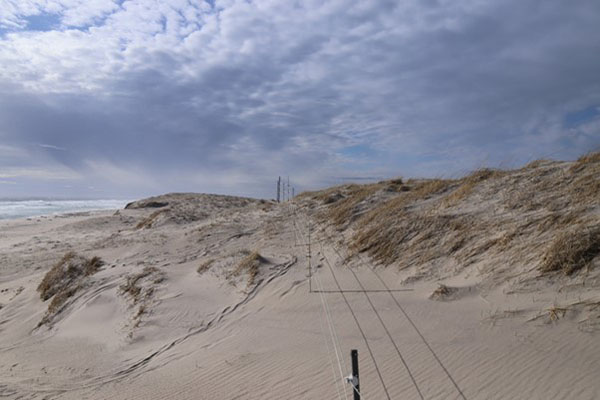
- In winter, dead marram grass traps more sand, making the dunes uneven around the clumps — over time, this will help the dunes grow and become more stable
Results
Researchers are currently in the process of analyzing the data. A final report by Parks Canada will be available when the analysis is complete.
Parks Canada and the Sable Island Institute are preparing a long-term plan for the exclosure fences.
Methods
Exclosures
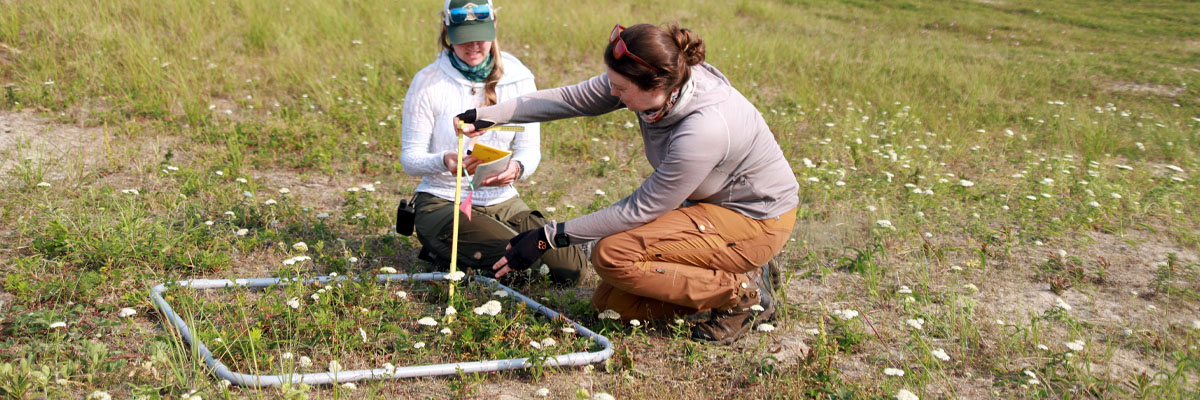
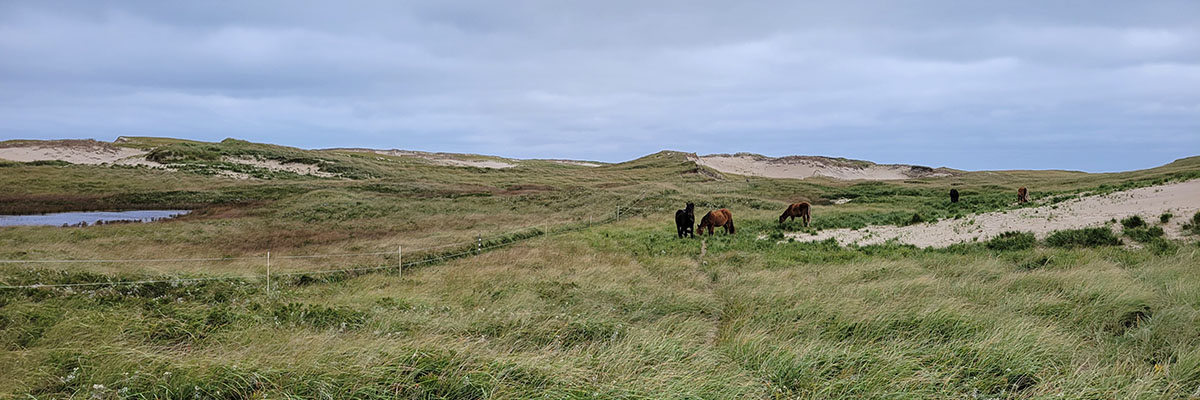
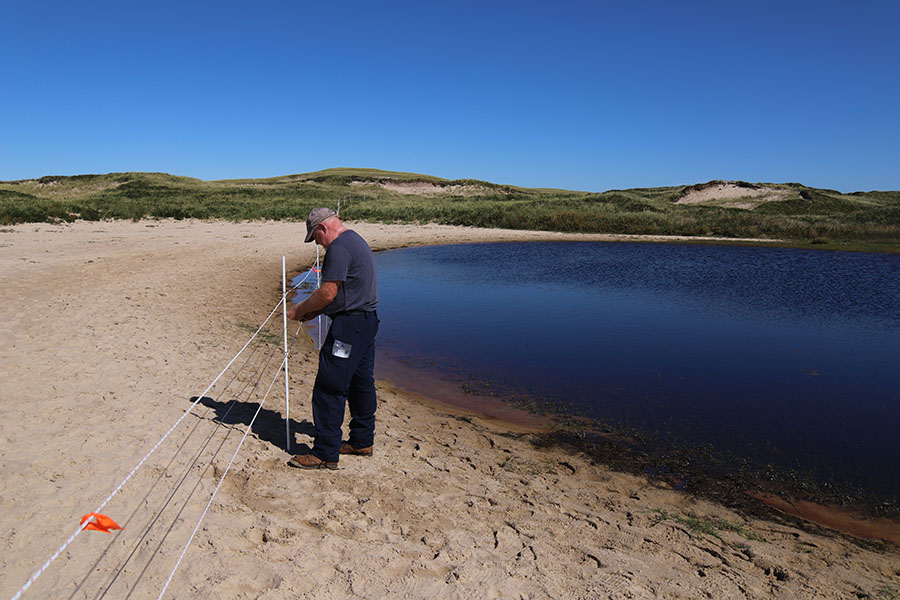
Temporary fences were installed to create exclosures to keep the wild horses from walking through or grazing in nine small (one hectare) areas on the island and three small ponds.
Total area of the island inside the exclosures:
- 0.6% of the total vegetated area of the island
- ~5% of the freshwater reserves
Several control sites were identified in similar areas on the island. The control sites remained open to the horses and were not fenced in.
Scientists studied key ecological attributes inside the exclosures and in the control sites.
Ensuring the well-being of Sable Island’s horses
Since their protection in 1961, the horse population has been steadily increasing with the population fluctuating between 450 and 550 in recent years. Parks Canada considers the Sable Island horses part of the island’s ecosystem and, as such, protects them as wildlife under the Canada National Parks Act and the National Parks Wildlife Regulations.
Use of electric fences
Electric fences are regularly used for horses and are designed to startle, not harm the animals. After consulting with experts in the field, electric fences were deemed to be the safest. The fences are checked regularly to ensure the safety of horses.
Access to food
The exclosures are a very small fraction (0.6%) of the vegetated area of the island. There has been no indication that foraging is limited for the horses, as their population has been steadily increasing since 1961.
The horses are not tame and do not depend on humankind for survival. The horses feed primarily on the abundant marram, or beach grass, that covers a third of the island’s surface. They supplement their food intake by eating various other plants, such as beach pea, sandwort, and even some algae that washes up on the beach.
Access to water
Three smaller ponds representing 5% of the freshwater area on the island are also fenced in, or exclosed. The pond exclosure locations were selected in areas where there are alternate sources of water from nearby ponds.
Horses access freshwater from:
- many ponds on the island
- wells that they dig themselves
- abundant standing water in the wetter seasons
Collaboration and funding
The Fences in the Sand project is a collaboration between Parks Canada and the Sable Island Institute.
A Parks Canada Conservation and Restoration (CoRe) program
The Fences in the Sand project is part of the Parks Canada Conservation and Restoration (CoRe) program. The Government of Canada provides a federal investment of $15 million annually to support high priority projects that make a difference on the ground in maintaining or restoring ecological integrity and helping in the recovery of species at risk.
Related links
- Date modified :