
Management planning
Pacific Rim National Park Reserve
Planning the future together
Nine First Nations and Parks Canada are co-developing the next management plan for Pacific Rim National Park Reserve. The plan will include a collective vision for the entire national park reserve, with specific management strategies, objectives, and targets for the West Coast Trail, Broken Group Islands, and Long Beach units. This plan will guide decisions to protect, present, and operate the national park reserve together over the next ten years.
The plan is anticipated to be completed by late 2027.
Many of the nine Nations are involved through management planning working groups, with representatives appointed by each Nation’s leadership. These representatives consult with their leadership and communities and provide advice on the process. Some of the Nations have chosen to be involved through occasional meetings and official correspondence.
There will be opportunities for the Nations’ community members and citizens, other interest-holders, and the public to provide their feedback as the plan is being co-developed. News and updates will be posted on this webpage.

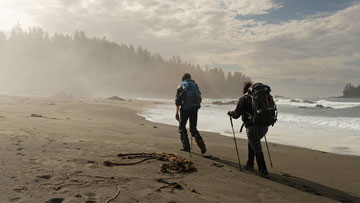
Long Beach Unit:
Current stage
Scoping
West Coast Trail Unit:
Current stage
Consultation feedback analysis
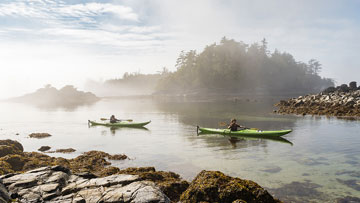
Broken Group Islands Unit:
Current stage
Scoping
On this page
A co-developed approach
First Nations ancestral territories and Pacific Rim National Park Reserve
The ḥaḥahuułi (ha-ha-hool-thee) or disib̓aʔk (dis-say-bak) (ancestral territories) of the Ditidaht, Hupacasath, Huu-ay-aht, Pacheedaht, Tla-o-qui-aht, Toquaht, Tseshaht, Uchucklesaht, Yuułuʔiłʔatḥ span the southern part of the west coast of Vancouver Island. These Nations each have their own territories, laws, and practices, yet they are connected to each other through familial bonds and shared aspects of language, tradition, and culture. Each Nation has their own birthplace and creation story, and they remain firmly rooted in the lands and waters of their home places. Their relationships with their territories have supported their social, cultural, economic, and spiritual well-being for millennia.
Pacific Rim National Park Reserve intersects with the territories of nine First Nations:
Ditidaht First Nation
Hupacasath First Nation

Huu-ay-aht First Nations
Pacheedaht First Nation

Tla-o-qui-aht First Nation
Toquaht Nation
Tseshaht First Nation
Uchucklesaht Tribe

YuułuɁiłɁatḥ (Ucluelet First Nation)
Ditidaht First Nation
Hupacasath First Nation
Huu-ay-aht First Nations
Pacheedaht First Nation
Tla-o-qui-aht First Nation
Toquaht Nation
Tseshaht First Nation
Uchucklesaht Tribe
YuułuɁiłɁatḥ (Ucluelet First Nation)
Pacific Rim National Park Reserve was established without consultation with these Nations, and without recognizing them or their governance systems. The national park’s “reserve” designation means that Canada and the Nations can amend the boundary through legal decisions, treaties, or agreements. Today, the nine Nations and Parks Canada cooperatively manage the national park reserve through cooperative management boards, shared decision-making tables, or on a project-by-project basis.
Shared decision-making
Engagement and consultation
The management planning working groups for each unit of the national park reserve are at different stages in the management planning process. Each working group will decide by consensus the best approach for engagement and consultation.
The purpose of engagement and consultation is to provide opportunities for First Nations community members and citizens, as well as other partners, interest-holders, and the public to be informed about the process and to provide feedback on the priorities developed by the working group for the co-management of each national park reserve unit.
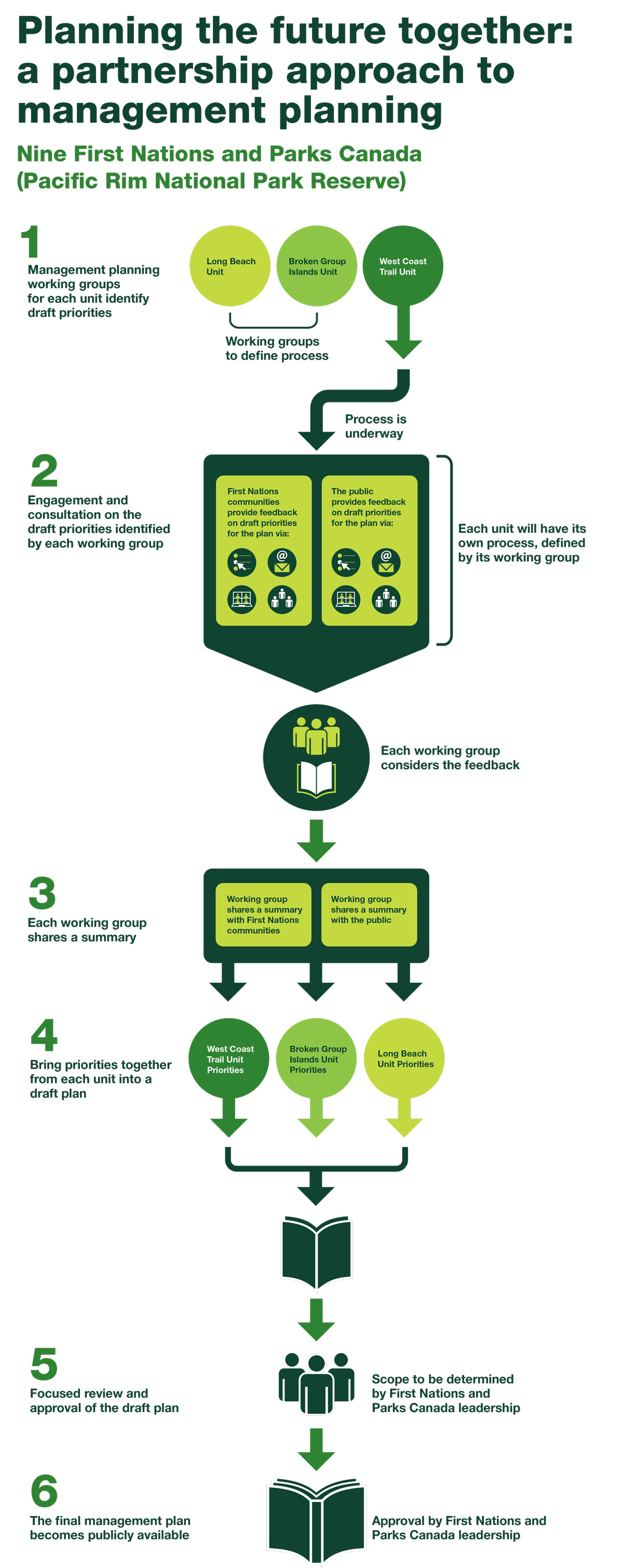
This flowchart illustrates six steps in the current management planning process for Pacific Rim National Park Reserve, highlighting the public engagement and consultation processes for the West Coast Trail Unit.
The goal is to co-develop a final plan in one document that includes an overarching vision for Pacific Rim National Park Reserve and the planning direction for each unit.
-
Descriptive text
Planning the future together: a partnership approach to management planning
Nine First Nations and Parks Canada (Pacific Rim National Park Reserve)
Step 1
Management planning working groups for each unit identify draft priorities.
Long Beach Unit and Broken Group Islands Unit – working groups to define priorities.
West Coast Trail Unit - process is underway.
Step 2
Engagement and consultation on the draft priorities identified by each working group.
Each unit will have its own process, defined by its working group.
West Coast Trail:
First Nations communities provide feedback on draft priorities for the plan via:
Survey, virtual session, in-person sessions, email/mail.
The public provides feedback on draft priorities for the plan via:
Survey, virtual session, in-person sessions, email/mail.
Each working group considers the feedback.
Step 3
Each working group shares a summary of the feedback.
Working group shares a summary with First Nations communities.
Working group shares a summary with the public.
Step 4
Bring priorities together from each unit into a single draft plan.
• West Coast Trail Unit priorities
• Broken Group Islands Unit priorities
• Long Beach Unit priorities
Step 5
Focused review and approval of the draft plan.
Scope to be determined by First Nations and Parks Canada leadership.
Step 6
Approval by First Nations and Parks Canada leadership.
The final management plan becomes publicly available.
Parks Canada’s commitments
The Government of Canada is committed to truth, reconciliation, and renewed relationships with Indigenous Peoples, based on a recognition of rights, respect, collaboration, and partnership.
Many heritage places administered by Parks Canada have seen a transition over time from a past where Indigenous Peoples were separated from their ancestral lands and waters to the present, where Parks Canada works with Indigenous Peoples towards a collaborative approach to managing these sites. This supports the United Nations Declaration on the Rights of Indigenous Peoples Act (UNDA) Action Plan.
In response to the Truth and Reconciliation Commission’s Call to Action 79, Parks Canada has committed to making space for Indigenous Peoples’ histories, voices, and perspectives at heritage places. Parks Canada collaborates with over 300 Indigenous partners in many ways, including shared governance in the operations and management of places administered by Parks Canada.
What is a Parks Canada Management Plan?
A Parks Canada management plan is the main public accountability document that guides how a national park, national park reserve, national historic site, or national marine conservation area is cared for and managed over a ten-year period.
A management plan guides decision-makers as they:
- Protect natural and cultural resources – Setting measures and goals to manage wildlife, ecosystems, and cultural heritage.
- Facilitate visitor experiences – Planning how people can safely visit, learn about, and enjoy the place.
- Work together – Including the knowledge, priorities, and rights of Indigenous partners and communities connected to the place.
- Work with others – Facilitating collaboration with partners and interest-holders on common interests.
- Plan for infrastructure needs – Infrastructure assessment, maintenance, signage, buildings, trails, and access routes.
- Prepare for challenges – Helping to respond to challenges such as climate change, fluctuating visitor attendance, emergencies, and environmental threats.
- Make decisions – Informing sound decisions about where to invest financial and human resources.
Under the Canada National Parks Act, each Parks Canada-administered heritage place must review their management plan every ten years.
Plan review and implementation process
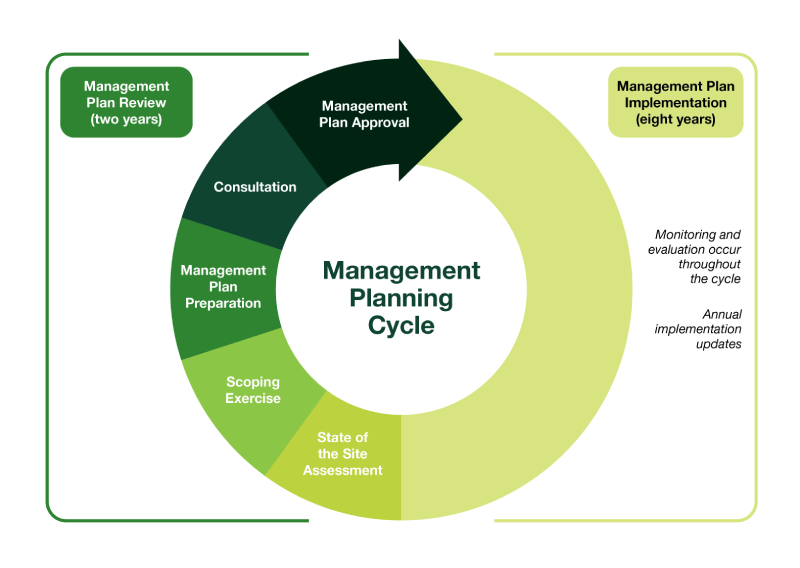
Management plan review and implementation is a continuous cycle of engagement and consultation, decision-making, implementation, evaluating, and reporting.
In the unit-based management planning approach for Pacific Rim National Park Reserve, each respective working group is co-developing:
- A State of the site assessment, which summarizes the current state of the national park reserve unit, by reviewing ecological monitoring data, cultural resource information, visitor experience information, and the relationships between Parks Canada and First Nations, and with other partners and interest-holders.
- A scoping exercise, which identifies priorities, key challenges, and opportunities.
- The key strategies, objectives, and targets for each unit that will go into the final plan.
- An engagement and consultation approach to provide opportunities for feedback from First Nations community members, other interest-holders, and the public.
Once those steps are complete:
- The final plan will be approved by leadership of the First Nations and Parks Canada.
- The national park reserve will report annually on progress in implementing the management plan.
For a copy of Pacific Rim National Park Reserve’s 2010 Management Plan contact: pacrim.info@pc.gc.ca
-
Descriptive text
Circular graphic showing the ten-year Management Planning Cycle, moving clockwise from the top with management plan implementation for eight years (from 12 o’clock to 6 o’clock), then moving clockwise through the planning steps listed in the text for the remaining two years (from 6 o’clock up to 12 o’clock).
Ways to stay connected
- News and updates will be posted on this webpage.
- Follow us on social media:
- Contact us by email at any time at: pacrim.info@pc.gc.ca
Related links
- Date modified :