Rideau Canal Cultural Landscape Study – Ottawa Reach
Rideau Canal National Historic Site
The Rideau Canal is one of the defining features of the National Capital Region. It is designated as a UNESCO World Heritage Site, a national historic site of Canada, and a Canadian heritage river. Residents and visitors alike cherish the beauty and recreational opportunities this waterway brings to the city.
Parks Canada, the National Capital Commission (NCC), and the City of Ottawa commissioned Matrix Heritage to produce a cultural landscape study for the Ottawa urban section of the Rideau Canal corridor, known as the Ottawa Reach. Presented to the City of Ottawa’s Built Heritage Committee in July 2026, the study is an important tool that will support the three partner organizations in the stewardship and management of the canal and its surroundings.
Learn more about the roles and responsibilities of each partner organization:
About the study
The Rideau Canal Cultural Landscape Study – Ottawa Reach outlines the heritage values and character-defining elements of the Ottawa Reach of the Rideau Canal. It also provides guidance on how these heritage features can be protected, enhanced, and celebrated for the benefit of current and future generations.
The study focuses on the Rideau Canal itself, its immediate surroundings, and adjacent areas that have a significant influence on the canal’s cultural landscape.
The Rideau Canal Cultural Landscape Study will be a guiding document for the three partner organizations to inform their respective planning, reporting, project development, and review of internal and external proposals for both the lockstation grounds and the lands along the Rideau Canal.
Study Area
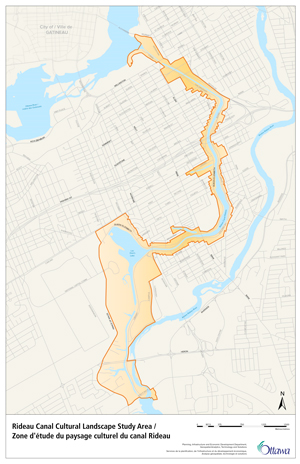
The study area covers approximately 8.5 kilometres of the Rideau Canal within Ottawa’s urban core. It stretches from the Ottawa Locks at the Ottawa River in the north to the Hogs Back Locks and Falls in the south.
Character Areas
In addition to identifying the overall heritage values, character-defining elements, and conservation guidance for the Ottawa Reach as a whole, the study identifies seven distinct Character Areas, each with its own attributes and area-specific ways to help conserve what makes these sections of the Canal special:
Entrance Valley
With its iconic views and well preserved historic landscape, Entrance Valley served as the Rideau Canal’s administrative and transportation hub. It reflects both early 19th century waterway travel and later railway development in Canada’s Capital.
Plaza
This area illustrates the Rideau Canal’s evolution from a military waterway to a recreational and cultural destination. Landmark buildings, bridges, and green spaces such as Confederation Park contribute to its role as a vibrant gathering space for public events and community life.
Laurier to Bronson
Known for its innovative canal engineering used along the Deep Cut and Mutchmor’s Cut, this section helped shape Ottawa’s urban development. Its scenic and recreational qualities are defined by parkways, natural features, and unique sections like Patterson Creek Park and Brown’s Inlet.
Dow’s Lake
An outstanding example of the Canal’s original slackwater technology, Dow’s Lake has strong cultural and social associations through seasonal festivals, and its scenic natural and designed landscapes support recreation and ecological diversity while offering iconic Capital experiences.
Hartwells and Hogs Back
This area showcases the engineering ingenuity required to overcome challenging terrain. Locks, dams, natural features, military heritage, and evolving Capital landscapes create a rich and memorable visitor experience.
Queen Elizabeth Driveway
Ottawa’s first scenic parkway, Queen Elizabeth Driveway was created to enhance the beauty of the Capital. Its attractive design and picturesque landscapes, combined with its long-standing role as a recreational corridor linking key green spaces, continue to shape the character of the surrounding neighbourhoods and public spaces.
Colonel By and Echo Drives
Developed as part of broader Capital beautification and ceremonial planning efforts, these scenic drives offer magnificent views of the Rideau Canal and have influenced the surrounding residential development and the area’s strong architectural and experiential qualities.Engagement
Indigenous Engagement
The histories and perspectives of the Algonquin Nation are integral to understanding the cultural landscape of the Rideau Canal’s Ottawa Reach.
Engagement with the Algonquins of Pikwakanagan First Nation (AOPFN) and the Algonquins of Ontario took place throughout 2024 and 2025. This included a presentation on the project at an in-person meeting of the Algonquin Advisory Committee, organized by the AOPFN Consultation Office and supported through a collaboration agreement.
Through this engagement, several key areas of interest were identified, including:
- Conservation of terrestrial and aquatic wildlife;
- Water quality;
- Protection of culturally significant plant species;
- Increased visibility of Algonquin history and culture; and
- Protection of spiritual, archaeological, and heritage places along the Rideau Canal
Building on this work, Parks Canada, the NCC and the City of Ottawa will continue to engage with the Algonquin Nation, in line with their respective mandates, as part of ongoing management of the Ottawa Reach and future projects.
Public Participation
The study’s engagement activities gathered input from local communities, stakeholders, and the broader public through an online survey, two public engagement kiosks, and stakeholder meetings.
More than 335 people participated in kiosks held in November 2023 at the Minto Recreation Complex and the Aberdeen Pavilion at Lansdowne Park. The online Rideau Canal Cultural Landscape Survey, open from November 17 to December 8, 2023, received 2,640 responses. Additional online discussions with community groups, businesses, and property owners in the study area took place in September 2023 and February 2024.
The following public engagement themes emerged:
- The corridor is important for multi-modal transportation.
- Environmental concerns should inform decision making.
- Green space is important for relaxation and recreation.
- The Rideau Canal is an important landmark.
- The Rideau Canal’s history should be recognized and preserved.
- The corridor’s natural beauty should be preserved.
Public and stakeholder participation were important elements in the development of the Rideau Canal Cultural Landscape Study – Ottawa Reach. Feedback provided through the engagement program informed the study’s conclusions and recommendations.
A comprehensive review of engagement activities is available in Appendix 9 of the study.
Contact
Ontario Waterways
Parks Canada
34 Beckwith Street South
Smiths Falls, ON K7A 2A8
Related links
- Water Management InfoNet
- Jobs on the Rideau Canal
- Real property, occupation and development
- Rideau Corridor Landscape Strategy
- Film & Video productions
- Commercial permits
- Rideau Canal and Merrickville Blockhouse National Historic...
- Contact
- Notice of Mooring Restrictions
- LaSalle Causeway boater access
- Date modified :