
For the week of April 6, 2026.
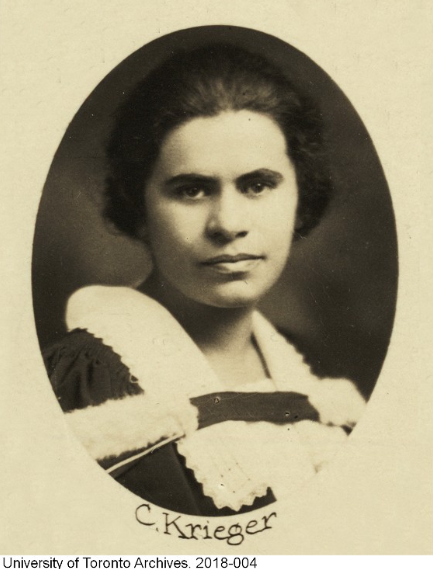
On April 9, 1894, Dr. Cecilia Krieger was born into a Jewish family in Jasło, then part of Austria-Hungary and now Poland. She later moved with her family to Toronto, Ontario, to escape rising antisemitism. There, she became the first woman in Canadian history to earn a doctorate in mathematics. Krieger made important contributions to her field and helped other Canadian women pursue careers in science and mathematics.
Krieger was studying mathematical physics at the University of Vienna in 1920, when her family made the difficult decision to move to Toronto to escape growing anti-Jewish violence. Krieger immediately enrolled at the University of Toronto to continue her studies. She took private lessons to improve her English and worked a summer job at a Muskoka inn to fund her education. At the University of Toronto, she likely faced barriers to full participation in campus life given that gender-based segregation and the exclusion of Jewish people were common practices at the time.
Krieger persisted, earning her bachelor’s (1924), master’s (1925), and doctoral (1930) degrees in mathematics. Her doctoral thesis was published in two parts: On the summability of trigonometric series with localized properties in 1928, and On Fourier constants and convergence factors of double Fourier series in 1930. Krieger was only the third Canadian and the first woman to complete doctoral studies in mathematics.
Krieger worked at the University of Toronto after graduation as a lecturer but did not receive an appointment as assistant professor until 1942, when wartime personnel shortages made it easier for women to gain promotions in academia. She held this position for the next 20 years. During that time, she published her best-known works: English translations of Introduction to General Topology (1934) and General Topology (1952) by Polish mathematician Wacław Sierpiński. Krieger added a 30-page appendix to General Topology that has been celebrated for its discussion of the theory of infinite cardinals and ordinals.
Krieger was also an outspoken advocate for women’s equal opportunity for education as an active member of the Canadian Federation of University Women, founded in 1919 to unite women scholars and break down gender-based barriers in academia. She served as the convener of its scholarship committee, helping young women gain access to the funds they needed to pursue higher education. In honour of her work, the Canadian Mathematical Society made her one of two namesakes of the Krieger-Nelson Prize, established in 1995 and awarded annually to Canadian women who have made outstanding contributions to the study of mathematics.
In 1953 Krieger married Dr. Zygmunt Dunaij, a physician and Holocaust survivor. She officially retired from the University of Toronto mathematics department in 1961 but continued to teach for five more years. After the death of her husband in 1968, Krieger joined the faculty of Upper Canada College in Toronto, where she taught until her death on August 17, 1974.
The Canadian Federation of University Women was designated a national historic event in 2011. The Historic Sites and Monuments Board of Canada advises the Government of Canada on the commemoration of national historic events, which evoke significant moments, episodes, movements, or experiences in the history of Canada.
The National Program of Historical Commemoration relies on the participation of Canadians in the identification of places, persons, and events of national historic significance. Any member of the public can submit a subject to the Historic Sites and Monuments Board of Canada. Learn how to participate in this process.