
For the week of February 3, 2025.
NOTE: The Residential School System is a topic that may cause trauma invoked by memories of past abuse. The Government of Canada recognizes the need for safety measures to minimize the risk associated with triggering. A National Residential School Crisis Line has been set up to provide support for former residential school students and their families. You can access information on the website or access emotional and crisis referral services by calling the 24-Hour National Crisis Line: 1-866-925-4419.
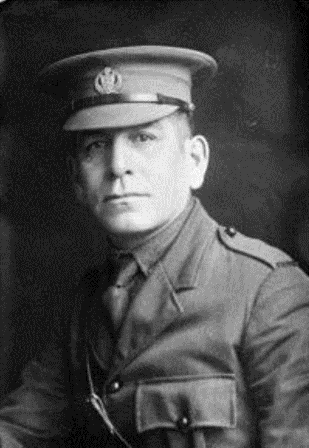
On February 3, 1861, Onondeyoh (Fred Loft) was born to George Rokwaho Loft and Ellen Smith at Six Nations of Grand River in southwestern Ontario. He went on to serve in the Canadian Expeditionary Force during the First World War (1914–1918) and played an important role in advocating for Indigenous rights in the years that followed.
In 1873, Onondeyoh (“Beautiful Mountain”) attended the Mohawk Institute, a residential school in Brantford, Ontario. Like all residential schools, it sought to assimilate Indigenous children and repress their cultures. The conditions at the school were poor, Onondeyoh later recalled one of many issues he faced while there: “In winter the rooms and beds were so cold that it took half the night before I got warm enough to fall asleep.” After a year, he transferred to a public school in the neighbouring town of Caledonia. He excelled and earned a scholarship to attend the Ontario Business College in Belleville in 1885. Starting in the 1890s, he petitioned the Superintendent-General of Indian Affairs for the end of residential schools and the improvement of education for First Nation children.
During the First World War, Onondeyoh encouraged Indigenous men to enlist in the Canadian Expeditionary Force, as he did in 1917, despite being too old for military service. He was initially assigned to the 256th Infantry Battalion and then made a lieutenant in the Canadian Forestry Corps. Approximately 4,000 First Nations men (or 35 percent) served, defending a country that did not afford them the full rights and freedoms of citizenship. In 1917, the Six Nations Confederacy honoured Onondeyoh with a pine tree chieftainship for his leadership role, making him an official representative of the council. Onondehyoh used his new status to secure an audience with King George V at Buckingham Palace in 1918, during which he raised the issue of First Nations autonomy.
Back in Canada in 1918, Onondeyoh led the creation of the League of Indians of Canada, the first national political organization for all First Nations peoples. That year, it held a regional meeting at Ohsweken, Ontario, where discussion focused on the lack of respect for Treaty rights and the expropriation of reserve lands. This was followed by the first national meeting, held at Ketegaunseebee (Garden River First Nation) in 1919. The League saw push back from the Department of Indian Affairs, which enforced strict limits set out in the Indian Act. It limited how the League could spend its funds banning spending on lawyers and other legal means. The Department of Indian Affairs at the same time made a failed attempt to enfranchise Onondeyoh, as a way to strip him of “Indian Status” under the law.
Onondeyoh left Canada in 1926 to care for his ill wife in the United States. When he returned to Toronto in the early 1930s, he continued his activism until his death in 1934. The League only lasted a few years longer but was later reborn as the National Indian Brotherhood, which became the Assembly of First Nations in 1982.
Onondeyoh (Fred Loft) was designated a national historic person in 2019. The Historic Sites and Monuments Board of Canada advises the Government of Canada on the commemoration of national historic persons—individuals who have made unique and enduring contributions to the history of Canada.
The National Program of Historical Commemoration relies on the participation of Canadians in the identification of places, persons, and events of national historic significance. Any member of the public can submit a subject to the Historic Sites and Monuments Board of Canada. Learn how to participate in this process.