For the week of August 25, 2025.
On August 31, 1836, the Nova Scotia Horticultural Society presented a report to the legislative assembly and the people of Halifax that proposed the building of a public garden. It opened in 1837 and became part of the Halifax Public Gardens in 1874, which exemplifies High Victorian Gardenesque landscape design.
In its 1836 report, the Nova Scotia Horticultural Society argued that a garden would enhance the physical and mental health of residents, beautify the urban landscape, foster interest in botany, and instill pride in the community. The legislature agreed, granting the Society access to a portion of the 95-hectaure (235-acre) Halifax Common, established in 1763 on the ancestral lands of the Mi’kmaq, who faced large-scale displacement and land loss as a result of European settlement and colonial policy. The Society opened a roughly two hectare (5.5-acre) garden in 1837.
Facing financial troubles, the Society sold its garden to the city in 1867. The city then combined it with an adjacent public garden and a parcel of the Halifax Common that included Griffin’s Pond, forming the Public Gardens in 1874. The 6.5-hectare (16-acre) gardens opened to the public in 1875. Superintendent Richard Power, a horticulturist and gardener from Ireland, was responsible for unifying the expanded gardens.
He designed them in the High Victorian Gardenesque tradition, with a symmetrical arrangement of gravel pathways, groomed lawns, and geometric, serpentine, and scroll flower beds. By the end of the 1870s, there were more than a hundred different species of trees and multiflorous plants in the gardens. Griffin’s Pond was given a more naturalistic shape and waterfowl were introduced. Power oversaw the gardens until his retirement in 1915, returning briefly in 1921–1922. He was succeeded by two of his sons.
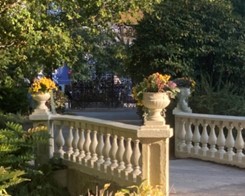
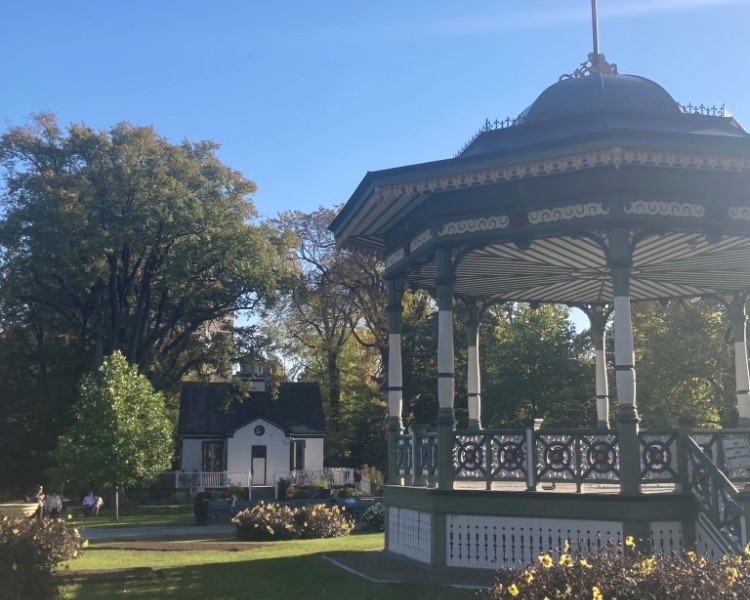
The gardens have evolved over time, but its High Victorian Gardenesque design is largely intact. A key attraction is the multicolour Bandstand at the heart of the gardens, built in 1887 for Queen Victoria’s Golden Jubilee. The gardens are famous for their subtropical plants and vibrant bedding displays, featuring mosaic patterns of brightly colored foliage. Other features include the modest Horticultural Hall (built by the Society in 1847), two classically inspired fountains, concrete urns and statues, two ornate concrete bridges, and a wrought-iron fence with an elaborate main entrance gate. The gardens remain free for the public to enjoy and continue to instill pride in the community, as the Society had hoped.