Originally published December 11, 2023.
On December 12, 1941, the Kingston Odeon theatre, designed by architects Harold Kaplan and Abraham Sprachman, opened its doors on 389 Princess Street. Between 1929 and 1965, the firm of Kaplan & Sprachman oversaw the construction of more than three hundred theatres in small towns and urban centres across Canada. Their distinctive style, often combining elements of Art Deco and Moderne architecture, captured the glamour of cinema in the mid-20th century.
Kaplan and Sprachman were Jewish Canadians who immigrated to Canada as children. Kaplan was born in Romania in 1895, and Sprachman in Ukraine the following year. As teenagers, both showed talent for design and studied draftsmanship. In the 1920s, they partnered with the Jewish community in Toronto on the building of synagogues, major office buildings in the downtown core, such as the Fashion building on Spadina, and residences in Forest Hill, including the Mayfair Mansions. The partnership with the Jewish community continued in later decades, producing the Oakville Golf Course and the Baycrest Centre.
In 1926, they designed their first movie theatre in Toronto. Sources disagree as to whether this was the Clyde or the Mayfair. At the time, cinemas were a new building type and were in high demand. The practice of Kaplan & Sprachman, which officially opened in 1929, cornered the market in cinema design, creating modern facilities with an attractive Art Deco style, new materials, and contemporary engineering. In the 1930s, the firm built 41 theatres and renovated 77, despite the economic downturn during the Great Depression. In 1934, the firm was involved in their first project outside of Toronto, the Capitol theatre in Sarnia, Ontario. Towards the end of the 1930s, it was designing smaller theatres in northern Ontario, the West Coast, and the Maritimes.
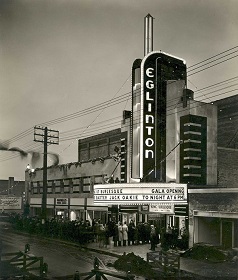
Kaplan & Sprachman fused technology and style to create a memorable experience for the movie-going public. The firm used new materials, like chrome detailing and structural glass block; new engineering, such as acoustic systems and soundproofing materials and open stadium theatres; and new technology, including air conditioning and ventilation systems. Some well-known designs include the Vancouver Vogue Theater (1935) and the Toronto Eglinton Theatre (1936), which both showcase a grand neon-lit tower on the front facade. The grand exterior flows into a decorative interior, which features ornamental light fixtures, bright colours, shiny metals, mirrors, geometric patterns, paintings, and sculptures.
Kaplan & Sprachman continued to have success with cinema design in the early postwar era, designing 46 more movie theatres in the late 1940s. However, their style fell out of fashion in the 1950s, replaced by more functional suburban movie theatres. At the same time, the growing popularity of the television meant fewer cinemas were being built. Business dramatically slowed for Kaplan & Sprachman, which worked mostly on movie theatre renovations after the 1950s.