For the week of January 29, 2024.
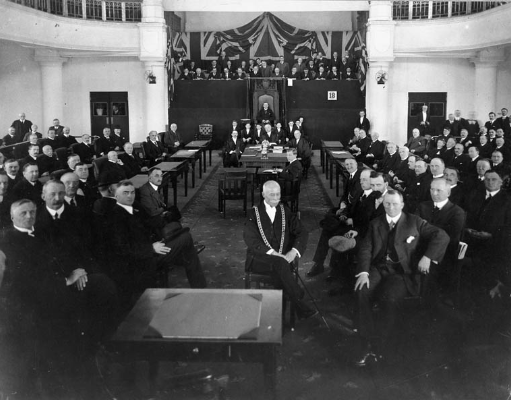
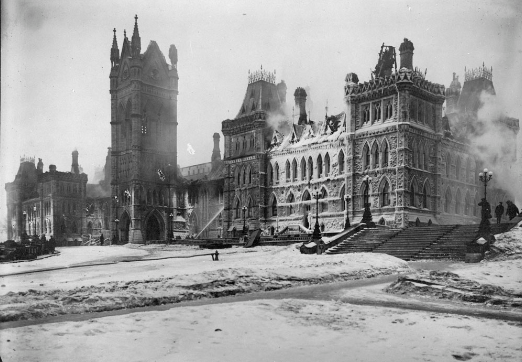
On February 4, 1916, the House of Commons convened for the first time at the Victoria Memorial Museum (now the Canadian Museum of Nature) in Ottawa after fire destroyed the Parliament Building. For the next three years, the museum housed the Parliament of Canada.
In 1857, Ottawa was chosen as the capital for the Province of Canada, which united Upper and Lower Canada. Construction of the Parliament Buildings began two years later. After Confederation in 1867, they housed the new federal legislature. The original designs included Eastern and Western departmental buildings, and a central building for the House of Commons and Senate. The four-storey central building boasted two legislative chambers, a library, offices, committee rooms, and the Victoria Tower, overlooking the nine-hectare lawn.
As Parliament was sitting on the evening of February 3, 1916, fire broke out in the Reading Room. The fire spread quickly and, shortly after midnight, the Victoria Bell tower collapsed. The fire department worked through the night, saving lives and preserving the irreplaceable library. Seven people died.
At the nearby Château Laurier hotel, Prime Minster Robert Laird Borden and his cabinet worked to find a new meeting place for Parliament. With the assistance of the Department of Public Works, they selected the Victoria Memorial Museum, built in 1911 roughly 1.4 kilometres south of Parliament Hill. To make space for government officials, all the galleries and exhibits were closed to the public, and some scientists and curators moved their offices off site.
The House of Commons met for the first time in the rotunda on February 4. The second floor of the rotunda had a circular balcony, which became the viewing gallery for press and visitors. Four days later, the Senate met on the first floor in the Mineral Gallery. This was a time of tremendous change, amid the First World War (1914–1918), and Parliament passed important legislation during the sessions at the Victoria Memorial Museum, including the Military Service Act (1917), which introduced conscription, and the Act to Confer the Electoral Franchise upon Women (1918).
The reconstruction of the Parliament Building took place between 1916 and 1920. The exterior design of the new central building followed the original Neo-Gothic Revival Style of the complex and integrated the octagonal library. It was two storeys taller than the original and had limestone interior walls, rather than wood panelling, to help protect against fire. The 1920 building, known today as the Centre Block, stands today as a symbol of Canada’s resilience in wartime, and its Peace Tower, completed in 1927, commemorates the armistice that ended the First World War.