
For the week of September 9, 2024.
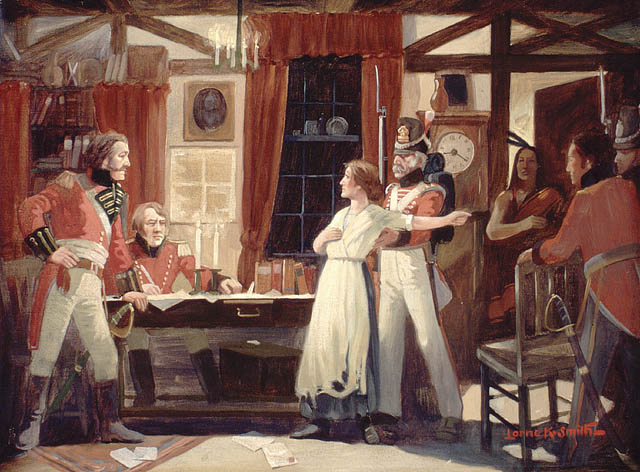
On September 13, 1775, Laura Secord (née Ingersoll) was born in Great Barrington, Massachusetts. She moved with her family to the British colony of Upper Canada (now Ontario) in 1795. There, during the War of 1812, she walked more than 30 kilometers behind enemy lines to warn British authorities of an impending American attack. Women historians uncovered and popularized this story in the late 19th century. In the years that followed, Secord was celebrated and mythologized as a Canadian heroine.
In 1812, war began between Great Britain and the United States. Much of the fighting took place in Upper Canada. Communities along its southern border were particularly vulnerable to American attack, including Queenston, where Laura Secord had settled with her husband James. Together, they would have six daughters and one son.
Major-General Sir Isaac Brock coordinated the defence of Upper Canada by about 1,600 British regulars, a small number of local militia units, and allied First Nations. James Secord was a sergeant in the 1st Lincoln militia. During the Battle of Queenston Heights on October 13, 1812, he was seriously injured and never fully recovered.
James was still convalescing when American forces occupied Queenston. On June 21, 1813, Laura overheard plans to attack the British outpost at John DeCew’s house, which was under the command of Lieutenant James Fitzgibbon. He needed to be warned. With her husband unable to make the journey, Laura decided to go alone.
She left home at dawn the following morning and walked more than 30 kilometres through enemy lines and dangerous terrain, carefully avoiding interception by American troops. Along the way, she encountered Six Nations warriors near DeCew Falls led by Kanyen’kehà:ka Pinetree Chief Teyoninhokarawen (John Norton). They helped her reach DeCew house, where she delivered her message to Lieutenant Fitzgibbon.
Scouts were dispatched to warn other detachments of the impending attack, including British forces and First Nations allies encamped on the west bank of Ten Mile Creek. On June 24, First Nations allies of the British ambushed the American troops at the Battle of Beaver Dams, forcing their surrender. Official reports of this important victory did not mention the role of First Nations or name Laura Secord.
Over the years, she appealed to Lieutenant Fitzgibbon for certificates acknowledging her role to help her and James find work. They left Queenston in 1835 when James secured a position as Collector of His Majesty’s Customs at the Port of Chippawa. He died in 1841 and, with no military pension, Laura lived humbly and taught school in her home for a time.
Laura Secord began to receive public attention after 1860. She was the only woman on a list veterans of the War of 1812 presented to the Prince of Wales during a ceremony at Queenston Heights that year and she subsequently received £100 for her service. Her story was then taken up by female authors like Sarah Anne Curzon and Emma Currie. They were actively involved in the movement for women’s rights and used Laura Secord as an example of women’s contributions to Canadian society. Many versions followed. Inspired by these heroic tales, in 1913 Frank O’Connor decided to name his Toronto candy store in her honour. Laura Secord Chocolates has helped keep her name alive ever since.
Laura Ingersoll Secord, John Norton (Teyoninhokarawen), and Sir Isaac Brock are designated national historic persons, and The Battle of Beaver Dams is a designated national historic event. The Historic Sites and Monuments Board of Canada advises the Government of Canada on the commemoration of national historic events, which evoke significant moments, episodes, movements, or experiences in the history of Canada, and national historic persons—individuals who have made unique and enduring contributions to the history of Canada.
The National Program of Historical Commemoration relies on the participation of Canadians in the identification of places, events, and persons of national historic significance. Any member of the public can nominate a topic or consideration by the Historic Sites and Monuments Board of Canada. Learn how to participate in this process.