
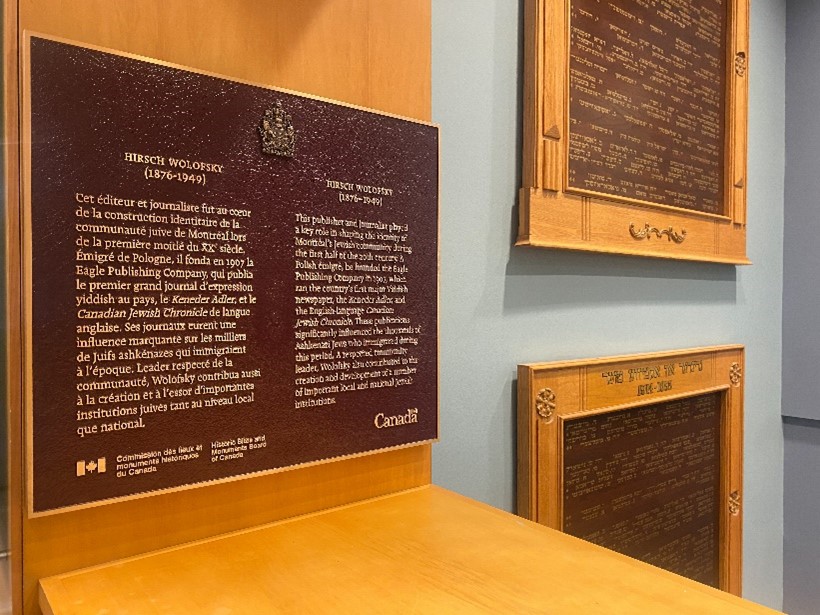
For the week of August 26, 2024.
On August 30, 1907, Hirsch “Harry” Zvi Wolofsky’s Eagle Publishing Company launched the Keneder Adler, as a weekly Yiddish-language newspaper in Montréal, Quebec. Wolofsky and his publishing house went on to become a leading voice for the Jewish community in Canada.
Wolofsky was born on September 15, 1876, in the small village of Szydłowiec in Poland. At the time, this region was under Russian rule and the Jewish population faced severe restrictions on their rights and freedoms, including where they could live. Szydłowiec (Shidlovtse in Yiddish) was a shtetl, where the majority Jewish population lived and worked according to Jewish traditions. As a scholar and community leader, Wolofsky’s father cared for their religious needs and served an administrative function within the community. Hirsch Wolofsky assumed some of these duties as his father’s health declined in the 1880s.
Following the death of his father, around 1891, Hirsch Wolofsky decided to leave home. In Warsaw and then Łódź, he worked in the wine industry. He was 18 years old and prospering when he married Sarah Bercovitch, the daughter of his business partner. However, the situation in Poland was getting worse for Jewish people. When his business licence was abruptly revoked, Hirsch and Sarah Wolofsky left Poland for England and then Montréal. They were not alone in making this journey. The Jewish population of Montréal grew from 7,500 in 1901 to more than 57,000 by 1931. Many came from Eastern Europe and spoke Yiddish as their first language.
In Montréal, Hirsch opened a fruit store on Saint-Laurent Boulevard (the Main), where many Jewish people lived and worked. After fire destroyed his business, he invested the financial compensation he received in a new publishing venture. In 1907, he co-founded the Eagle Publishing Company with four partners and launched the Keneder Adler. The others eventually withdrew from the business, leaving Wolofsky in charge. A few years later, he acquired The Jewish Times and relaunched the English-language newspaper as the The Canadian Jewish Chronicle.
Under his leadership, the Keneder Adler transformed from a weekly to a daily newspaper, with roughly 10,000 subscribers by 1910. This was far more than the three other Yiddish-language newspapers in Canada at the time. The mandate of the Keneder Adler was to serve Jewish Canadians, helping to preserve their collective identity, advance their shared interests, and help integrate new arrivals into Canadian life. The paper provided a platform for Jewish Canadian journalists, writers, and intellectuals, including Jacob Isaac Segal, Bryna Bercovitch, Reuben Brainin, Rachel Korn, Chava Rosenfeld, and Abraham Moses Klein. The Keneder Adler helped educate Yiddish-speaking Canadians on various subjects, ranging from the Canadian electoral system to Japanese poetry.
Wolofsky used his position at the Eagle Publishing Company to support all aspects of Jewish community life. For example, he played an important role in resolving the Aberdeen School Strike of 1913 and helped establish Montréal’s Jewish Public Library in 1914, the United Talmud Torah of Montréal in 1917, the Canadian Jewish Congress in 1919, the Jewish Community Council of Montréal (Vaad Ha’ir) in 1922, and the Jewish General Hospital in 1934. He documented his efforts in his memoirs, published in English and Yiddish shortly before his death in 1949.
Hirsch “Harry” Zvi Wolofsky and Abraham Moses Klein were designated national historic persons in 2007. The Founding of the Canadian Jewish Congress was designated a national historic event in 2005. The Main was designated as a national historic site in 1997. The Historic Sites and Monuments Board of Canada advises the Government of Canada on the commemoration of: national historic events, which evoke significant moments, episodes, movements, or experiences in the history of Canada; national historic sites, which can include a wide range of historic places such as gardens, complexes of buildings, and cultural landscapes; and national historic persons—individuals who have made unique and enduring contributions to the history of Canada.
The National Program of Historical Commemoration relies on the participation of Canadians in the identification of places, events, and persons of national historic significance. Any member of the public can nominate a topic for consideration by the Historic Sites and Monuments Board of Canada. Learn how to participate in this process.