
Originally published on August 22, 2022.
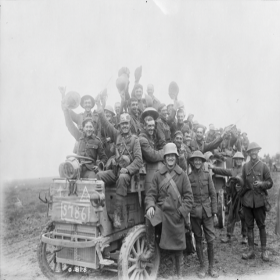
At the end of August 1916, the Canadian Corps was preparing to enter the Battle of the Somme, which the British, French, and their colonial forces had been fighting against Germany on the Western Front of the First World War (1914–1918) since July 1. In less than three months of fighting at the Somme in France, from early September to the middle of November 1916, Canada suffered 24,029 casualties—more than any other series of battles except for the Hundred Days Campaign at the end of the war.
Since October 1914, the Allied forces of the Triple Entente had been locked in a stalemate with the Central Powers, led by Germany and Austria-Hungary, along the 700-kilometre Western Front. Modern weapon innovations forced the construction of thousands of kilometers of trenches, separated by “No Man’s Land,” a chaotic jumble of shell holes, barbed wire, and the wreckage of previous attacks.
In 1916, the Allies marshalled their forces on a 25-kilometre stretch of the Somme in northern France for a major offensive, which they hoped would break the stalemate and take pressure off the French in their battle against the Germans at Verdun, to the south. The initial artillery barrage on June 24, which was meant to create an opportunity for troops to advance across No Man’s Land to attack the German lines, failed to destroy much of the barbed wire and fortified dugouts. The situation was then made worse by communications problems on the morning of the initial attack. Gains were minimal, casualties appalling: on July 1, the first day of the battle, the British suffered 57,000 casualties. Of around 800 frontline soldiers of the Newfoundland Regiment who fought at Beaumont-Hamel, only 68 answered roll call the next day.
The Canadian Corps was sent in late August 1916 to reinforce the greatly diminished Allied forces and help capture strategic objectives. During the Battle of Courcelette (September 15 to 22), the Canadians adapted new approaches to modern warfare, such as the “creeping barrage”—a recent tactical innovation that involved firing massive artillery barrages just ahead of one’s advancing infantry in a continuous rhythm, providing cover for the soldiers as they slowly advanced, while simultaneously pinning down or destroying enemy fortifications. Rudimentary tanks were also used for the first time in this battle, with mixed results.
Canadians continued to fight on the Somme until November, when the offensive ground to a halt. The lessons learned during the Somme offensive contributed to important victories later in the war. For example, the British general in command of the Canadian troops used a creeping barrage at the Battle of Vimy Ridge in April 1917—a significant victory for Canada in the First World War.
Beaumont-Hamel and Vimy Ridge were designated as national historic sites in 1996 and 1997, respectively, and The Hundred Days Offensive was designated as a national historic event in 2014. The Historic Sites and Monuments Board of Canada advises the Government of Canada on the commemoration of national historic sites, which are urban, rural, and wilderness sites across Canada that are an integral part of our past and present, and national historic events, which evoke significant moments, episodes, movements, or experiences in the history of Canada.
The National Program of Historical Commemoration relies on the participation of Canadians in the identification of places, events and persons of national historic significance. Any member of the public can nominate a topic for consideration by the HSMBC. Learn how to participate in this process.