
For the week of August 12, 2024.
On August 16, 2019, the Government of Canada recognized the Meshikamau-shipu travel route in Labrador as a national historic event. Since time immemorial, the Innu have travelled and lived along this 330-kilometre network of trails, rivers, and lakes in their homeland of Nitassinan. This landscape holds great significance for the Innu, reflecting their history, culture, spirituality, and ongoing presence.
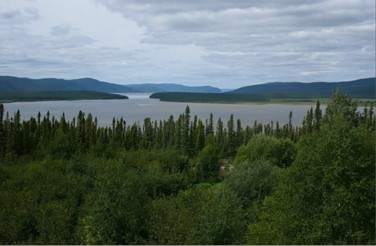
The Meshikamau-shipu was one of many travel routes established by the Innu throughout the Quebec-Labrador Peninsula. It followed rivers and lakes through a subarctic, open-forest, tundra landscape. This route was an important tie for the Innu as it brought them to a familiar place of gathering. The ability to travel across their ancestral homeland has always been essential to Innu. The skill to make long journeys, cover vast distances in little time, and traverse rugged terrain became a source of prestige within Innu society, tied to knowledge and capability.
In Innu-aimun, Meshikamau-shipu means “river to Meshikamau.” This is a reference to the route’s western terminus in the former Michikamau Lake region in central Labrador. Before it was flooded without Innu knowledge in the 1970s for a hydroelectric development on the Mishta-shipu (Upper Churchill River), the Meshikamau region was at the heart of Innu society. Families came here from across what is now known as the Quebec-Labrador Peninsula. It was an imperative gathering place and resource region for atiku (caribou) of the Penipuapishku (Red Wine Mountains) and George River.
The eastern end of the travel route is Sheshatshiu on the shores of Atatshi-uinipeku (Lake Melville). This is a prominent Innu community with a long history, spanning thousands of years. Over the years, people have been drawn here by rivers rich in salmon and because of the continual use of the area by the Innu, including fur traders after the 1740s and Catholic missionaries after 1867. The nearby annual gathering place of Upatshuan on Kakatshu-utshishtun (Grand Lake) was exceptionally bountiful during the spring and fall fish spawning runs and waterfowl migrations.
Along the Meshikamau-shipu travel route, there are many other gathering places, portage paths, birth and burial sites, ancestral camp sites, and places of spiritual significance. Just one of these places along the map of life for the Innu is the mountain of Petshishkapushkau (Kueshtakapishkau or Toadman’s House), on the west side of the former Meshikamau Lake. It is said to be the residence of Anikapeu, an animal master of frogs and toads. The Meshikamau-Shipu Travel Route holds the footprints left by the Innu, and oral histories that have been and will continue to be passed on for generations.
Meshikamau-shipu Travel Route was designated a national historic event in 2019. The Historic Sites and Monuments Board of Canada advises the Government of Canada on the commemoration of national historic events, which evoke significant moments, episodes, movements, or experiences in the history of Canada.
The National Program of Historical Commemoration relies on the participation of Canadians in the identification of places, events, and persons of national historic significance. Any member of the public can submit a subject to the Historic Sites and Monuments Board of Canada. Learn how to participate in this process.