For the week of August 5, 2024.
On August 5, 1987, the Government of Canada designated the Main Dairy Barn of the Central Experimental Farm in Ottawa, Ontario, a Classified federal heritage building. The barn, also known as building # 88, is the centrepiece of the sprawling 427-hectare model farm complex. The Department of Agriculture established the Central Experimental Farm in 1886 to improve Canadian farming methods.
Model or experimental farms first developed in Britain in the late 18th and early 19th centuries. They were sites of experimentation in fertilization and cultivation, livestock breeding and crop development, and the design of agricultural buildings and landscapes. They emerged as part of a growing movement to embrace modern, scientific, and industrialized approaches to agriculture. Model farms emphasized innovation, careful planning and design, and systematic methods of working.
In Canada, the federal government funded the establishment of five experimental farms in Ontario, Nova Scotia, Saskatchewan, Manitoba, and British Columbia. They became part of a nationwide network for agricultural research, development, and problem-solving which expanded over the decades. The Central Experimental Farm supported agricultural practice in Ontario and Quebec and served as the headquarters of the system, conducting food research of national significance.
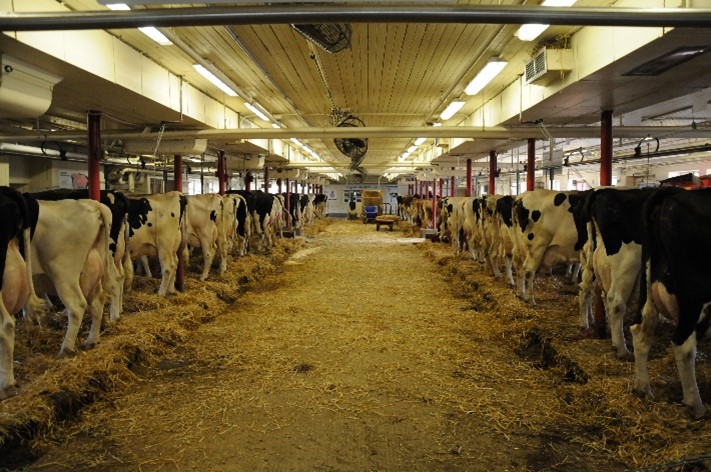
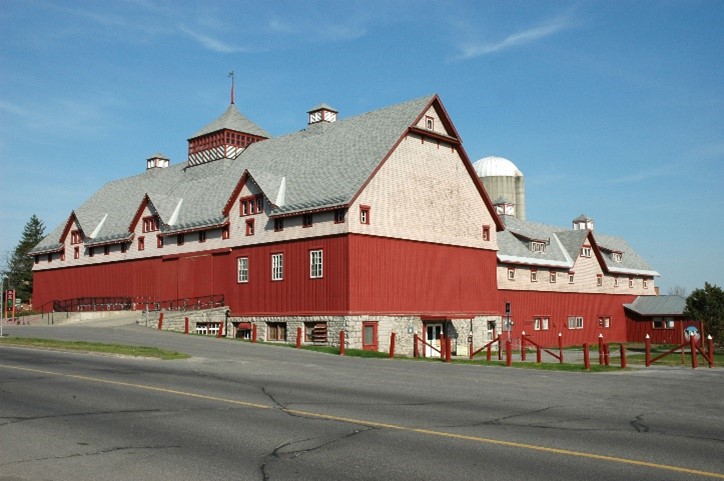
The Main Dairy Barn of the Central Experimental Farm was built in 1914 and modelled after the original barn from the 1880s, which was destroyed by fire. The building is long with a gable-roof and is joined at right angles at the east and west by wings, forming a central courtyard. It is a basement barn, which was a common design in Ontario at the time. Barns of this type have a full masonry foundation, where cattle are housed, and a main floor accessed from a ramp, which could be used to store hay, grain, and equipment. The Main Dairy Barn has wings for additional stabling. Today, the Canada Agriculture and Food Museum occupies the building, maintaining a showcase herd on the lower level and exhibitions on the main floor.
The Main Dairy Barn has an efficient plan, designed to maximize functionality. However, it is also highly ornamental and picturesque, with fine brick, decorative wood shingles, board and batten, and dormers. The ridge has a large central lantern tower with bell-like roof, flanked by ventilators. Most Canadian farmers would not have been able to afford such elaborate plans for their outbuildings. The design of the Main Dairy Barn expresses the vision of experimental farms as aspirational spaces, which reflected the growing prominence and possibility of agricultural practice in the newly formed Dominion of Canada.