For the week of July 15, 2024.
On July 19, 2011, the Government of Canada designated Vancouver’s Chinatown district a national historic site. Victoria’s Chinatown had received the same recognition in 1995. These two neighbourhoods were established in the late 19th century, when British Columbia was home to nearly all people of Chinese descent in Canada. Over the decades that followed, both Chinatowns developed into areas of historical and architectural significance, which remain vital parts of their cities today.
There was a significant Chinese population in British Columbia when it entered Confederation in 1871. Miners and labourers came to the region from the western United States, and later from Hong Kong and China, during the Fraser River and Cariboo gold rushes of the 1850s and 1860s. Most eventually left gold-mining towns to work in the canneries of New Westminster and the coal mines of Nanaimo. However, about 57 percent of the Chinese population of British Columbia settled in Victoria by 1880. Many of them lived in Chinatown, which was centred around Cormorant Street (now Pandora Avenue).
The 1881 census reported that 4,383 Chinese people lived in Canada, with about 99% residing in British Columbia. Those figures grew significantly over the next decade. Between 1881 and 1885, more than 10,000 Chinese labourers came to British Columbia from the western United States and Hong Kong to help build the Canadian Pacific Railway. They worked in dangerous conditions and hundreds died as a result. Many former railway workers eventually settled in Vancouver. In 1886, the newly incorporated city leased 160 acres (24.3 hectares) of land along Main Street at East Pender to the Chinese community. This laid the foundations for Chinatown.
As a result of discrimination and segregation, Chinese people tended to live and work in self-contained Chinatowns, which provided opportunities for fellowship and a sense of security. These neighbourhoods in cities like Victoria and Vancouver met most of the social, cultural, economic, and spiritual needs of the community. Chinese people established a wide range of businesses, recreational clubs, benevolent organizations, and associations based on county, clan, dialect, politics, and religious affiliation.
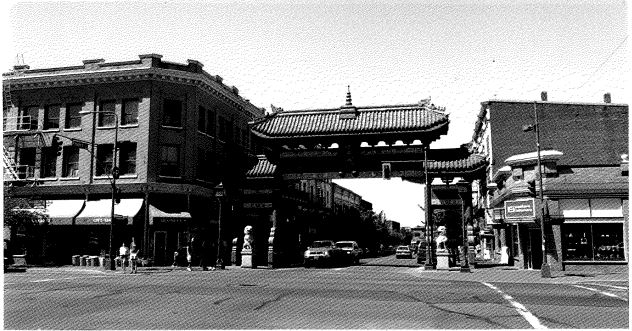
The Chinatowns of Victoria and Vancouver are identifiable by their unique architecture. In Victoria, Chinatown emerged as a cohesive grouping of buildings that adapted standard forms and designs found elsewhere in the city. They had flared temple-styled roofs, inset and projecting wrought-iron balconies, additional “cheater” storeys, interior courtyards, and brightly hued tiled overhangs. In Vancouver, Chinatown stood out for its “recessed balcony” style of architecture, which blended Western building methods with styles associated with Guangdong and Fujian provinces in China. Buildings of this design had deeply recessed balconies, mezzanines, a strong verticality, and tiled roofs. In these ways, Chinatowns made a lasting mark on the built environment in Victoria and Vancouver.