
For the week of July 1, 2024.
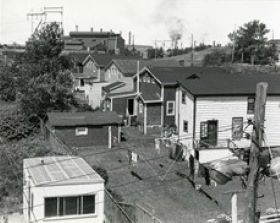
On July 7, 2014, the Government of Canada recognized the Development of Whitney Pier as a national historic event. During the early 20th century, the steel industry attracted many people to this neighbourhood in Sydney, Nova Scotia. In the process, Whitney Pier became one of the most ethnoculturally diverse communities in the Maritimes.
Whitney Pier is located on Cape Breton Island or Unama’ki, the ancestral and unceded territory of the Mi’kmaq people. By the late 19th century, it was a flourishing fishing and farming district, known as “Eastmount” or “South Sydney Harbour.” It was later renamed Whitney Pier after Henry Melville Whitney of Boston, Massachusetts. He organized the Dominion Coal Company in 1893 and established the Dominion Iron and Steel Company in 1899, which built a steel plant at Whitney Pier. By the early 20th century, Sydney had become an important centre for the manufacturing of basic steel, as well as steel rails and other products.
There were only about 500 people living in Whitney Pier before the opening of the steel plant, but that soon changed. Sydney expanded rapidly with the arrival of thousands of people from around the Atlantic region, the United States, the Caribbean, and Europe. By 1913, the population of Whitney Pier had grown to roughly 8,000, and the community now had a distinctive multi-ethnic character.
At first, there were few municipal services in Whitney Pier, and residents faced housing shortages and overcrowding. The situation improved as the community grew and developed. Over time, many small, local businesses emerged, such as Hirsh’s Dairy, Carter’s Book Store, and Delvechio’s Bakery. New houses of worship were established, including the Holy Ghost Ukrainian Catholic Church (1913), the St. Mary’s Polish Catholic Church (1913), and the African Orthodox Church (1928). There were also many benevolent and mutual aid societies, like the St. Rita’s Society (1912) and the Daughters of Jacob Aid Society (1913). They organized social events and fundraisers, and supported community members in many other ways.
The Development of Whitney Pier was designated a national historic event in 2014. The Historic Sites and Monuments Board of Canada advises the Government of Canada on the commemoration of national historic events, which evoke significant moments, episodes, movements, or experiences in the history of Canada.
The National Program of Historical Commemoration relies on the participation of Canadians in the identification of places, persons, and events of national historic significance. Any member of the public can submit a subject to the Historic Sites and Monuments Board of Canada. Learn how to participate in this process.