For the week of June 24, 2024.
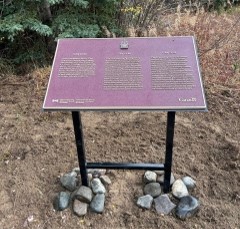
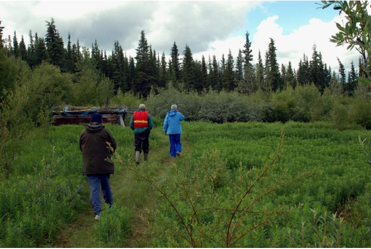
On June 26, 2012, the Government of Canada recognized T’äw Tà’är as a national historic site. Also known as Winter Crossing, T'äw Tà'är is a former village site and meeting place on the west bank of the Teslin River in Yukon. This important cultural landscape illustrates the connections between seasonal food-gathering activities, family relations, travel, and trade for the Ta’an Kwäch’än.
T’äw Tà’är is located about 30 kilometres east of Tàa’an Män (Lake Laberge) in the eastern region of Ta’an Kwäch’än traditional territory. The Ta’an Kwäch’än are part of the Athapaskan linguistic family and speakers of Southern Tutchone. Yukon Athapaskan peoples share a common cultural heritage, shaped in part by the flowing waters of the Yukon River and its tributaries. For thousands of years, the Ta’an Kwäch’än shared their lands with neighbours, including the Tagish Kwaan, the Big Salmon people, the Champagne (Shadhäla) and Hutshi peoples, and the Tlingit. There are trails and waterways crisscrossing Ta’an Kwäch’än traditional territory. Many of these travel routes converge at T’äw Tà’är.
Many people passed through T’äw Tà’är on their way to seasonal hunting, gathering, and fishing sites. In the autumn, families went to the mountains east and west of T’äw Tà’är to hunt mbay (sheep), mezi (caribou), and hanay (moose), and harvested ts’ékhǜra (whitefish) in nearby lakes. In the winter, they trapped furbearing animals and fished through the ice on Tàa’an Män. From early spring to early fall, they harvested small mammals and fowl. Arctic grayling (Thymallus arcticus) spawn just upriver at Hutamya Chù (Open Creek). In the early spring, this fish can be harvested at T’äw Tà’är, where the Teslin River meets Hutamya Chù. The name T’äw Tà’är means “grayling run up” in Southern Tutchone.
By facilitating seasonal travel, the trails and waterways that meet at T’äw Tà’är brought together First Nations peoples living along the upper Yukon River and Teslin River watersheds. They fostered a shared sense of culture, strengthened relationships through marriage and trade, and improved relations between neighbours, including the Northern Tutchone, Tagish, Tlingit, and Kaska peoples. These relationships are still important today.