For the week of March 4, 2024.
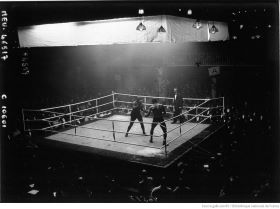
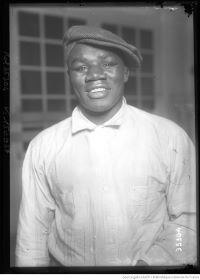
On March 4, 1886, Sam Langford was born in Weymouth Falls, a historically African Nova Scotian community in Digby County. As a teenager, he moved to Boston, Massachusetts, where his athletic skills were soon recognized. One of the greatest boxers of his generation, he fought in all divisions from lightweight to heavyweight between 1901 and 1923.
Langford had a difficult childhood. He experienced abuse as a child and his mother died young. At 13 years old, he left home for Boston, where he worked odd jobs and started boxing. At the time, Boston was the centre of the sport in North America. Pugilism had shed its long association with street violence and gained new legitimacy as a “scientific” pursuit, requiring skill and technique, as much as strength and stamina. Some even considered it an art, appealing to Victorian sensibilities and promoted as a "manly enterprise.”
Langford was soon training to fight professionally with help from Joe Woodman, a retired pharmacist who became his manager. Langford started out as lightweight at 132 pounds in 1902. In the years that followed, he grew and moved into the welterweight, the middleweight, and then the heavyweight divisions. He was still small but fast, powerful, and skilled enough to take on much larger opponents.
Twice he fought future world champion Jack Johnson, a fellow Black boxer who was about 30 pounds heavier and six inches taller than himself. Langford lost both matches in 1906 but fought so well that Johnson avoided a rematch after claiming the world heavyweight title in 1908. Johnson later described Langford as the “toughest” fighter he knew. Langford had more success against Andrew Chiariglione (“Fireman Jim Flynn”), another contender for the world heavyweight title. Langford won two of their three matches between 1908 and 1910. In keeping with norms of the time, the American press used stereotypes to criticize his decisive victories over a boxer racialized as “white.”
Langford had few opportunities to challenge white boxers and, despite his sterling record, he was denied a title fight. Like many of his contemporaries, he was confined to the segregated World Colored Heavyweight Championship. Some have argued that champions feared his skills in the ring: his nicknames included “the Boston Terror" and the “Weymouth Wizard.” Within the popular imagination, boxers represented a masculine ideal of physical strength, discipline, and scientific mastery. There were fears within the boxing community that men of African descent would become dominant and thereby upset a social order based upon notions of white superiority. Such thinking resulted in informal barriers that limited the careers of many Black boxers, especially before the 1940s.
Langford retired from boxing in 1923. The sport had taken a physical toll, leaving him with near complete vision loss. Sam Langford died in Boston in 1956.