For the week of December 25, 2023.
On December 28, 1943, the Battle of Ortona ended with Canadian forces as the remaining Germans retreated from the town on the eastern coast of Italy. This was one of the hardest-fought battles for Canadian troops during the Italian Campaign (1943–1945) of the Second World War.
Allied forces, including Canadian, British, and American troops, landed in Sicily in July 1943. By this time, the Soviet Red Army was already fighting Germany and its allies (known collectively as the Axis powers) in Eastern Europe. The landing in Italy opened a “second front” in Western Europe, which the Allies hoped would strain enemy resources and prevent a concentration of German forces along the Eastern Front. Following the successful Sicilian Campaign, the Allies continued their offensive north through the Italian mainland.
The 1st Canadian Division reached the outskirts of Ortona in early December. Canadians launched several assaults but failed to take an enemy stronghold south of Ortona known as “The Gully,” where a natural trench protected German forces against artillery fire. After the Canadians captured nearby positions, the Germans abandoned the gully and regrouped to Ortona in mid-December, where the German 1st Parachute Division mounted a defence. The Canadians decided to try and take Ortona, and the Battle for Ortona began on December 20.
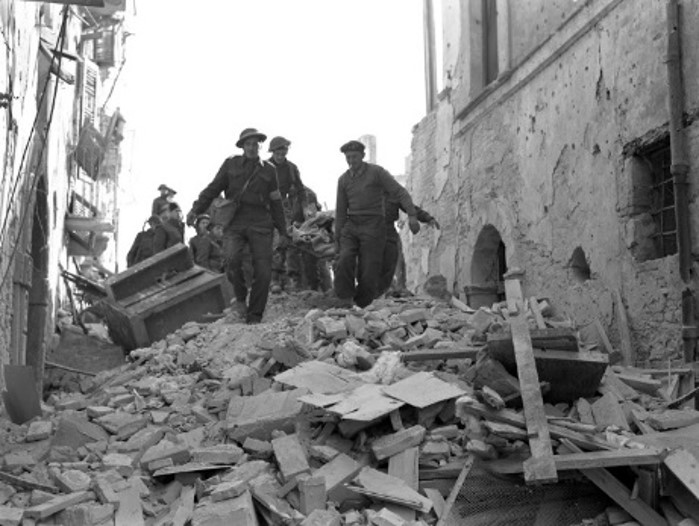
The battle within the town limits involved brutal urban warfare. German engineers demolished several buildings, blocking side streets and forcing Canadian tanks to enter the town along the main street, where they were easy targets. To avoid sniper and machine gun fire, Canadians fought house-to-house, staying indoors as much as possible. Their “mouse-holing” tactics involved using explosives to breach the walls that connected adjoining houses. They could then pass through the walls and secure the next house without having to go into the street and through the ground-level doors of buildings, which were booby-trapped or open to enemy small-arms fire. The fighting in Ortona allowed the Canadians to gain experience and practice techniques later studied by other Allied armies.
Despite facing heavy resistance from the defenders, the Canadians captured Ortona, and the last Germans evacuated the town on December 28. However, victory came at a heavy cost: the 1st Canadian Division suffered more than 2,300 casualties. The experience took a particularly heavy toll on the mental health of Canadian soldiers. Dr. Arthur Manning Doyle, the divisional psychiatrist of the 1st Canadian Division, saw nearly 600 soldiers from in and around Ortona for psychiatric evaluation between December 7 and 28, only clearing 20 to 25 per cent of them for return to duty.